


Sponge Filter Foam
In the landscape of industrial filtration, selecting the appropriate media requires a deep understanding of fluid dynamics, material science, and the specific demands of the application environment. Sponge filter foam, technically known as reticulated foam, is a versatile porous material widely utilized for both mechanical and biological filtration. While often associated with smaller-scale systems, its role in industrial pre-filtration, air handling, and specialized fluid processing is significant.
For engineers and procurement professionals, evaluating sponge filter foam involves more than simply checking pore size. It requires an analysis of the reticulation process, polymer stability, and the eventual transition point where synthetic media may need to be replaced by more robust solutions, such as stainless steel wire mesh or sintered metal components. This guide examines the technical specifications of sponge filter foam and provides a framework for industrial selection.
The Engineering of Reticulated Sponge Filter Foam
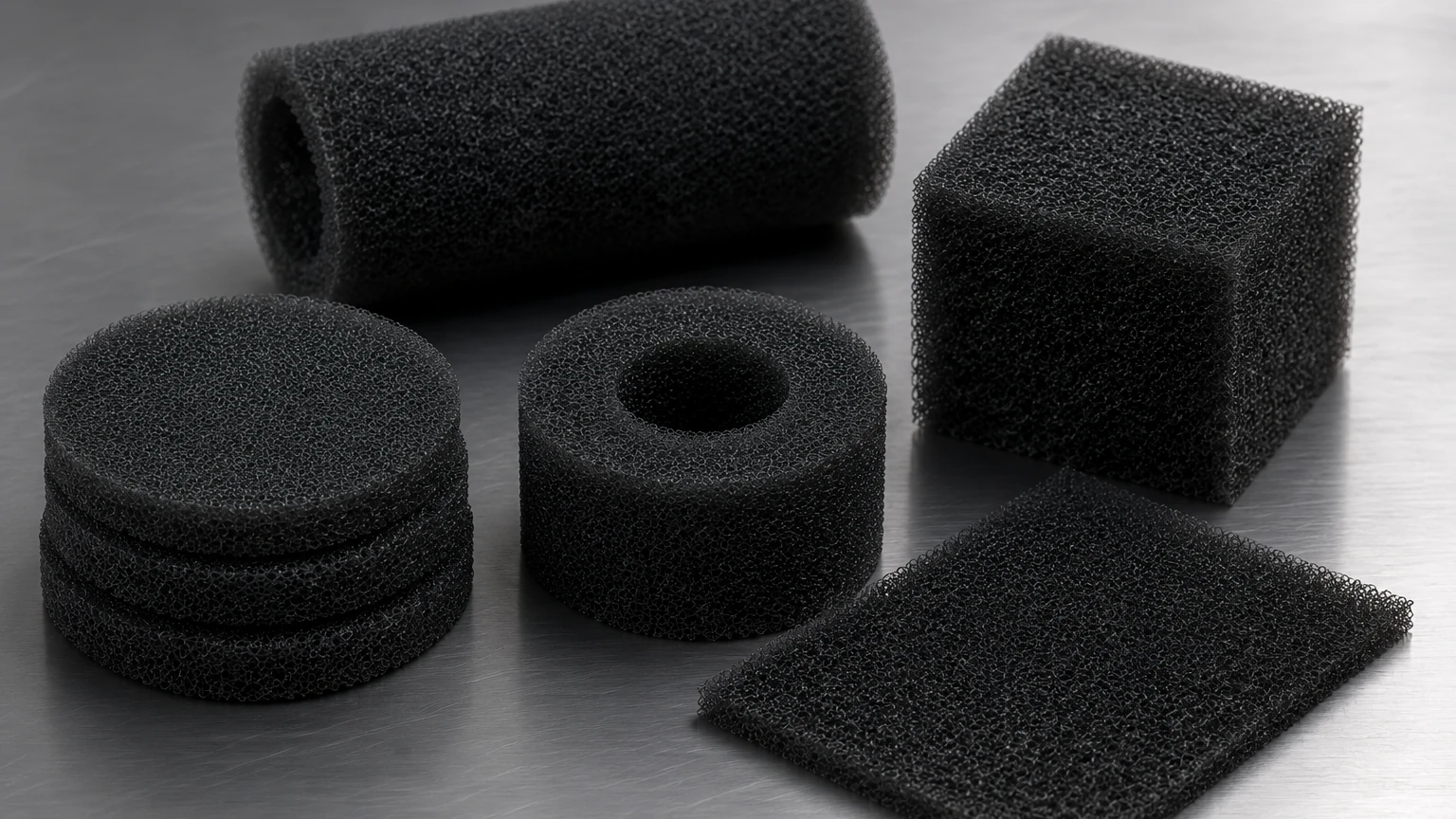
Sponge filter foam is distinct from standard upholstery or packaging foam due to a process called reticulation. In its raw state, polyurethane foam consists of a network of "struts" and thin membranes (windows) that create a closed-cell or semi-open-cell structure. To make it suitable for filtration, these membranes must be removed, leaving only the skeletal framework.
There are two primary methods for reticulation:
1. Thermal Reticulation (Zapping): The foam blocks are placed in a vacuum chamber filled with a combustible gas mixture. Upon ignition, a controlled flash flame consumes the thin cell membranes without melting the thicker structural struts. This results in a highly consistent, open-pored structure.
2. Chemical Reticulation (Quenching): The foam is submerged in a caustic solution (typically a heated alkaline bath) that chemically dissolves the cell membranes. This method is often used for specific polymer types where thermal shock might compromise the material integrity.
The resulting reticulated sponge filter foam possesses a void volume often exceeding 95%, allowing for high flow rates with minimal initial pressure drop. This open-cell architecture is what enables the foam to act as a depth filter, trapping particulates within the complex internal matrix rather than just on the surface.
Key Performance Metrics: PPI and Porosity
The most critical specification for sponge filter foam is PPI, or Pores Per Inch. This metric defines the coarseness or fineness of the foam and directly dictates the filtration efficiency and flow resistance.
* 10 to 30 PPI (Coarse): Used primarily for high-flow applications, such as large-scale air intake filters or pre-filters for heavy industrial machinery. These grades excel at capturing large debris while maintaining a very low delta P (pressure drop).
* 45 to 60 PPI (Medium): A standard range for general-purpose fluid filtration. It balances particle retention with a reasonable service life before clogging occurs.
* 80 to 100+ PPI (Fine): These grades are utilized for fine polishing of fluids or air. While they offer superior clarity, they are prone to rapid blinding if the influent has a high solids loading. Fine foam is often used in medical or laboratory environments where precise air quality is required.
When specifying PPI, engineers must also consider the "tortuosity" of the path. A thicker block of 30 PPI foam may provide better filtration than a thin sheet of 60 PPI foam because the fluid must travel a longer, more complex path, increasing the probability of particle impingement on the foam struts.
Material Science: Choosing Between Polyether and Polyurethane
Not all sponge filter foam is chemically identical. In industrial B2B procurement, the choice between polyether-based and polyester-based polyurethane is vital for long-term reliability.
Polyether-Based Foam
Polyether foams are the preferred choice for aqueous applications. They exhibit excellent resistance to hydrolysis (the breakdown of material caused by water contact). If a filter will be submerged or exposed to high humidity, polyether is the standard. It also offers better resistance to microbial growth, making it suitable for water treatment and food-grade pre-filtration.
Polyester-Based Foam
Polyester foams generally offer higher mechanical strength, better tear resistance, and superior resistance to hydrocarbons and many solvents. However, they are susceptible to hydrolytic degradation. In the presence of water or high humidity, polyester foam will eventually crumble and lose its structural integrity. Therefore, polyester-based sponge filter foam is typically reserved for air filtration, oil mist collection, or applications involving non-aqueous chemicals.
Industrial Limitations and the Shift to Stainless Steel Media
While sponge filter foam is cost-effective and versatile, it has distinct physical boundaries that engineers must respect. In high-temperature environments, under extreme chemical exposure, or where high-pressure differentials are present, synthetic foam can fail.
Common failure modes for foam include:
* Compression Set: Under high flow pressure, the foam may compress, effectively closing the pores and causing a massive spike in pressure drop.
* Chemical Degradation: Exposure to strong acids, bases, or certain oxidizing agents can dissolve the polymer struts.
* Thermal Softening: Most polyurethane foams begin to lose structural integrity above 100°C (212°F).
In these demanding scenarios, industrial facilities often transition to metal-based filtration. For those seeking high-performance alternatives that offer the same depth-filtration benefits but with significantly higher durability, exploring the Main Page of specialized manufacturers like Kaifil provides insights into stainless steel wire mesh and custom metal cartridges. Stainless steel media provides the permanence and cleanability that sponge foam lacks, particularly in heavy-duty chemical processing and hydraulic systems.
Comparative Analysis: Foam vs. Metal Wire Mesh
To help purchasing teams make informed decisions, it is useful to compare sponge filter foam with stainless steel wire mesh across several industrial parameters:
| Feature | Sponge Filter Foam | Stainless Steel Wire Mesh |
| :— | :— | :— |
| Initial Cost | Low | High |
| Reusability | Limited (Cleaning is difficult) | Excellent (Backwashable/Ultrasonic) |
| Temperature Limit | ~90°C – 110°C | Up to 800°C+ (Alloy dependent) |
| Chemical Resistance | Variable (Polymer dependent) | Exceptional (304/316L/Hastelloy) |
| Filtration Type | Depth Filtration | Surface or Depth (Multi-layer) |
| Structural Strength | Low (Requires housing support) | High (Self-supporting options) |
| Micron Precision | Nominal | Absolute |
For applications where the cost of downtime is high, the longevity of stainless steel often results in a lower total cost of ownership (TCO) compared to the frequent replacement cycles required by sponge filter foam.
Maintenance Cycles and Operational Efficiency
One of the primary challenges with sponge filter foam in an industrial setting is the maintenance protocol. Unlike metal filters, which can often be cleaned in situ via backpulsing or backwashing, foam typically requires manual removal and physical agitation to release trapped contaminants.
In biological applications, such as wastewater treatment, the foam acts as a substrate for biofilm. While this is beneficial for ammonia and nitrite reduction, the accumulation of biomass eventually restricts flow. Engineers must establish a replacement or cleaning schedule based on the observed pressure differential. If the foam is cleaned too aggressively, the reticulated struts can tear, leading to "channeling" where fluid bypasses the media through large gaps, effectively ending the filter's usefulness.
Engineering Considerations for Custom Filtration Solutions
When designing a system that incorporates sponge filter foam, or when upgrading from foam to a more permanent solution, several engineering factors must be confirmed:
1. Face Velocity: The speed at which the fluid hits the filter surface. High face velocities can cause foam deformation or bypass.
2. Housing Compatibility: Foam requires a tight seal against the housing walls to prevent "edge leakage." In industrial housings, this often requires a compression fit of 5-10%.
3. Filtration Accuracy: Foam provides nominal filtration. If the process requires an absolute rating (e.g., 99.9% retention of 10-micron particles), a transition to precision-engineered metal mesh or sintered components is necessary.
4. Sterilization Requirements: If the system requires SIP (Steam-in-Place) or CIP (Clean-in-Place) with harsh chemicals, synthetic foam is generally excluded in favor of stainless steel.
Conclusion: Selecting the Right Path
Sponge filter foam remains a staple in the filtration industry due to its high porosity, low cost, and effective depth-loading capabilities. It serves as an excellent primary filter for air and a biological substrate for water treatment. However, for engineers managing critical industrial processes, the limitations of synthetic polymers regarding temperature, pressure, and chemical compatibility are significant.
When the application demands precision, durability, and the ability to withstand rigorous cleaning cycles, the shift toward custom stainless steel solutions is often the most technically sound and cost-effective long-term strategy. By understanding the properties of both reticulated foam and metal media, technical professionals can optimize their filtration systems for maximum efficiency and minimum downtime. For those evaluating the next step in their filtration infrastructure, reviewing the technical capabilities and product ranges on the Main Page will provide the necessary data to transition from temporary media to permanent, high-performance filtration components.
