


Stainless Filter Mesh
In industrial filtration, the selection of media determines the efficiency, longevity, and safety of a process. Stainless filter mesh stands as one of the most versatile and reliable materials for critical separation tasks. Engineered from high-quality alloys, this material provides the mechanical strength, thermal stability, and chemical resistance required for demanding environments such as chemical processing, pharmaceutical manufacturing, and food production.
For engineers and procurement professionals, understanding the nuances of stainless filter mesh—from weave patterns to material grades—is essential for optimizing filtration systems. As a specialized manufacturer, Kaifil provides tailored solutions that address specific industrial challenges, ensuring that every filtration component meets rigorous performance standards. To explore our full range of capabilities, you can visit our Main Page to review product options and application support.
Material Science: Selecting the Right Alloy
The performance of stainless filter mesh begins with the metallurgy of the wire. While many alloys are available, the industry primarily relies on the 300-series stainless steels due to their excellent balance of corrosion resistance and mechanical properties.
Type 304 and 304L
Type 304 is the standard industrial grade. It offers good resistance to atmospheric corrosion and many organic and inorganic chemicals. However, in environments with high chloride concentrations, it may be susceptible to pitting. Type 304L (low carbon) is preferred when welding is required, as it prevents carbide precipitation that can lead to intergranular corrosion.
Type 316 and 316L
For more aggressive environments, Type 316 is the industry benchmark. The addition of molybdenum enhances its resistance to chlorides and acids. In pharmaceutical and marine applications, 316L is almost universally specified to ensure the highest level of corrosion resistance and to maintain purity standards.
Specialty Alloys
In extreme cases involving high temperatures or highly acidic media, specialty alloys like 904L, Monel, or Inconel may be utilized. These materials are selected when standard stainless steel grades cannot withstand the chemical or thermal stress of the application.
Engineering Weave Types and Their Functions
The geometry of the weave determines the filtration characteristics of the stainless filter mesh, including its micron rating, flow capacity, and mechanical stability. There are three primary weave types used in industrial filtration:
Plain Weave
This is the most common and straightforward weave, where each warp wire crosses over and under each shute wire. It provides a consistent aperture size and is ideal for general-purpose filtration, sieving, and particle separation where high flow rates are prioritized over ultra-fine precision.
Twill Weave
In a twill weave, each shute wire passes over and under two warp wires. This allows for the use of heavier wires in a given mesh count, resulting in a stronger and more durable mesh. It is often used for heavier filtration loads where the mesh must resist deformation under pressure.
Dutch Weave (Plain and Twilled)
Dutch weaves utilize different diameters for warp and shute wires. The shute wires are driven closely together, creating a dense, wedge-shaped opening. This weave does not have a straight-through opening like plain weave; instead, it creates a tortuous path for the fluid. Dutch weave stainless filter mesh is essential for fine filtration (down to 5-10 microns) and offers superior mechanical strength for high-pressure applications such as hydraulic systems.
Key Performance Metrics for Filter Selection
When specifying stainless filter mesh for an industrial project, engineers must evaluate several technical parameters to ensure the component will perform as expected under operational loads.
Micron Rating: Absolute vs. Nominal
- Nominal Rating: This represents an approximate filtration level, indicating that the mesh will retain a majority of particles at that size. It is often used for non-critical pre-filtration.
- Absolute Rating: This is the diameter of the largest hard spherical particle that will pass through the mesh under specified test conditions. For critical applications in the pharmaceutical or aerospace sectors, an absolute rating is required to guarantee process integrity.
Open Area and Flow Rate
The "open area" is the percentage of the total mesh surface that is unobstructed. A higher open area allows for higher flow rates and lower initial pressure drops. However, there is an engineering trade-off: increasing the open area often requires thinner wires, which can reduce the structural integrity of the filter. Engineers must balance the required flow velocity with the mechanical demands of the system.
Pressure Drop (Delta P)
Pressure drop is the difference in pressure between the upstream and downstream sides of the filter. As the stainless filter mesh captures contaminants, the pressure drop increases. Understanding the clean pressure drop of a specific mesh type is vital for sizing pumps and determining the frequency of cleaning or replacement cycles.
Advanced Manufacturing: Sintered Stainless Filter Mesh
For applications involving extreme pressure, high-velocity flow, or frequent backwashing, standard woven wire mesh may lack the necessary rigidity. In these instances, sintered metal mesh is the preferred solution.
Sintering is a process where multiple layers of stainless filter mesh are bonded together using heat and pressure in a vacuum furnace. This creates a molecular bond between the wires at every contact point. The result is a porous plate that maintains the precise filtration rating of the original mesh but gains significantly higher mechanical strength and durability.
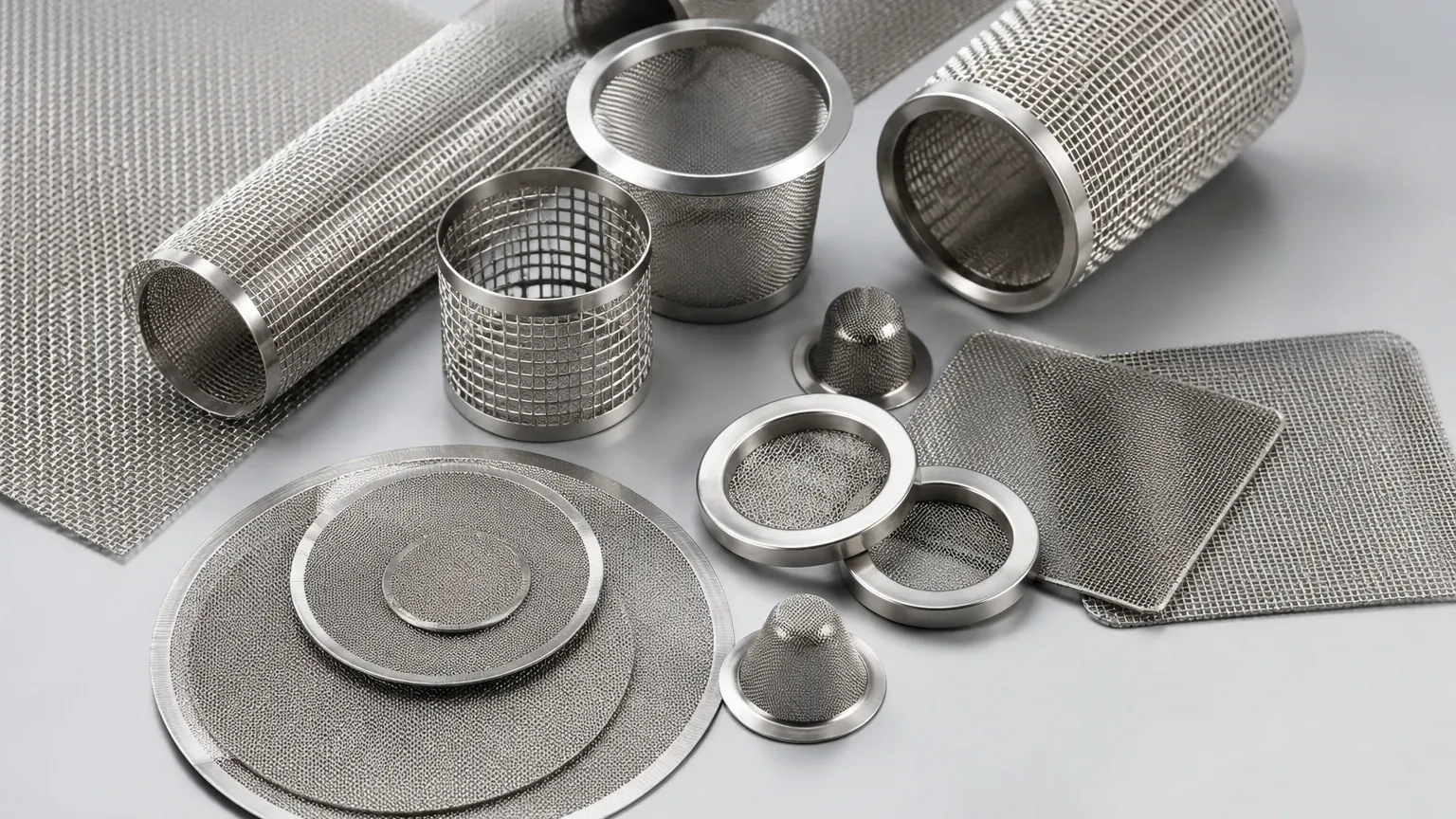
Sintered mesh components can be fabricated into complex shapes, such as pleated cartridges or conical strainers, without the risk of wire migration or pore size distortion. This makes them ideal for high-viscosity polymer filtration and high-temperature gas separation.
Industry-Specific Applications and Requirements
Stainless filter mesh is utilized across a broad spectrum of industries, each with its own set of regulatory and technical constraints.
Chemical and Petrochemical Processing
In these sectors, the primary concern is chemical compatibility and the ability to withstand high temperatures. Stainless mesh is used to protect downstream equipment from particulates, facilitate catalyst recovery, and refine chemical intermediates. The durability of the material ensures that filters do not degrade when exposed to volatile organic compounds (VOCs) or corrosive reagents.
Food and Beverage Production
Filters used in food processing must comply with FDA and international health standards. Stainless steel is the material of choice because it is non-leaching, easy to sterilize, and resistant to the caustic cleaning agents used in Clean-in-Place (CIP) cycles. Common applications include juice clarification, syrup filtration, and the removal of solids from edible oils.
Pharmaceutical and Biotechnology
Purity is the paramount concern in pharmaceutical manufacturing. Stainless filter mesh with high-precision micron ratings is used for sterile venting, solvent filtration, and active pharmaceutical ingredient (API) recovery. The smooth surface of the stainless steel wires prevents bacterial growth and allows for thorough validation of cleaning processes.
Hydraulic and Lubrication Systems
In hydraulic systems, even microscopic particles can cause catastrophic component failure. Dutch weave stainless filter mesh is frequently used in high-pressure inline filters to remove wear particles and environmental contaminants, ensuring the longevity of valves, pumps, and actuators.
Customization and OEM Integration
Standard off-the-shelf filtration products often fail to meet the unique spatial or performance requirements of specialized industrial machinery. This is where Kaifil’s expertise in custom manufacturing becomes a critical asset for engineering teams.
Customization options include:
- Custom Dimensions: Precision cutting and forming to fit specific housing geometries.
- Multilayer Composites: Combining different mesh types (e.g., a fine filtration layer supported by a coarse drainage layer) to optimize performance.
- Edge Treatments: Specialized welding, framing, or binding to ensure the mesh remains secure within its assembly and prevents bypass.
- Surface Coatings: Applying specialized treatments to enhance hydrophobicity or improve release characteristics for sticky cakes.
By working closely with an OEM partner, companies can develop filtration components that are perfectly matched to their equipment’s flow characteristics and maintenance schedules.
Maintenance, Cleaning, and Service Life
One of the primary advantages of stainless filter mesh over disposable media (such as paper or polymer membranes) is its cleanability. A well-maintained stainless filter can remain in service for years, significantly reducing the total cost of ownership.
Cleaning Methods
- Ultrasonic Cleaning: High-frequency sound waves create cavitation bubbles that dislodge deeply embedded particles from the mesh pores. This is the most effective method for fine Dutch weaves.
- Backwashing: Reversing the flow of the process fluid can clear surface-loaded contaminants. This is often automated in continuous process systems.
- Chemical Cleaning: Soaking the mesh in specific solvents or acids can dissolve organic or mineral scaling. It is crucial to ensure the cleaning agent is compatible with the specific stainless steel grade.
Determining Replacement Cycles
While stainless mesh is durable, it is not indestructible. Engineers should monitor for signs of "blinded" mesh (permanent clogging), mechanical deformation, or wire fatigue. Regular inspection of the mesh integrity ensures that the filtration system continues to protect downstream assets without causing excessive energy consumption due to high pressure drops.
Conclusion: Selecting a Technical Partner
Choosing the right stainless filter mesh involves more than just selecting a micron rating. It requires a comprehensive understanding of fluid dynamics, material science, and the specific stresses of the operating environment. Whether you are designing a new system or looking to optimize an existing process, the technical expertise of the manufacturer is a vital component of the project's success.
Kaifil specializes in providing high-performance, customized filtration solutions that meet the exacting standards of global industries. From material selection to final production, our team supports engineers in achieving efficient and cost-effective filtration. For detailed technical specifications and to discuss your project requirements, please visit our Main Page to access our full resource library and product catalog.
