


Filter Press Companies
In the landscape of industrial liquid-solid separation, filter press companies play a critical role by providing the equipment and technical expertise necessary to manage complex slurry processing. A filter press is a batch-operation piece of equipment used to separate solids and liquids using pressure filtration. While the fundamental technology has existed for over a century, modern engineering requirements—driven by the need for higher cake dryness, faster cycle times, and resistance to corrosive chemicals—have forced a significant evolution in how these systems are designed and manufactured.
For engineers and procurement professionals, selecting among various filter press companies requires a deep understanding of both the mechanical hardware and the filtration media. The choice of a partner impacts not only the initial capital expenditure (CAPEX) but also the long-term operational efficiency (OPEX) of a plant. This guide examines the technical criteria, material considerations, and vendor evaluation processes essential for successful filtration projects.
Categorizing the Filter Press Industry
Filter press companies generally fall into three categories: original equipment manufacturers (OEMs), component specialists, and system integrators. Understanding these distinctions is the first step in a technical procurement strategy.
1. Full-Scale OEMs: These companies design and build the entire filter press structure, including the heavy-duty steel frame, hydraulic closing systems, and control logic. They often provide turnkey solutions but may be less flexible regarding custom component integration.
2. Component and Media Specialists: These firms focus on the "heart" of the filtration process—the plates, filter cloths, and precision metal filters. For high-performance applications, such as those requiring extreme chemical resistance or precise micron ratings, engineers often turn to specialists like Kaifil to provide custom stainless steel filtration solutions that outperform standard synthetic media.
3. Service and Retrofit Providers: These companies specialize in optimizing existing installations. They provide replacement parts, plate upgrades (such as moving from recessed plates to membrane squeeze plates), and automation retrofits to extend the life of aging equipment.
Engineering Specifications and Performance Metrics
When engaging with filter press companies, technical teams must define performance expectations based on the specific characteristics of their slurry. A "one-size-fits-all" approach rarely succeeds in demanding industrial environments. Key metrics include:
Solids Concentration and Feed Pressure
The concentration of solids in the feed slurry dictates the volume of the filter press. Higher solids concentrations typically allow for shorter cycle times. Furthermore, the feed pressure—often ranging from 7 bar (100 psi) to 20 bar (225 psi) or higher—determines the required structural integrity of the press frame and the type of pump (e.g., air-operated diaphragm or centrifugal) required.
Cake Dryness and Wash Requirements
In many chemical and mining applications, the goal is to achieve maximum cake dryness to reduce disposal costs or to recover valuable filtrate. Filter press companies offering membrane (diaphragm) plates allow for a secondary squeeze step, which mechanically compresses the cake after the initial filtration. If the cake requires washing to remove impurities, the company must design the plate internal porting to ensure uniform flow of the wash liquid through the entire cake volume.
Cycle Time and Automation
Total cycle time includes feeding, pressure maintenance, core blow, cake discharge, and cloth washing. Companies that provide advanced automation—such as automatic plate shifters, cloth washing robots, and integrated PLC systems—can significantly reduce labor costs and improve consistency between batches.
The Role of Material Selection in Harsh Environments
One of the most critical decisions in the procurement process is the material of construction for both the plates and the filter media. While polypropylene is the standard for many general-purpose applications, it has limitations regarding temperature and chemical compatibility.
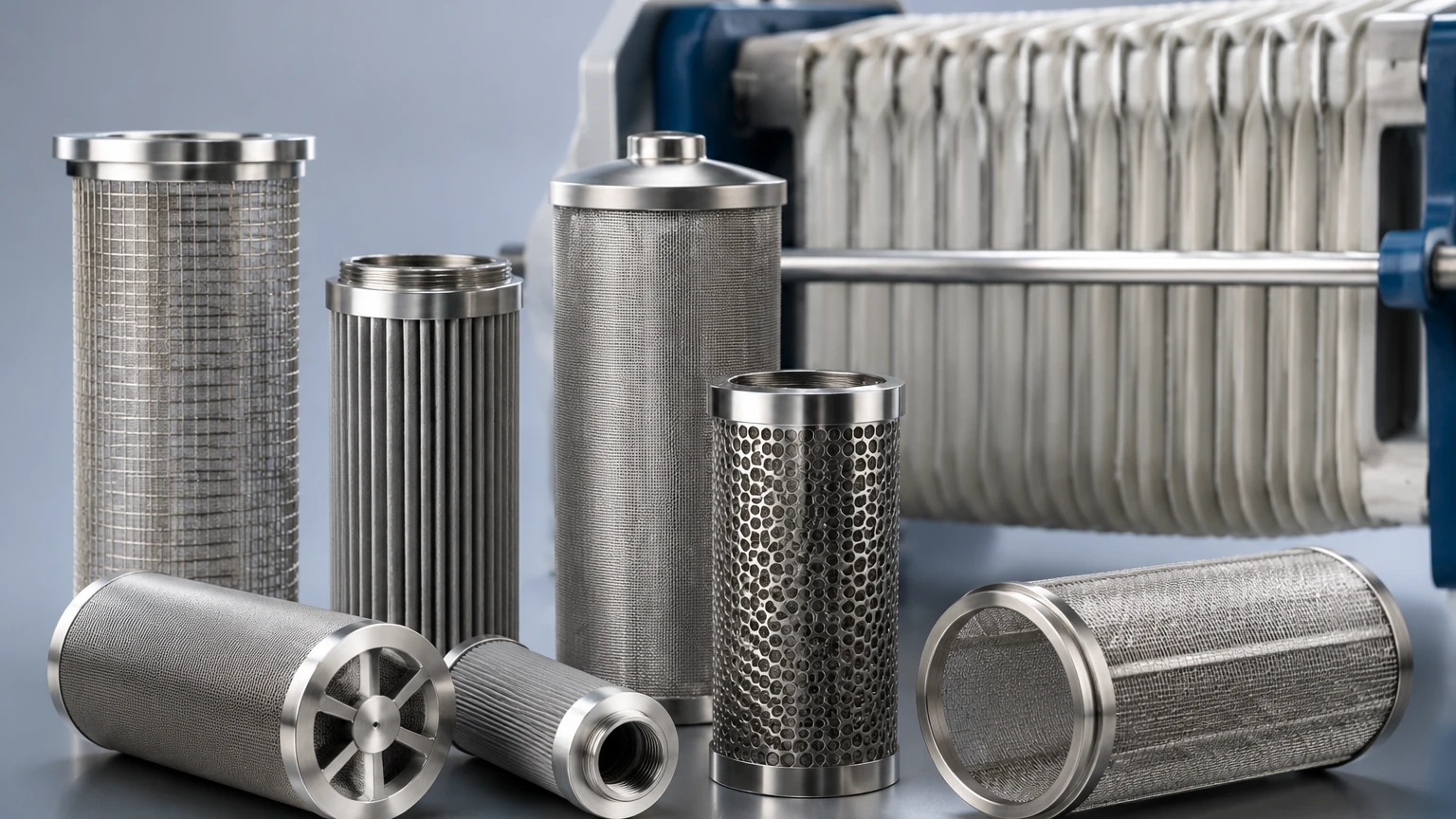
In industries such as pharmaceutical manufacturing, food and beverage processing, and high-temperature chemical synthesis, stainless steel components are often mandatory. Stainless steel filter cartridges and wire mesh filters provide the durability and precision needed where synthetic cloths might fail. For instance, when dealing with solvents or high-temperature caustic solutions, precision metal filter components ensure that the structural integrity of the filter media is maintained under high differential pressures. To explore specific technical data on these materials, engineers can visit the Main Page to review product options and application support.
Evaluating Manufacturing Capabilities
Not all filter press companies operate with the same quality standards. A technical audit of a potential supplier should focus on their manufacturing precision and material traceability. Key areas to confirm include:
* Machining Precision: The sealing surfaces of filter plates must be machined to extremely tight tolerances to prevent "wicking" or leakage under high pressure. Inquire about the CNC machining capabilities of the manufacturer.
* Welding and Fabrication: For the press frame, look for companies that follow recognized welding standards (such as AWS or ISO). If the application is in a sanitary environment, the finish of the stainless steel (e.g., Ra values) must meet specific regulatory requirements.
* Testing and Validation: Does the company offer pilot-scale testing? Slurry behavior is notoriously difficult to predict theoretically. Testing a sample of the actual process fluid on a pilot press is the only reliable way to determine the optimal flux rate, cake thickness, and cloth selection.
Common Risks and Mitigation Strategies
Partnering with the wrong filter press companies can lead to significant operational bottlenecks. Engineers should be aware of several common risks:
1. Undersized Equipment
To win a bid, some suppliers may propose a smaller, less expensive press that operates at the limit of its capacity. This leads to excessive wear on the hydraulic system and prevents the plant from handling process upsets or future capacity increases. Always verify the "effective filtration area" versus the "total volume."
2. Poor Media Compatibility
The filter cloth or mesh is the most frequent point of failure. If the media is not perfectly matched to the particle size distribution and chemical profile of the slurry, it will blind (clog) prematurely. This increases downtime for cleaning and reduces throughput. Utilizing high-quality stainless steel wire mesh filters can mitigate these risks in high-stress applications.
3. Inadequate After-Sales Support
Filter presses are mechanical systems that require regular maintenance. Before finalizing a contract, confirm the availability of spare parts such as gaskets, hydraulic seals, and filter plates. A company that cannot provide a clear lead time for wear parts is a liability to the plant’s uptime.
Total Cost of Ownership (TCO) Considerations
A professional procurement analysis must look beyond the initial purchase price. The TCO of a filter press system includes:
* Energy Consumption: The power required for high-pressure feed pumps and hydraulic power units.
* Consumables: The lifespan and replacement cost of filter cloths or metal mesh. While stainless steel media may have a higher upfront cost, its longevity in harsh environments often results in a lower TCO compared to frequent replacements of synthetic cloths.
* Labor Costs: The degree of automation determines how many man-hours are required per shift to operate the press and discharge the cake.
* Disposal/Recovery Value: The efficiency of the dewatering process directly impacts the weight of the waste (and thus the cost of hauling) or the purity of the recovered product.
Integration with Upstream and Downstream Processes
Filter press companies should not view their equipment in isolation. A successful installation requires seamless integration with the rest of the plant. This includes the slurry conditioning tanks (where flocculants or coagulants may be added), the feed pump control logic, and the cake handling system (conveyors or bins).
Furthermore, in many precision industries, the filtrate from a filter press may require a secondary "polishing" step. This is where stainless steel filter cartridges and precision metal filter components become essential. By removing any trace fines that may have bypassed the primary press, these components ensure the final product meets the required purity standards.
Conclusion: Selecting the Right Partner
Choosing from the available pool of filter press companies is a decision that requires balancing mechanical robustness with filtration science. Engineers must prioritize suppliers who demonstrate a deep understanding of material science—particularly the advantages of stainless steel and precision mesh in demanding applications—and who offer transparent technical data to support their claims.
By focusing on engineering fundamentals, such as chemical compatibility, pressure ratings, and automation potential, purchasing teams can secure a filtration solution that provides reliable performance for years to come. For those seeking specialized, high-performance filtration components to complement or enhance their industrial systems, reviewing the technical capabilities of a manufacturer like Kaifil is a recommended next step in the engineering process.
