


Sterile Filters
In industrial processing, the requirement for sterility is not merely a quality preference but a critical safety and regulatory mandate. Sterile filters serve as the final barrier against microbial contamination in liquids and gases, ensuring that products in the pharmaceutical, food and beverage, and biotechnology sectors remain free from viable microorganisms. Unlike standard particulate filters, sterile filters are engineered to achieve a specific microbial retention efficiency, typically defined by their ability to remove high concentrations of a challenge organism, such as *Brevundimonas diminuta*.
For engineers and procurement specialists, selecting the appropriate sterile filtration system requires a deep understanding of material science, fluid dynamics, and validation protocols. High-performance filtration solutions, such as those found on the Kaifil Main Page, provide the mechanical integrity and precision required to maintain sterile boundaries in demanding industrial environments.
The Engineering Principles of Sterile Filtration
Sterile filtration operates on several physical mechanisms to remove microorganisms, which typically range in size from 0.2 to 2.0 micrometers. The most common standard for a "sterilizing grade" filter is the ability to retain a minimum of $10^7$ colony-forming units (CFU) of *Brevundimonas diminuta* per square centimeter of effective filtration area.
Removal Mechanisms
1. Sieve Retention: This is the primary mechanism where particles or microorganisms larger than the pore size of the filter medium are physically trapped on the surface. For sterile applications, a 0.22-micrometer absolute rating is the industry standard for liquid filtration.
2. Adsorption: In some media, electrokinetic charges (zeta potential) attract and hold particles smaller than the physical pore size. While useful, adsorption is often considered a secondary mechanism because it can be influenced by the pH, ionic strength, and temperature of the fluid.
3. Inertial Impaction and Diffusion: Predominantly relevant in gas filtration (such as sterile air or vent filters), these mechanisms rely on the momentum of particles or Brownian motion to cause them to collide with and adhere to the filter fibers.
Absolute vs. Nominal Ratings
In the context of sterile filters, nominal ratings are insufficient. A nominal rating refers to an approximate retention value, whereas an absolute rating signifies that the filter will retain 99.9% or more of particles at the specified micron size under defined test conditions. For sterile processes, only absolute-rated filters provide the necessary security to guarantee the removal of bacteria.
Material Selection for Sterile Applications
The choice of material for sterile filters is dictated by the chemical nature of the process fluid, the operating temperature, and the method of sterilization. While polymer membranes (such as PES, PTFE, or PVDF) are common in single-use applications, industrial B2B environments often demand the durability of stainless steel.
Stainless Steel Filter Media
Stainless steel, particularly 316L grade, is the material of choice for sterile filters used in steam filtration, high-temperature gas filtration, and aggressive chemical processing. The advantages of stainless steel include:
* Thermal Stability: Capable of withstanding continuous exposure to high-temperature steam during Sterilization-in-Place (SIP) cycles.
* Mechanical Strength: Unlike polymer membranes, stainless steel filters do not suffer from media migration or structural collapse under high differential pressures.
* Corrosion Resistance: 316L provides excellent resistance to the cleaning agents used in Cleaning-in-Place (CIP) protocols.
Surface Finish and Hygiene
For sterile filters, the internal surface finish of the filter housing is as important as the filter element itself. Surfaces must be polished to a specific roughness average (Ra), typically less than 0.8 µm (32 micro-inches), to prevent microbial attachment and biofilm formation. Electropolishing is frequently employed to achieve a passive, ultra-smooth surface that facilitates effective cleaning.
Types of Sterile Filter Construction
Sterile filters are designed in various configurations to balance filtration surface area, flow rate, and pressure drop. The construction method significantly impacts the filter's lifespan and its ability to be regenerated.
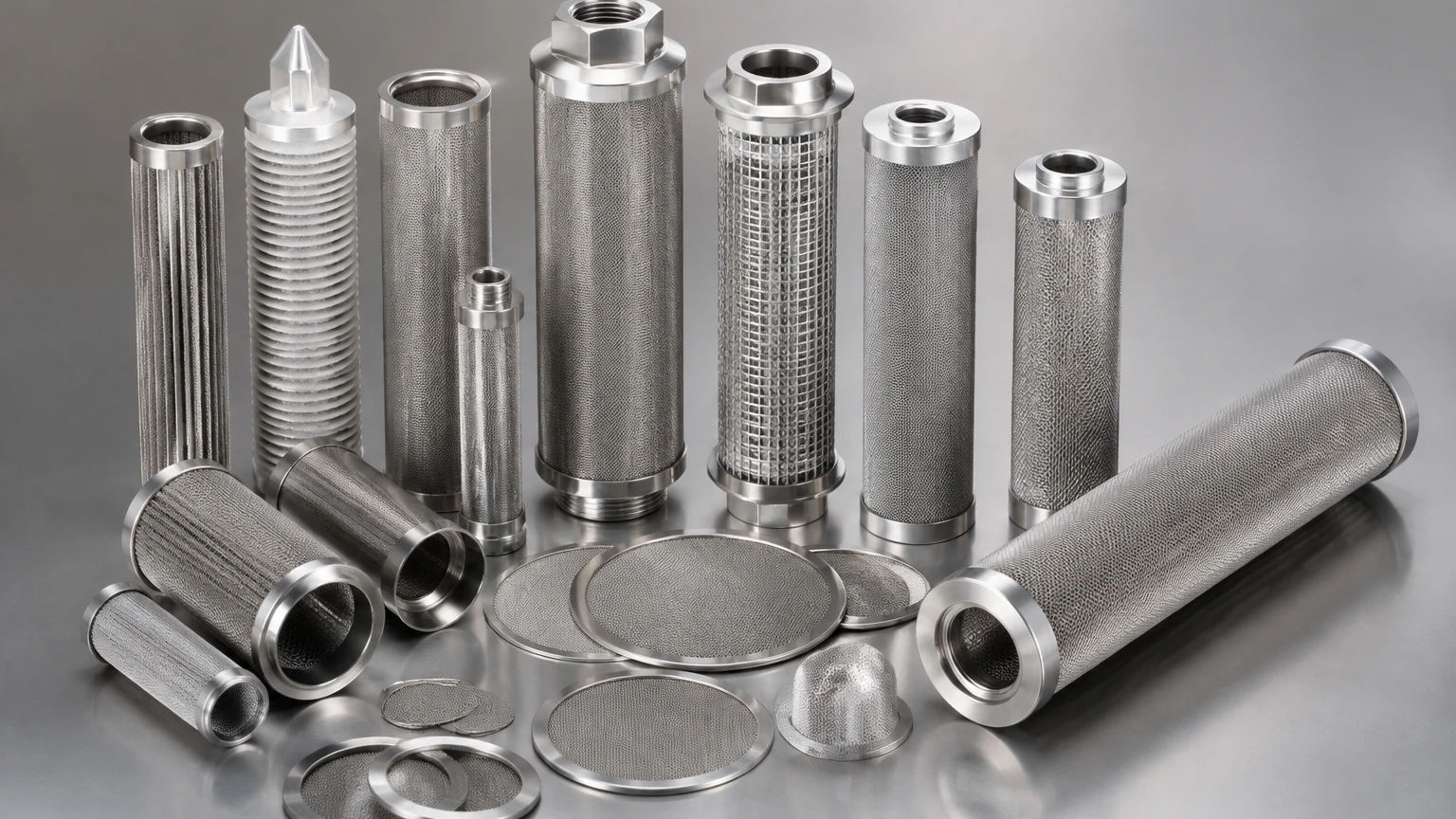
Sintered Metal Mesh Filters
Sintered metal mesh is created by layering multiple sheets of stainless steel wire cloth and bonding them through a high-temperature sintering process. This creates a robust, porous structure with precise pore sizes. In sterile gas applications, sintered mesh provides a permanent solution that can be cleaned and reused thousands of times, significantly reducing the total cost of ownership compared to disposable cartridges.
Pleated Filter Elements
To maximize the effective filtration area within a compact housing, filter media is often pleated. Pleated sterile filters are ideal for high-flow applications where a low initial differential pressure is required. By increasing the surface area, the flux (flow per unit area) is reduced, which can extend the time between cleaning or replacement cycles.
Depth vs. Surface Filtration
* Surface Filters: These trap contaminants on the upstream side of the media. They are easier to clean via backpulsing or backwashing.
* Depth Filters: These utilize a thick matrix of fibers or sintered particles to trap contaminants throughout the thickness of the media. Depth filters offer higher dirt-holding capacity but are generally more difficult to validate for absolute microbial retention in liquid streams without a secondary membrane layer.
Integrity Testing and Validation Protocols
One of the most critical aspects of using sterile filters in a B2B environment is the ability to verify that the filter is intact and performing to its specifications. Integrity testing is a non-destructive method performed before and after a filtration batch.
Common Integrity Tests
1. Bubble Point Test: This test measures the minimum pressure required to force air through a liquid-wetted filter. The bubble point is inversely proportional to the pore size; a lower-than-expected bubble point indicates a damaged filter or a pore size larger than the sterile rating.
2. Diffusion Flow (Forward Flow) Test: This measures the rate at which gas diffuses through the liquid-filled pores of a wetted filter at a pressure below the bubble point. Excessive flow indicates a compromise in the filter's integrity.
3. Water Intrusion Test (WIT): Specifically used for hydrophobic filters (like PTFE or specially treated stainless steel) in gas service. It measures the pressure required to force water into the hydrophobic pores.
Log Reduction Value (LRV)
Validation involves determining the Log Reduction Value, which is the logarithm of the ratio of microorganisms in the influent to the microorganisms in the effluent. A sterilizing-grade filter must provide an LRV of at least 7 for *B. diminuta*. This technical data is essential for engineers when documenting process safety for regulatory bodies like the FDA or EMA.
Sterilization-in-Place (SIP) and Maintenance
In many industrial processes, the sterile filter must be sterilized while installed in the system to prevent re-contamination during assembly. Sterilization-in-Place (SIP) typically involves the use of saturated steam.
Thermal Stress and Cycle Life
Repeated SIP cycles impose significant thermal stress on filter components. Polymer filters often have a limited "steam life," after which the material becomes brittle and prone to failure. Stainless steel sterile filters, however, are designed for hundreds of SIP cycles. Engineers must track the number of sterilization cycles and perform regular integrity tests to ensure the filter remains within its performance window.
Cleaning-in-Place (CIP)
For liquid sterile filters, CIP protocols involve circulating caustic or acidic cleaning agents through the filter housing. It is vital to confirm that the filter media and all seals (O-rings/gaskets) are chemically compatible with these agents. Common seal materials for sterile applications include EPDM, Silicone, and Viton, each offering different levels of resistance to heat and chemicals.
Industrial Applications of Sterile Filters
Sterile filtration is utilized across a broad spectrum of industries, each with unique environmental challenges.
Food and Beverage
In the beverage industry, sterile filters are used for "cold stabilization" of beer and wine, removing yeast and spoilage bacteria without the need for heat pasteurization, which can alter the flavor profile. Additionally, sterile air filters are used to provide overpressure in storage tanks to prevent the ingress of airborne contaminants.
Pharmaceutical and Biotech
This sector requires the highest level of validation. Sterile filters are used for the final fill-finish of injectable drugs, the filtration of growth media for bioreactors, and the purification of process gases. The use of 316L stainless steel components ensures that no extractables or leachables contaminate the high-purity product.
Compressed Air and Gas
Many manufacturing processes require sterile compressed air for pneumatic tools, product drying, or aeration. Sterile gas filters must be hydrophobic to prevent moisture from blinding the pores, which would lead to a massive pressure drop and potential microbial breakthrough.
Engineering Selection Guide: Confirming Specifications
When sourcing sterile filters, engineers should evaluate several technical parameters to ensure the chosen solution meets the application's demands. Before finalizing a purchase, confirm the following data points:
* Flow Rate and Viscosity: Determine the maximum required flow rate and the viscosity of the fluid at operating temperature. This dictates the size of the filter housing and the number of elements required.
* Operating Pressure and Temperature: Ensure the filter and housing are rated for the maximum pressure (including potential surges) and the sterilization temperature.
* Differential Pressure ($ΔP$): Calculate the clean pressure drop and define the terminal pressure drop at which the filter must be cleaned or replaced.
* Chemical Compatibility: Verify that the 316L stainless steel and elastomer seals are compatible with both the process fluid and the cleaning chemicals.
* Regulatory Compliance: Ensure the filters meet relevant standards such as 3-A Sanitary Standards, ASME BPE, or FDA CFR Title 21.
For specialized requirements and custom-engineered filtration components, visiting the Main Page allows technical teams to review available configurations and manufacturing capabilities that align with these rigorous industrial standards.
Conclusion
Sterile filters are a cornerstone of modern industrial process safety. By combining advanced material science with rigorous validation testing, these components allow for the production of safe, high-quality products in the most demanding sectors. Whether utilizing disposable polymer membranes for small-batch pharmaceutical work or robust stainless steel sintered mesh for large-scale industrial steam and gas applications, understanding the technical boundaries of sterile filtration is essential for any engineering team. Proper selection, installation, and maintenance, supported by frequent integrity testing, ensure that the sterile barrier remains uncompromised throughout the equipment's operational life.
