


String Wound Cartridge Filters
In the landscape of industrial liquid processing, string wound cartridge filters represent one of the most established and versatile technologies for depth filtration. These components are engineered to remove suspended solids, sediment, and organic contaminants from a wide array of process fluids. For engineers and procurement professionals, understanding the technical nuances of these filters—ranging from material compatibility to winding geometry—is essential for optimizing system performance and managing operational costs.
As a specialized manufacturer of stainless steel filtration solutions, Kaifil recognizes that while the filter media itself may vary, the structural integrity and engineering precision of the filter assembly are paramount. This guide provides a technical overview of string wound cartridge filters, their performance characteristics, and the critical factors involved in selecting the right filtration solution for demanding industrial environments.
The Engineering Principles of Depth Filtration
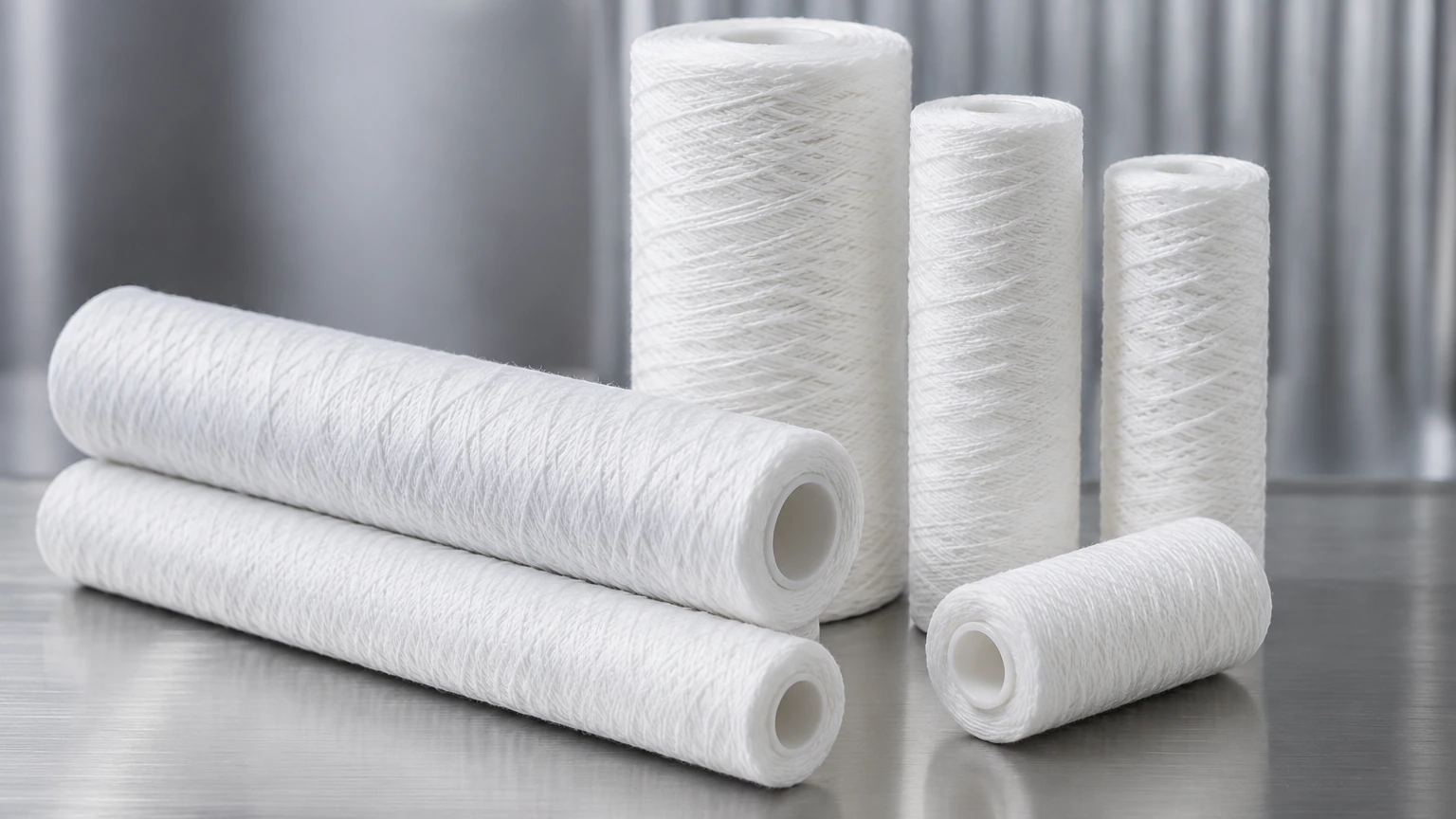
String wound cartridge filters operate on the principle of depth filtration. Unlike surface filters, which trap particles on a single plane, depth filters utilize the entire thickness of the filter media to capture contaminants. This is achieved through a specific manufacturing process where textile yarns are wound around a central support core in a precise, staggered pattern.
Gradient Density and Particle Capture
The winding process creates a series of diamond-shaped openings that become progressively smaller toward the center of the cartridge. This creates a "gradient density" effect. Larger particles are trapped in the outer layers of the yarn, while finer particles penetrate deeper into the matrix before being captured. This mechanism offers several technical advantages:
1. High Dirt-Holding Capacity: Because the entire volume of the filter is utilized, string wound cartridges can hold a significant mass of contaminants before reaching terminal pressure drop.
2. Extended Service Life: The graduated pore structure prevents the outer surface from blinding prematurely, allowing for longer intervals between filter changes.
3. Low Initial Pressure Drop: The open structure of the outer layers ensures that fluid can enter the filter with minimal resistance, preserving pump efficiency.
Precision Winding Geometry
The performance of a string wound filter is dictated by the tension and pattern of the wind. Modern CNC winding machines allow for "precision winding," which eliminates the inconsistencies found in older, manual processes. By adjusting the pitch and tension, manufacturers can fine-tune the micron rating and ensure that the filter maintains its structural integrity even under fluctuating pressure conditions.
Material Selection: Yarn and Core Compatibility
Selecting the appropriate materials for both the yarn and the core is the most critical step in ensuring the longevity of a filtration system. Chemical compatibility, temperature resistance, and potential for fiber migration must all be evaluated.
Yarn Media Options
* Polypropylene (PP): The most common material for general-purpose applications. It offers excellent chemical resistance to acids, alkalis, and many solvents. However, it is limited by a maximum operating temperature of approximately 60°C to 80°C (140°F to 176°F).
* Cotton (Bleached or Natural): Often used for oils, water, and alcohols. Bleached cotton is preferred for food-grade applications or where the natural oils in raw cotton might contaminate the filtrate. Cotton can withstand higher temperatures than polypropylene, typically up to 120°C (250°F).
* Glass Fiber: Reserved for high-temperature applications and aggressive chemical environments where synthetic fibers would degrade. Glass fiber filters can operate at temperatures exceeding 400°C (750°F) when paired with a compatible metal core.
* Polyester: Provides a middle ground for temperature resistance (up to 150°C) and is often used in synthetic oil filtration and specific chemical processes.
Core Materials and Structural Integrity
The core provides the mechanical strength required to prevent the filter from collapsing under differential pressure. At Kaifil, the focus is often on high-performance metal cores that complement our custom stainless steel filtration solutions.
* Polypropylene Cores: Suitable for low-temperature, non-critical applications where cost is a primary driver.
* Tin-Plated Steel: Offers higher strength than plastic but is limited by corrosion resistance.
* Stainless Steel (304/316): The gold standard for industrial applications. Stainless steel cores provide maximum structural rigidity and are essential for high-temperature processes, steam sterilization, and applications involving corrosive fluids. Using a 316L stainless steel core ensures that the filter assembly does not introduce metallic contaminants into high-purity processes, such as those found in the pharmaceutical or food and beverage sectors.
Performance Metrics: Micron Ratings and Flow Dynamics
Engineers must distinguish between nominal and absolute micron ratings when specifying string wound cartridge filters. Most string wound filters are classified as "nominal," meaning they are designed to trap a high percentage (typically 80% to 90%) of particles at a specific micron size.
Understanding Micron Ratings
String wound filters are available in ratings from 0.5 microns to 150 microns. Because they are depth filters, they are highly effective at removing deformable particles and gelatinous contaminants that might bypass a thin surface membrane. However, for applications requiring 99.9% efficiency (absolute rating), a string wound filter is typically used as a pre-filter to protect more expensive downstream membrane or pleated cartridges.
Flow Rate and Differential Pressure ($ΔP$)
The relationship between flow rate and pressure drop is a key design consideration. A higher flow rate through a single cartridge will result in a higher initial pressure drop and a shorter service life. To optimize the system, engineers should aim for a low initial $ΔP$ (typically less than 2-3 psi).
When the differential pressure reaches a certain threshold—usually between 15 and 25 psi depending on the housing and pump specifications—the cartridges should be replaced. Operating beyond this limit risks "bypass," where the pressure forces contaminants through the media, or structural failure of the cartridge.
Industrial Applications and Use Cases
String wound cartridge filters are utilized across a broad spectrum of industries due to their adaptability and cost-effectiveness.
Chemical and Petrochemical Processing
In chemical manufacturing, these filters are used to remove catalysts, scale, and sediment from process streams. The ability to pair specialized yarns with stainless steel cores makes them ideal for handling aggressive solvents and high-temperature resins. They are frequently used in the filtration of lubricating oils, fuel oils, and hydraulic fluids to protect sensitive downstream equipment.
Food and Beverage Industry
For the food and beverage sector, string wound filters must meet stringent purity standards. Bleached cotton or FDA-compliant polypropylene yarns are used to filter potable water, vegetable oils, and syrups. In these applications, the filters serve to remove particulate matter that could affect the clarity, taste, or shelf life of the final product.
Water Treatment and Desalination
In large-scale water treatment and Reverse Osmosis (RO) plants, string wound filters serve as critical pre-filters. They remove silt, sand, and other suspended solids that would otherwise clog RO membranes. Given the high volumes of water processed, the high dirt-holding capacity of wound cartridges is a significant operational advantage, reducing the frequency of maintenance shutdowns.
Customization and Engineering Specifications
One of the primary strengths of string wound technology is the ability to customize the filter to the specific requirements of the application. Beyond material selection, several physical parameters can be adjusted:
* Length and Diameter: Standard lengths range from 5 to 40 inches, with diameters typically at 2.5 or 4.5 inches (Big Blue). Custom lengths can be manufactured for specialized housings.
* End Cap Configurations: While many wound filters use a Double Open End (DOE) design, they can be fitted with various end caps, such as 222 or 226 O-rings, to ensure a bypass-free seal in high-purity housings.
* Anti-Static and Low-Extractable Versions: For electronics manufacturing or solvent filtration, specialized yarns can be treated to reduce static buildup or minimize the leaching of surfactants and binders.
As a manufacturer focused on precision metal components, Kaifil provides the engineering support necessary to integrate these filtration elements into complex industrial systems. For more information on our full range of custom filtration components, you can visit our Main Page to review product options and application support.
Total Cost of Ownership and Maintenance Cycles
When evaluating filtration solutions, it is a mistake to look only at the unit price of the cartridge. The Total Cost of Ownership (TCO) includes the cost of the filters, the labor required for replacement, the cost of disposal, and the potential downtime of the production line.
Strategies for Cost Optimization
1. Proper Sizing: Oversizing the filter housing to allow for more cartridges or larger diameter cartridges reduces the flux (flow per unit area), which significantly extends the life of each filter.
2. Staged Filtration: Using a coarse string wound filter (e.g., 25 micron) followed by a finer one (e.g., 5 micron) is often more cost-effective than using a single fine filter, as the coarser filter protects the more expensive fine filter from premature loading.
3. Monitoring $ΔP$: Implementing automated pressure monitoring allows maintenance teams to change filters exactly when needed, rather than on a fixed schedule that may result in wasted filter life or bypassed contaminants.
Avoiding Common Risks
The primary risk with low-quality string wound filters is fiber migration. If the yarn is not properly tensioned or if the fibers are of poor quality, small strands of the filter media can break off and enter the filtrate. This is particularly problematic in pharmaceutical and microelectronics applications. Specifying high-quality, precision-wound cartridges with continuous filament yarns can mitigate this risk.
Conclusion
String wound cartridge filters remain a cornerstone of industrial filtration due to their robust depth-filtration capabilities and extensive customization options. By carefully selecting yarn and core materials—particularly utilizing stainless steel for demanding environments—engineers can ensure reliable performance and protect downstream processes.
Whether you are managing a water treatment facility, a chemical processing plant, or a food production line, understanding the technical variables of these filters is the key to achieving efficient and cost-effective filtration. For organizations requiring specialized filtration components or custom-engineered stainless steel solutions, Kaifil offers the technical expertise and manufacturing capability to meet the most rigorous industrial standards. Visit our Main Page to explore how our filtration solutions can be tailored to your specific operational needs.
