


Titanium Shell and Tube Heat Exchanger
In industrial thermal management, the selection of materials for heat transfer equipment is dictated by the chemical composition of the process fluids, operating temperatures, and pressure requirements. A titanium shell and tube heat exchanger represents a specialized solution for environments where standard austenitic stainless steels or copper alloys fail due to localized corrosion, pitting, or stress corrosion cracking. As a robust configuration for high-pressure applications, the shell and tube design combined with titanium’s unique metallurgical properties provides a reliable method for managing heat in aggressive chemical, marine, and power generation sectors.
Understanding the engineering nuances of these units is essential for technical professionals tasked with optimizing plant efficiency and minimizing downtime. This guide explores the technical specifications, design considerations, and maintenance requirements associated with titanium-based thermal systems.
Engineering Advantages of Titanium in Heat Transfer
Titanium is categorized as a reactive metal, meaning it has a high affinity for oxygen. When exposed to air or moisture, it instantaneously forms a tenacious, microscopic oxide film (TiO2). This passive layer is exceptionally stable and provides the primary defense against corrosive attack. In the context of a titanium shell and tube heat exchanger, this allows for the handling of highly corrosive media that would otherwise degrade industrial equipment.
Corrosion Resistance in Aggressive Media
Titanium exhibits superior resistance to chlorides, including seawater, brackish water, and brine solutions. Unlike stainless steel, which may suffer from chloride-induced stress corrosion cracking (CSCC) at elevated temperatures, titanium remains immune to this failure mode in most industrial environments. It is also highly resistant to oxidizing acids, such as nitric and chromic acids, as well as organic acids and alkaline solutions. For engineers designing systems for chemical processing, this material choice often eliminates the need for frequent replacement cycles.
Strength-to-Weight Ratio and Thermal Efficiency
While titanium has a lower thermal conductivity than copper or aluminum, its high strength allows for the use of thinner-walled tubes. Thinner walls reduce the thermal resistance of the metal barrier, partially compensating for the lower conductivity of the material itself. Furthermore, the high strength-to-weight ratio of titanium allows for lighter overall equipment weight, which can be a critical factor in offshore oil and gas platforms or shipboard installations where structural loads are strictly capped.
Structural Design and Configuration of Shell and Tube Systems
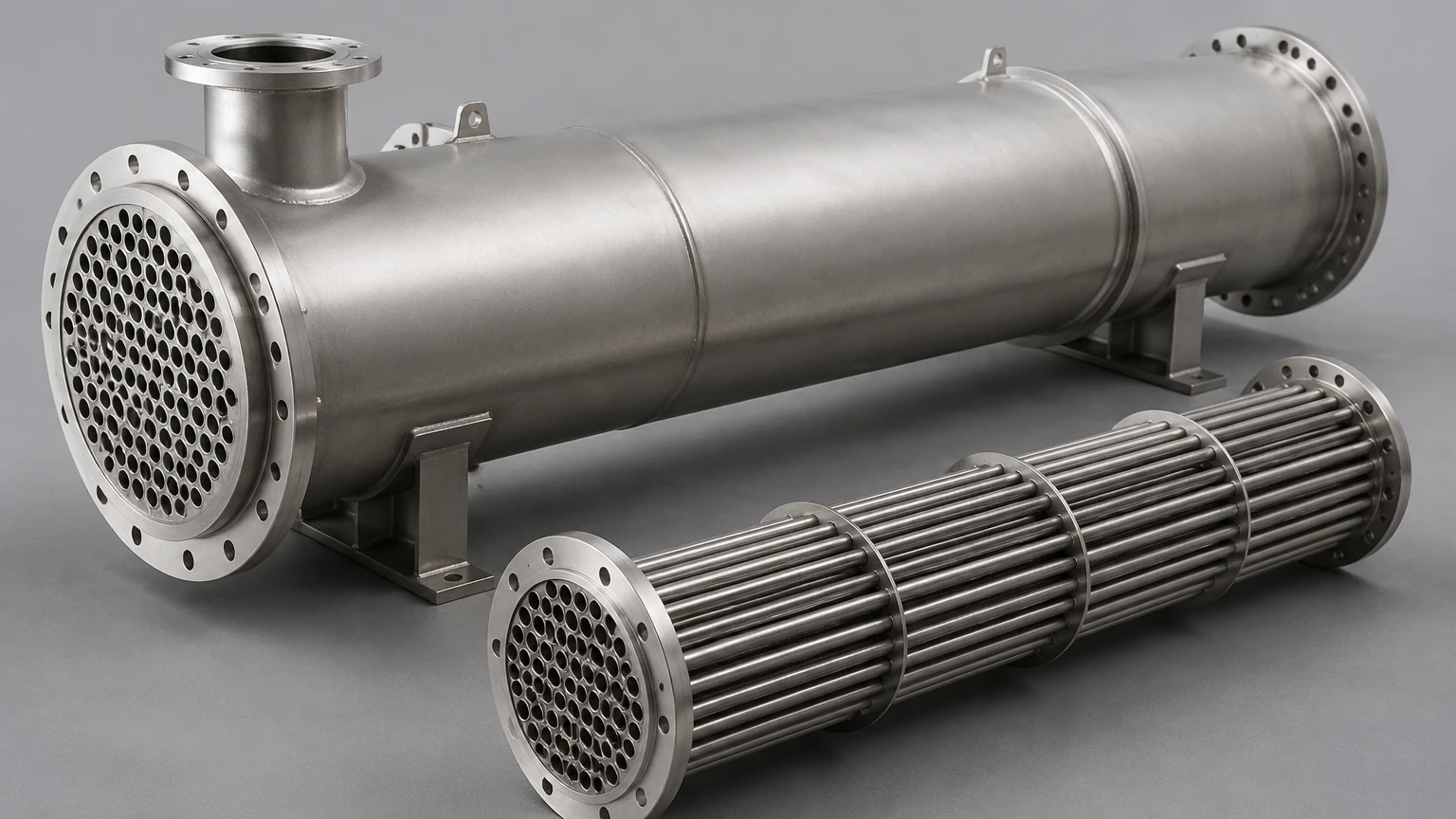
The shell and tube configuration is the most common design for high-pressure applications because its cylindrical shape is naturally resistant to internal pressure. A titanium shell and tube heat exchanger consists of a large pressure vessel (the shell) with a bundle of tubes inside it. One fluid runs through the tubes, and another fluid flows over the tubes (through the shell) to transfer heat between the two fluids.
Tube Bundle and Tube Sheets
The tube bundle is the heart of the exchanger. In titanium units, the tubes are typically seamless or welded and drawn to meet ASTM specifications (such as ASTM B338). The tube sheets—the plates that hold the tubes in place—must also be compatible with titanium. In many cases, engineers use titanium-clad carbon steel or solid titanium tube sheets to prevent galvanic corrosion at the tube-to-tube-sheet joint.
Baffle Design and Fluid Dynamics
Baffles serve two primary purposes: they support the tubes to prevent vibration and they direct the shell-side fluid across the tube bundle in a zigzag pattern to increase turbulence. Increased turbulence improves the heat transfer coefficient but also increases the pressure drop. For a titanium shell and tube heat exchanger, the baffle spacing and cut must be precisely calculated to balance thermal efficiency against the pumping power required to move the fluid through the system.
Critical Performance Factors: Thermal Conductivity and Fouling
When evaluating a titanium shell and tube heat exchanger, engineers must account for the fouling factor—the accumulation of unwanted material on the heat transfer surfaces. Fouling increases thermal resistance and can lead to localized under-deposit corrosion if not managed.
Managing the Fouling Factor
One of the advantages of titanium is its smooth surface finish, which can inhibit the adhesion of certain types of biological fouling and scale. However, in applications involving untreated cooling water or heavy chemical slurries, fouling is inevitable. Designing the exchanger with a higher "fouling allowance" ensures that the unit can still meet its thermal duty even as deposits accumulate over time.
To protect the integrity of the heat exchanger tubes, integrated filtration systems are often employed. High-quality filtration components, such as those detailed on the Main Page of specialized manufacturers, are used to remove suspended solids from the process stream before they enter the heat exchanger. By utilizing custom wire mesh filters or stainless steel cartridges, operators can significantly reduce the rate of fouling and mechanical erosion within the titanium tubes.
Thermal Expansion Considerations
Titanium has a lower coefficient of thermal expansion compared to many other metals. In a shell and tube design where the shell and the tubes are made of different materials (e.g., a titanium tube bundle in a carbon steel shell), the differential expansion during startup and shutdown can create significant mechanical stress on the tube sheets. To mitigate this, engineers may specify floating head designs or U-tube configurations, which allow the tube bundle to expand and contract independently of the shell.
Industrial Applications and Compatibility
The high cost of titanium compared to stainless steel means it is typically reserved for applications where its specific properties provide a clear total cost of ownership (TCO) advantage.
1. Marine and Desalination: Titanium is the industry standard for seawater-cooled condensers and desalination evaporators. Its resistance to biofouling and seawater corrosion ensures a service life often exceeding 20 years.
2. Chemical Processing: In the production of chlorine, terephthalic acid (PTA), and various chlorates, titanium is essential for handling the highly reactive intermediates.
3. Power Generation: Nuclear and fossil fuel power plants use titanium heat exchangers in their surface condensers, particularly when using salt or brackish water for cooling.
4. Pharmaceutical and Food: In these sectors, the inert nature of titanium prevents metal ion contamination of the product, ensuring high purity levels.
Fabrication and Quality Control Standards
Fabricating a titanium shell and tube heat exchanger requires specialized expertise, particularly regarding welding. Titanium is highly susceptible to embrittlement if exposed to oxygen, nitrogen, or hydrogen at temperatures above 250°C. Therefore, all welding must be performed under a strict inert gas shield (usually argon) using Gas Tungsten Arc Welding (GTAW).
Inspection and Testing
To ensure the reliability of the pressure vessel, several non-destructive testing (NDT) methods are employed:
* Radiographic Testing (RT): Used to inspect the integrity of the longitudinal and circumferential shell welds.
* Liquid Penetrant Testing (PT): Essential for detecting surface cracks in titanium welds or tube-to-tube-sheet joints.
* Hydrostatic Testing: The entire unit is pressurized to 1.3 to 1.5 times the design pressure to verify structural integrity.
* Helium Leak Testing: For high-vacuum or extremely hazardous applications, helium leak detection is used to ensure there are no microscopic paths for fluid bypass.
Maintenance Protocols and Lifecycle Management
While titanium is exceptionally durable, it is not maintenance-free. Proper care is required to maximize the return on investment for a titanium shell and tube heat exchanger.
Cleaning Procedures
Chemical cleaning (Clean-In-Place or CIP) is often used to remove scale. When selecting cleaning agents, it is vital to ensure they do not contain hydrofluoric acid, which rapidly dissolves the titanium oxide layer and attacks the base metal. Mechanical cleaning with soft brushes or high-pressure water jets is also common, provided the tools do not scratch the tube surfaces, which could create sites for future fouling.
Monitoring for Erosion
In systems with high fluid velocities, suspended solids can cause erosion-corrosion. While titanium is more resistant to erosion than copper-nickel alloys, it is not immune. Operators should monitor pressure drops across the exchanger; a sudden decrease may indicate tube failure, while a gradual increase indicates fouling. Implementing effective pre-filtration, such as the precision metal filter components offered by Kaifil, can mitigate these risks by ensuring that only clean fluids reach the heat transfer surfaces.
Procurement Guidelines for Technical Professionals
When requesting a quote or specifying a titanium shell and tube heat exchanger, engineers should provide a comprehensive data sheet to the manufacturer. Key information includes:
* Fluid Properties: Mass flow rates, inlet/outlet temperatures, density, viscosity, and specific heat for both shell-side and tube-side fluids.
* Material Grade: Specify the titanium grade (e.g., Grade 2 for general corrosion, Grade 7 or 12 for enhanced crevice corrosion resistance).
* Design Codes: Ensure compliance with ASME Section VIII Division 1 or TEMA standards.
* Allowable Pressure Drop: Define the maximum permissible loss of pressure to ensure the existing pumping system is adequate.
* Corrosion Allowance: While titanium often requires zero corrosion allowance, the shell material (if carbon steel) will require a specified thickness for longevity.
By focusing on these technical parameters, procurement teams can ensure they receive a unit that is properly sized for the thermal load and built to withstand the specific chemical environment of the facility. For more information on the filtration solutions that protect these critical assets, engineers can consult the Main Page of industrial filtration specialists to explore custom integration options.
