


Trickle Bed Reactor
In the landscape of industrial chemical processing, the trickle bed reactor (TBR) stands as a cornerstone technology, particularly within the petrochemical, pharmaceutical, and wastewater treatment sectors. As a three-phase catalytic reactor, its efficiency is fundamentally tied to the interaction between gas and liquid phases as they flow downward over a fixed bed of solid catalyst particles. For engineers and procurement specialists, understanding the mechanical and filtration requirements of these systems is essential for optimizing throughput, ensuring catalyst longevity, and maintaining process safety.
At the heart of a high-performing trickle bed reactor is the internal hardware that manages fluid distribution and catalyst retention. Components such as stainless steel wire mesh filters and precision-engineered support grids are not merely peripheral accessories; they are critical determinants of the reactor's hydrodynamic behavior. This article explores the technical nuances of TBR operation, the engineering challenges of internal filtration, and the selection criteria for the specialized metal components that sustain these demanding environments.
Fundamental Principles of Trickle Bed Reactor Operation
A trickle bed reactor operates on the principle of co-current downward flow. The liquid phase typically "trickles" over the catalyst surface in the form of films, rivulets, or droplets, while the gas phase occupies the remaining void space. This configuration is favored for its simplicity and the high catalyst-to-liquid ratio it allows, which is particularly beneficial for reactions where the liquid reactant is concentrated or where high pressure is required.
Phase Interaction and Mass Transfer
The performance of a trickle bed reactor is governed by the mass transfer rates between the gas, liquid, and solid catalyst. The primary goal is to ensure that the catalyst surface is effectively wetted. Incomplete wetting, often caused by poor liquid distribution, leads to "dry zones" where the reaction rate drops significantly or where unwanted side reactions occur due to localized overheating. Conversely, excessive liquid holdup can increase pressure drop and limit gas-phase mass transfer.
Engineers must evaluate the flow regimes—ranging from trickling flow at low velocities to pulsing flow at higher rates—to determine the optimal operating window. Achieving a stable trickling regime requires precise control over the inlet distribution, which is where high-quality filtration and distribution internals become indispensable.
The Role of Filtration Internals in TBR Performance
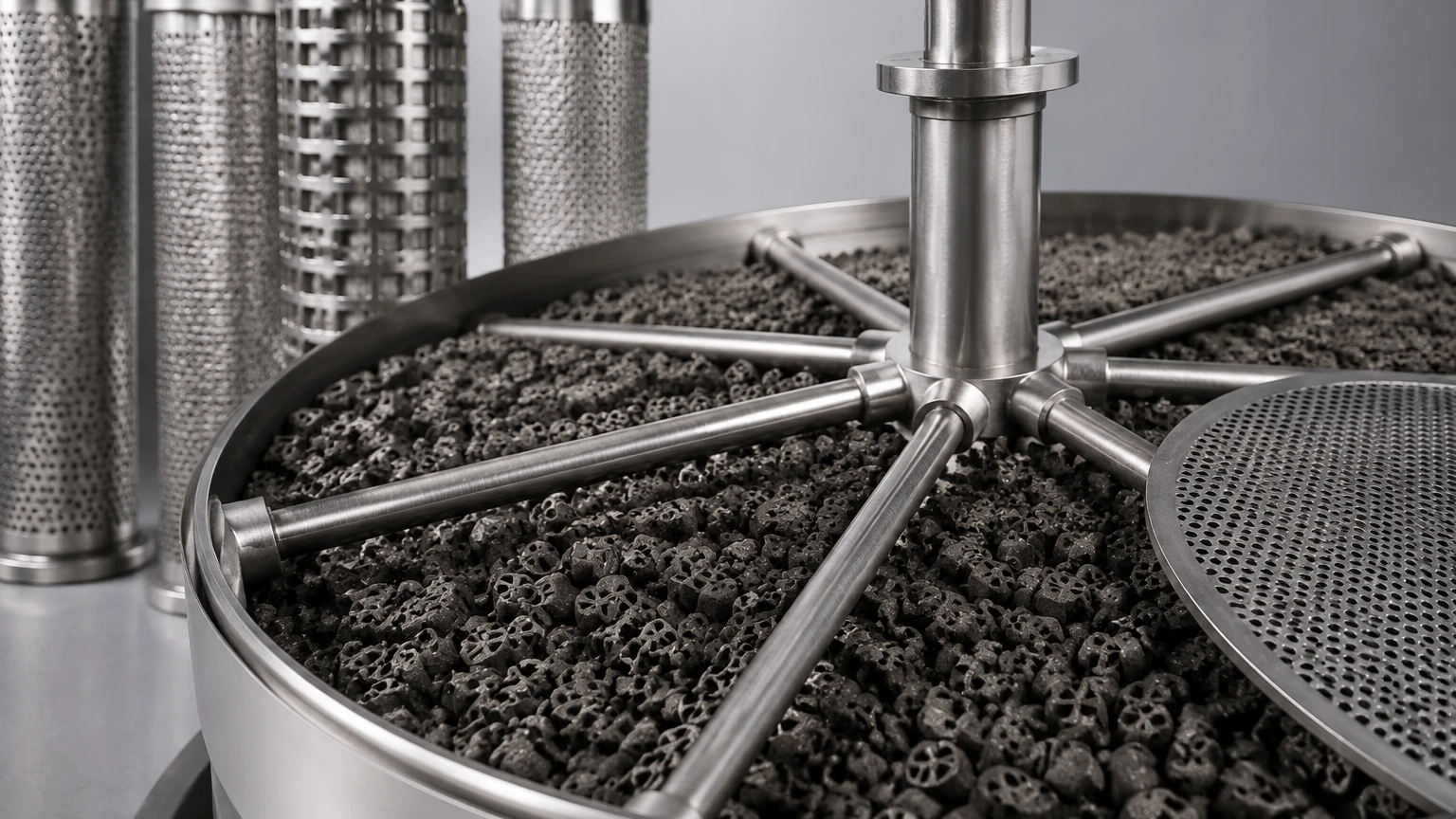
Internals within a trickle bed reactor serve several functions: they distribute the incoming feed, support the heavy catalyst bed, and prevent the migration of catalyst fines into downstream equipment. Given the high temperatures and corrosive nature of many industrial processes, stainless steel filtration solutions are the industry standard for these components.
Catalyst Support Grids
The catalyst bed must be supported by a structure that is mechanically robust enough to withstand the weight of the catalyst and the dynamic pressure of the flowing fluids. However, this support must also be highly permeable. Custom stainless steel wire mesh filters are often integrated into support grids to provide a precise pore size that retains catalyst particles while minimizing resistance to flow. If the support grid is poorly designed, it can lead to stagnant zones at the bottom of the reactor, promoting coke formation or catalyst degradation.
Liquid and Gas Distributors
Uniform distribution at the top of the reactor is perhaps the most critical factor in preventing channeling. Channeling occurs when the liquid finds a path of least resistance, bypassing large sections of the catalyst bed. Advanced distribution trays often incorporate filtration media to ensure that any particulates in the feed stream do not clog the small orifices of the distributor. By utilizing precision metal filter components, manufacturers can ensure that the feed remains clean and the distribution remains uniform over long production cycles.
Engineering Challenges: Pressure Drop and Flow Maldistribution
One of the most significant operational hurdles in a trickle bed reactor is the management of pressure drop. As the fluid moves through the narrow interstitial spaces of the catalyst bed, friction leads to a loss of pressure. This is described mathematically by the Ergun equation, though modified for two-phase flow in TBR applications.
Impact of Catalyst Fines
Over time, mechanical attrition or chemical degradation can cause catalyst particles to break down into smaller "fines." These fines migrate through the bed and can accumulate in the support grids or downstream filtration units. This accumulation significantly increases the pressure drop, forcing the system to operate at higher energy costs or, in extreme cases, necessitating an unscheduled shutdown. High-performance stainless steel filter cartridges are often employed at the reactor outlet to capture these fines, protecting downstream pumps and heat exchangers.
Preventing Hot Spots
In exothermic reactions, such as hydrodesulfurization, flow maldistribution can lead to localized temperature spikes known as hot spots. If the liquid flow is insufficient to carry away the heat of the reaction in a specific area, the temperature can rise rapidly, potentially leading to a thermal runaway or damage to the reactor vessel. Ensuring the integrity of the distribution internals through regular inspection and the use of high-quality materials is a primary safety requirement.
Material Selection and Durability for Reactor Internals
The environment inside a trickle bed reactor is often characterized by high pressure (up to 200 bar), elevated temperatures (300°C to 500°C), and chemically aggressive media. Consequently, the materials used for filtration and support components must be selected with extreme care.
1. Stainless Steel 316L: Known for its excellent corrosion resistance and mechanical strength, 316L is the baseline material for most industrial filtration components in TBRs.
2. Duplex Stainless Steels: For environments with high chloride concentrations or where stress corrosion cracking is a concern, duplex alloys provide superior yield strength and resistance.
3. High-Nickel Alloys: In extreme cases involving high-temperature oxidation or severe acid exposure, alloys like Inconel or Hastelloy may be required for the wire mesh and filter elements.
When selecting a manufacturer for these components, it is vital to confirm that they can provide material certifications and adhere to strict manufacturing tolerances. For those seeking comprehensive specifications on available material grades and filtration accuracies, the Main Page of professional manufacturers offers a wealth of technical data to support informed decision-making.
Customization and OEM Solutions for Reactor Internals
No two trickle bed reactors are identical. Variations in catalyst size, fluid viscosity, and reaction kinetics necessitate customized filtration solutions. OEM (Original Equipment Manufacturer) capabilities allow for the development of bespoke internals that match the specific geometry and process requirements of a given reactor.
Tailored Wire Mesh Designs
Wire mesh filters can be customized in terms of weave type (plain, dutch, or twilled) and wire diameter to balance mechanical strength with filtration fineness. For a trickle bed reactor, a "sintered" wire mesh is often preferred. Sintering bonds multiple layers of mesh together, creating a composite material that is incredibly rigid and has fixed pore sizes that will not shift under pressure.
Precision Metal Components
Beyond simple mesh, complex reactor internals such as scale traps and center pipes require precision machining and welding. These components must be designed to allow for easy installation and removal during catalyst changeouts. Working with a manufacturer experienced in industrial filtration ensures that these components are built to survive the rigors of multi-year operational cycles.
Operational Longevity and Maintenance
The total cost of ownership for a trickle bed reactor is heavily influenced by the frequency of maintenance and the lifespan of its internals. While high-quality stainless steel filters have a higher upfront cost than lower-grade alternatives, their durability often results in lower long-term expenses.
Cleaning and Reuse
Unlike disposable polymer filters, stainless steel filter cartridges and wire mesh components used in TBRs can often be cleaned and reused. Depending on the type of fouling—whether it is carbonaceous deposits, inorganic scales, or catalyst fines—cleaning methods such as ultrasonic cleaning, chemical circulation, or controlled burnout can restore the component's permeability. This capability is a significant advantage for large-scale industrial operations looking to minimize waste and reduce replacement part inventories.
Replacement Cycles
Engineers should establish clear criteria for when a filtration component has reached the end of its functional life. Indicators include a permanent increase in baseline pressure drop (even after cleaning) or visible mechanical deformation. Regular borescope inspections during catalyst replacement intervals are recommended to evaluate the condition of the support grids and distributors.
Technical Evaluation for Purchasing Decisions
When procuring filtration components for a trickle bed reactor, engineering teams should confirm several key parameters with their suppliers:
* Filtration Rating: Is the micron rating absolute or nominal? For catalyst retention, an absolute rating is typically required to prevent any bypass of fines.
* Pressure Rating: What is the maximum allowable differential pressure across the filter element before structural failure occurs?
* Chemical Compatibility: Does the selected alloy stand up to the specific sulfur, nitrogen, or chloride levels present in the process stream?
* Flow Capacity: Does the open area of the mesh or support grid allow for the required flux without inducing excessive turbulence or pressure drop?
By addressing these questions early in the design or procurement phase, companies can avoid costly operational delays and ensure the reliable performance of their reactor systems.
Conclusion
The trickle bed reactor remains a vital asset in modern industry, but its success depends heavily on the invisible work performed by its internal filtration and distribution components. From the robust support grids that hold tons of catalyst to the precision-woven wire mesh that ensures uniform liquid distribution, these stainless steel elements are the key to process efficiency. By focusing on high-quality materials, customized engineering, and rigorous maintenance standards, operators can maximize the throughput and safety of their TBR units. For detailed product options and engineering support regarding these critical filtration solutions, engineers are encouraged to consult technical resources and manufacturer specifications to find the ideal match for their specific application needs.
