


Tubular Flow Reactor
In the landscape of modern chemical engineering and industrial processing, the tubular flow reactor (TFR) stands as a cornerstone of continuous production. Often referred to as a plug flow reactor (PFR) in its idealized form, the tubular flow reactor is designed to facilitate chemical reactions in a continuous, controlled stream. Unlike batch reactors, where reactants are mixed in a vessel and processed over a specific duration, a TFR allows for a steady state of operation, offering significant advantages in terms of throughput, consistency, and thermal management.
For engineers and technical procurement teams, understanding the mechanical and filtration requirements of a tubular flow reactor is essential for optimizing system performance. These reactors are frequently employed in high-pressure, high-temperature, and corrosive environments, necessitating robust construction and precise auxiliary components, such as high-performance stainless steel filters, to ensure product purity and equipment longevity.
Fundamentals of Tubular Flow Reactor Design
A tubular flow reactor typically consists of a cylindrical pipe or tube through which reactants flow. As the fluid moves through the length of the tube, the chemical reaction progresses. The primary characteristic of an ideal TFR is that the fluid is perfectly mixed in the radial direction (perpendicular to the flow) but experiences no mixing in the axial direction (along the flow path). This "plug flow" ensures that every element of the fluid has the same residence time within the reactor.
From an engineering perspective, several variables dictate the efficiency of a tubular flow reactor:
* Residence Time: The duration the reactants spend inside the tube, determined by the tube's volume and the volumetric flow rate.
* Temperature Gradients: TFRs have a high surface-area-to-volume ratio, making them excellent for reactions that require precise heat exchange. However, managing the temperature profile along the length of the tube is critical to prevent thermal degradation or runaway reactions.
* Pressure Drop: As fluid travels through the reactor, friction against the tube walls and internal components (like catalyst beds or filters) creates a pressure drop. Minimizing this while maintaining flow velocity is a key design challenge.
The Role of Filtration in Continuous Flow Systems
In many industrial applications, a tubular flow reactor does not operate in isolation. It is part of a complex system that requires the removal of impurities, the retention of catalysts, or the protection of downstream equipment. This is where precision filtration components become vital.
Filtration in a TFR environment serves three primary functions:
1. Catalyst Retention: In heterogeneous catalysis, the reactor may contain solid catalyst particles. Filters are placed at the outlet or at specific intervals to prevent the catalyst from escaping the reactor zone.
2. Particulate Removal: Raw materials entering the reactor may contain trace solids that can clog narrow tubes or interfere with the reaction. Pre-filtration ensures a clean feed.
3. Product Clarification: Post-reaction, the fluid may contain precipitates or degraded materials that must be removed to meet quality standards.
For those seeking reliable filtration components for these demanding systems, it is beneficial to Review product options and application support on the Kaifil Main Page to understand how customized stainless steel solutions can be integrated into reactor designs.
Engineering Considerations for Reactor Filtration Components
When selecting filtration media for a tubular flow reactor, engineers must look beyond simple micron ratings. The harsh conditions inside a reactor require materials that can withstand chemical attack and mechanical stress.
Material Compatibility and Durability
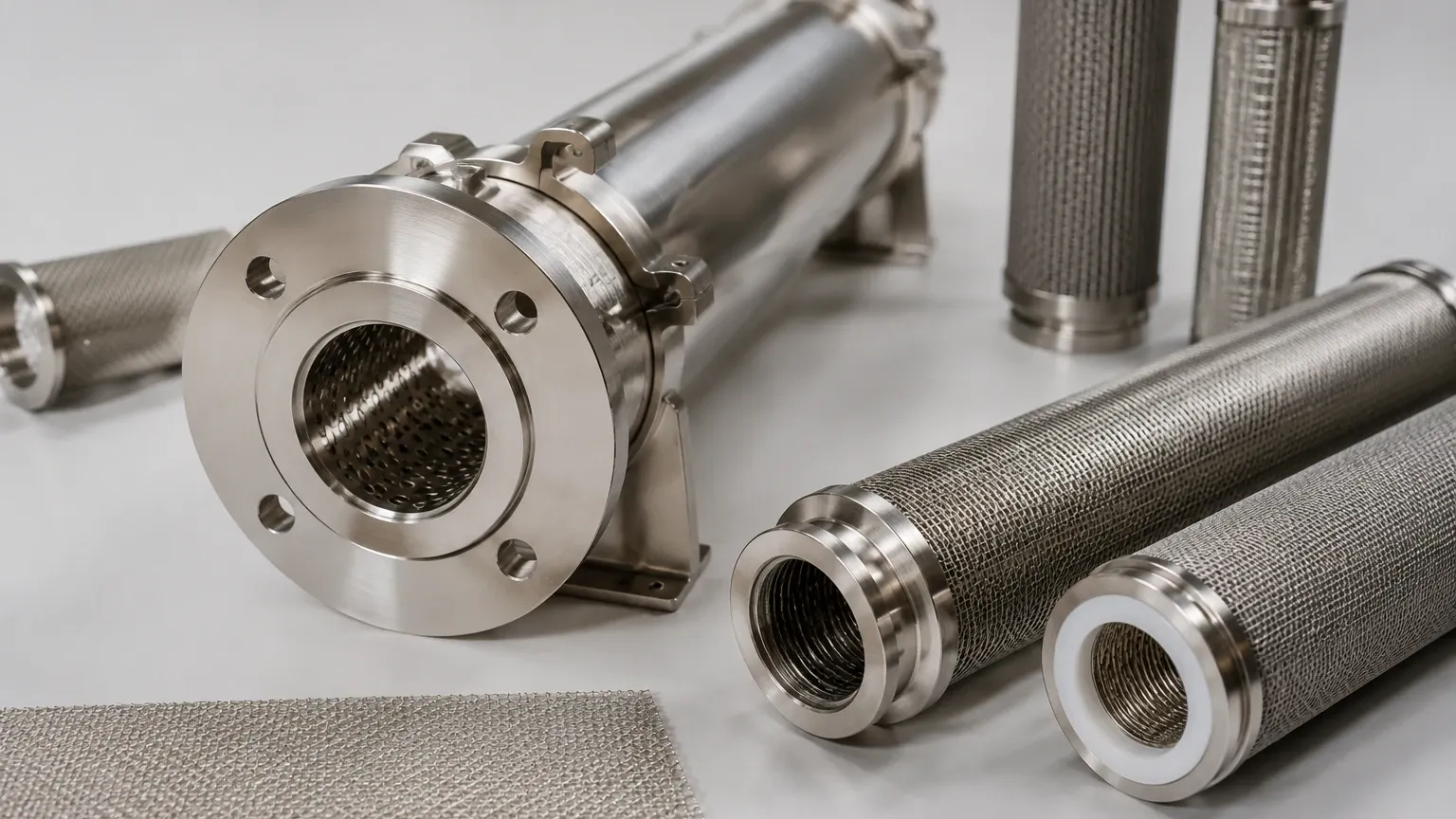
Stainless steel, particularly grades 304 and 316L, is the industry standard for TFR filtration. These materials offer exceptional resistance to corrosion from acids, alkalis, and organic solvents. In high-temperature applications, specialized alloys may be required, but for the majority of chemical processing and food-grade applications, stainless steel wire mesh or sintered metal cartridges provide the necessary durability.
Filtration Accuracy and Permeability
The choice between a coarse wire mesh and a fine sintered metal filter depends on the particle size of the catalyst or impurities. However, higher filtration accuracy often comes at the cost of increased resistance to flow. Designers must calculate the "clean pressure drop" and account for the eventual increase in pressure as the filter accumulates solids.
Mechanical Strength
In a tubular flow reactor, the filter is often subjected to high differential pressures. Sintered metal filters are particularly effective here because the sintering process bonds the metal particles or mesh layers together, creating a rigid structure that does not deform under pressure. This ensures that the filtration pore size remains constant throughout the production cycle.
Managing Catalyst Beds and Bed Supports
Many tubular flow reactors are designed as fixed-bed reactors, where the tube is packed with solid catalyst pellets. In these configurations, the filtration component serves as a bed support. The support must be strong enough to hold the weight of the catalyst and withstand the force of the fluid flow without allowing any catalyst migration.
Custom-designed stainless steel screens or perforated plates are often used for this purpose. The open area of the support must be maximized to prevent localized high-velocity zones, which can lead to catalyst attrition (the physical breaking down of catalyst particles). If the catalyst does break down, secondary fine-mesh filters downstream are necessary to capture the "fines" before they reach heat exchangers or pumps.
Maintenance, Cleaning, and Total Cost of Ownership
One of the primary benefits of using stainless steel filtration in a tubular flow reactor system is the ability to clean and reuse the components. Unlike disposable polymer filters, stainless steel cartridges can be cleaned using various methods:
* Backwashing: Reversing the flow through the filter to dislodge accumulated particles.
* Chemical Cleaning: Using solvents or acids to dissolve organic or inorganic fouling.
* Ultrasonic Cleaning: Using high-frequency sound waves in a liquid bath to remove deeply embedded contaminants from the mesh pores.
While the initial investment in stainless steel filtration is higher than that of disposable options, the total cost of ownership is significantly lower. The longevity of the material, combined with reduced downtime for filter changes and the elimination of disposal costs for contaminated filter media, makes it the more sustainable and economical choice for industrial-scale operations.
Customization for Specialized Reactor Applications
Every tubular flow reactor project has unique requirements based on the chemistry involved and the scale of production. Off-the-shelf filtration solutions rarely suffice for high-stakes industrial environments. Customization options often include:
* Tailored End Fittings: Ensuring the filter integrates seamlessly with existing piping and reactor flanges (e.g., NPT, BSP, or sanitary tri-clamp fittings).
* Layered Mesh Designs: Combining different mesh counts to create a gradient filtration effect, which increases dirt-holding capacity and extends the time between cleaning cycles.
* Reinforced Structures: Adding internal cores or external shrouds to filters that will operate under extreme pressure differentials.
By working with a manufacturer that understands the nuances of industrial filtration, engineering teams can ensure that their tubular flow reactor operates at peak efficiency with minimal risk of contamination or mechanical failure.
Conclusion: Confirming Technical Specifications
Before finalizing the design of a tubular flow reactor or purchasing replacement filtration components, technical professionals should confirm several key data points with their suppliers. These include the maximum operating temperature, the chemical composition of the process fluid, the expected flow rates, and the specific particle size distribution of any solids present.
By focusing on high-quality stainless steel components and precise engineering, companies can leverage the full potential of continuous flow chemistry, achieving higher yields and more consistent product quality. For detailed technical specifications and to explore how custom metal filtration can support your specific reactor configuration, visiting the Main Page provides a comprehensive overview of available technologies and engineering support services.
