


Vacuum Bag Housing
In industrial filtration, the vacuum bag housing serves as a critical pressure vessel designed to facilitate the removal of solids from liquid streams under negative pressure conditions. Unlike standard pressure-driven filtration systems where the fluid is pushed through the media, vacuum-based systems pull the fluid through, often placing the housing on the suction side of a pump or utilizing a dedicated vacuum source. This configuration requires specific engineering considerations regarding seal integrity, structural rigidity, and internal support to prevent component failure and ensure consistent filtration performance.
For engineers and procurement professionals, selecting a vacuum bag housing involves more than simply matching pipe sizes. It requires a deep understanding of fluid dynamics, material compatibility, and the mechanical stresses unique to vacuum environments. As a manufacturer specializing in stainless steel filtration solutions, Kaifil provides the technical expertise necessary to integrate these components into complex industrial processes, ensuring that every Main Page specification meets the rigorous demands of modern manufacturing.
Engineering Fundamentals of Vacuum Bag Housing
The primary function of a vacuum bag housing is to provide a secure, leak-proof environment where a filter bag can capture contaminants. In a vacuum application, the housing is subjected to external atmospheric pressure while the interior remains at a lower pressure. This differential creates a compressive force on the housing walls and, more importantly, requires a superior sealing mechanism to prevent the ingress of ambient air.
Structural Integrity and Material Selection
Most industrial vacuum bag housings are constructed from stainless steel, typically Grade 304 or Grade 316. The choice between these materials depends largely on the chemical nature of the fluid being processed.
* Stainless Steel 304: Suitable for general industrial water treatment, food and beverage applications, and non-corrosive chemical processing. It offers excellent durability and cost-effectiveness.
* Stainless Steel 316/316L: Preferred for pharmaceutical, marine, and highly corrosive chemical environments. The addition of molybdenum enhances resistance to pitting and crevice corrosion, particularly in chloride-rich environments.
Because vacuum housings must withstand external pressure, the wall thickness and weld quality are paramount. Engineering standards often dictate that these vessels be designed to handle full vacuum (approx. -14.7 psi or -1 bar) plus a safety margin, ensuring the vessel does not implode or deform during operation.
The Importance of the Vacuum Seal
In a positive pressure system, a small leak might result in a visible drip. In a vacuum system, a leak results in air being sucked into the process. This can lead to oxidation of the product, cavitation in downstream pumps, and a significant drop in filtration efficiency. Vacuum bag housings typically utilize high-performance O-rings or gaskets made from materials like Viton, EPDM, or Silicone. The housing cover must be precision-machined to ensure a perfectly flat mating surface, often employing heavy-duty swing bolts or V-band clamps to maintain a consistent seal under varying thermal and pressure conditions.
Key Components and Construction
A professional-grade vacuum bag housing consists of several integrated components, each playing a vital role in the filtration cycle. Understanding these components helps engineers identify potential points of failure and optimize maintenance schedules.
The Housing Body and Inlet/Outlet Configurations
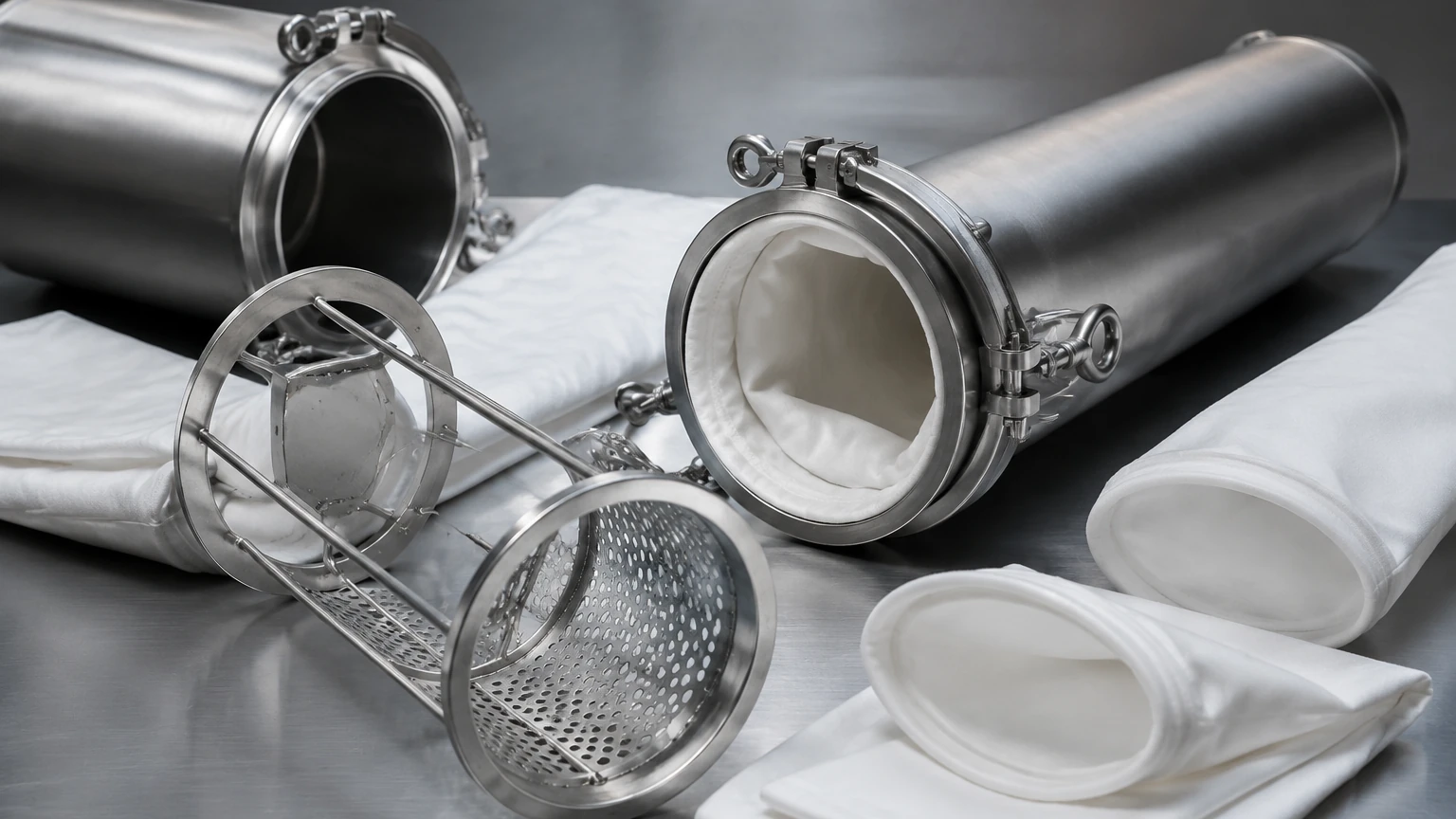
The housing body is the main cylindrical vessel. In vacuum applications, the inlet is typically located at the top or side-top, allowing the fluid to enter the filter bag from the inside out. This ensures that contaminants are trapped within the bag, making disposal and cleaning more efficient. The outlet is located at the bottom, often featuring a tangential or center-discharge design to minimize fluid holdup.
Internal Support Baskets
Because the filter bag is a flexible medium (often made of felt or mesh), it cannot withstand the force of the fluid flow alone. A vacuum bag housing must include a heavy-duty internal support basket. These baskets are usually made of perforated stainless steel or high-strength wire mesh.
At Kaifil, the design of the support basket is optimized to provide maximum open area, which reduces the initial pressure drop across the system. If the basket is poorly designed, it can create flow restrictions or, in extreme cases, allow the filter bag to stretch and burst under high vacuum loads. For precision applications, these baskets can be custom-engineered with specific hole patterns or mesh linings to support ultra-fine filter bags.
Cover and Venting Mechanisms
The cover of the vacuum bag housing must be easy to remove for bag changes but robust enough to maintain a vacuum seal. Many industrial designs feature a "low-profile" or "easy-access" lid. Crucially, every vacuum housing should be equipped with a vent valve. Before opening the housing for maintenance, the vacuum must be broken and the internal pressure equalized with the atmosphere. Attempting to open a vessel under vacuum is not only difficult but poses a significant safety risk to operators.
Selection Criteria for Industrial Applications
When specifying a vacuum bag housing for a project, several technical parameters must be evaluated to ensure the equipment is fit for purpose. Engineers should consider the following factors:
Flow Rate and Viscosity
The flow rate (measured in GPM or m³/h) determines the size of the housing. However, fluid viscosity plays a massive role in sizing. High-viscosity fluids (like resins, syrups, or heavy oils) require larger housings and coarser filter media to maintain an acceptable flow rate under vacuum. If the flow velocity is too high, it can cause premature clogging of the filter bag or excessive turbulence, which may bypass the seal.
Micron Rating and Filtration Efficiency
The target particle size for removal dictates the type of filter bag used within the housing. Vacuum systems are commonly used for coarse to medium filtration (1 micron to 1000 microns). If the application requires sub-micron filtration, the vacuum bag housing may serve as a pre-filter to protect more expensive downstream membrane filters or UV sterilizers.
Chemical Compatibility
Beyond the housing material, all internal components—including the support basket and seals—must be compatible with the process fluid. For example, in the chemical processing of solvents, Viton seals are often required due to their high chemical resistance, whereas EPDM might be sufficient for water-based food applications. Referencing a chemical resistance chart is a mandatory step in the procurement process.
Performance Optimization and Maintenance
To achieve the lowest total cost of ownership (TCO), a vacuum bag housing must be operated and maintained correctly. Neglecting maintenance not only degrades product quality but can also lead to pump damage.
Monitoring Differential Pressure
The most effective way to monitor the performance of a vacuum bag housing is by measuring the differential pressure ($ΔP$) between the inlet and outlet. As the filter bag collects solids, the resistance to flow increases, causing the vacuum level on the outlet side to increase (or the flow rate to drop).
Industrial housings should be fitted with vacuum gauges or electronic pressure transducers. A common rule of thumb is to replace or clean the filter bag when the differential pressure reaches 15–20 psi (1.0–1.4 bar), although this varies by bag material and process sensitivity. Operating beyond the recommended $ΔP$ can cause "blow-through," where particles are forced through the filter media, or even structural failure of the bag.
Cleaning and Sterilization
In industries like food, beverage, and pharmaceuticals, the vacuum bag housing must be cleaned regularly to prevent bacterial growth. Stainless steel housings are ideal for these environments because they can be polished to a high degree (Ra < 0.8 µm) and are compatible with Clean-In-Place (CIP) and Steam-In-Place (SIP) protocols. Ensuring there are no "dead legs" in the housing design—areas where fluid can stagnate—is essential for maintaining sanitary standards.
Common Risks and Engineering Solutions
Operating a vacuum bag housing involves specific risks that differ from standard pressure filtration. Addressing these risks during the design phase prevents costly downtime.
1. Air Ingress: As mentioned, the most common issue in vacuum systems is a compromised seal. Regular inspection of O-rings and the use of high-quality lubricants (where permitted) can mitigate this.
2. Bag Collapse: If the support basket is not properly seated or if the bag is the wrong size for the housing, the vacuum can pull the bag into the outlet piping. Using precision-manufactured baskets and bags with rigid collars (such as plastic flanges or steel rings) ensures a secure fit.
3. Pump Cavitation: If the vacuum bag housing becomes severely clogged, the downstream pump may experience cavitation due to a lack of fluid. Installing a low-pressure alarm or an automated bypass valve can protect expensive pumping equipment.
Customization and OEM Capabilities
Every industrial facility has unique spatial and process constraints. Standard off-the-shelf housings may not always fit the footprint or the specific flow requirements of a new production line. This is where custom manufacturing becomes a strategic advantage.
Kaifil works closely with engineering teams to develop customized vacuum bag housings that include:
* Multi-Bag Configurations: For high-flow applications, multiple bags can be housed in a single large vessel, allowing for higher solids loading and longer intervals between changes.
* Heating Jackets: For fluids that must be kept at a specific temperature to maintain low viscosity (such as waxes or food fats), steam or electric heating jackets can be integrated into the housing wall.
* Specialty Connections: While NPT or Flanged connections are standard, many processes require Tri-Clamp, Camlock, or proprietary fittings to match existing piping.
* Surface Treatments: Depending on the application, housings can be bead-blasted, passivated, or electropolished to meet specific aesthetic or functional requirements.
Conclusion: Making Informed Purchasing Decisions
The vacuum bag housing is a fundamental component in the industrial filtration landscape. Its ability to operate on the suction side of a process makes it indispensable for specific chemical, pharmaceutical, and food processing tasks. However, the technical nuances of vacuum operation—ranging from seal integrity to structural reinforcement—demand a high level of engineering precision.
When evaluating suppliers, engineers should look for manufacturers who provide comprehensive technical data, material certifications, and the ability to customize designs to meet specific application needs. By focusing on quality materials, robust construction, and proper maintenance, organizations can ensure efficient filtration, protect downstream equipment, and maintain the highest standards of product purity. For more information on custom stainless steel filtration components and housing options, technical teams are encouraged to review the available engineering resources and Main Page product specifications to find the optimal solution for their filtration challenges.
