


3 32 Perforated Metal
In industrial filtration and precision screening, the specification of aperture size is critical to the performance of the entire system. Among the various standard sizes available, 3/32" (0.09375 inch) perforated metal occupies a vital middle ground. It is frequently selected for applications where 1/16" perforations might cause excessive pressure drop and 1/8" holes are too large to provide the necessary particle retention.
Understanding the technical nuances of 3 32 perforated metal—including its open area percentages, material compatibility, and structural limitations—is essential for engineers and procurement specialists looking to optimize fluid dynamics or mechanical sorting processes. As a specialized manufacturer, Kaifil provides these components as part of a broader portfolio of Perforated & Expanded Metal solutions designed for demanding industrial environments.
Technical Specifications and Geometry of 3/32" Perforations
When specifying 3 32 perforated metal, the hole diameter is only the first of several variables that define the material’s performance. Engineers must also consider the arrangement of the holes and the distance between them, known as the pitch.
Hole Patterns: Staggered vs. Straight
The most common configuration for 3/32" holes is the 60-degree staggered pattern. This arrangement is preferred in industrial settings because it provides the highest structural integrity while maximizing the open area. In a staggered pattern, the holes are offset, ensuring that the "bridges" (the metal remaining between the holes) are uniform in all directions. This prevents the sheet from developing weak points that could lead to tearing under pressure.
Straight-row patterns are also available but are generally reserved for aesthetic applications or specific mechanical tracks where alignment with an external component is necessary. For filtration and ventilation, the staggered pattern is the industry standard.
Calculating Open Area
The open area is the percentage of the sheet that is comprised of holes versus solid metal. For 3/32" perforations, a common specification is a 5/32" staggered pitch. This configuration yields an open area of approximately 33%.
If an application requires higher flow rates, the pitch can be tightened (e.g., 1/8" staggered pitch), which increases the open area but reduces the structural strength of the sheet. Conversely, widening the pitch increases the "bridge" size, making the material more rigid but increasing the resistance to fluid or airflow.
Material Selection for Industrial Environments
The choice of base metal determines the longevity and chemical resistance of the perforated component. Because 3/32" holes are often used in liquid filtration and food processing, material selection is paramount.
Stainless Steel (304 and 316L)
Stainless steel is the primary choice for most B2B applications involving 3 32 perforated metal.
* Grade 304: Suitable for general-purpose use, offering excellent strength and basic corrosion resistance. It is commonly used in HVAC grilles, protective guards, and dry food sorting.
* Grade 316L: Essential for chemical processing, marine environments, and pharmaceutical applications. The addition of molybdenum provides superior resistance to chlorides and pitting. Kaifil specializes in 316L components to ensure durability in acidic or high-salinity conditions.
Aluminum and Carbon Steel
For weight-sensitive applications, such as aerospace or high-end electronics housing, aluminum (typically 3003-H14 or 5052-H32) is utilized. It offers a high strength-to-weight ratio and natural atmospheric corrosion resistance. Carbon steel is a cost-effective alternative for indoor applications where the metal will be painted or powder-coated to prevent oxidation.
Key Applications for 3/32" Perforated Metal
Due to its specific aperture size, 3 32 perforated metal is a staple in several critical industrial sectors.
1. Industrial Filtration and Strainers
In hydraulic systems and water treatment, 3/32" perforated sheets often serve as the "support core" or the primary straining element. It is large enough to allow high volumes of fluid to pass through while effectively capturing larger debris that could damage sensitive downstream pumps or fine mesh filters.
2. Food and Beverage Processing
This size is ideal for sifting and grading seeds, grains, and small legumes. In the malting process for breweries, 3/32" perforations are used in kiln floors to allow heat to rise through the grain bed while preventing the seeds from falling through the floor.
3. Acoustic Dampening
When used in conjunction with acoustic insulation materials, perforated metal acts as a transparent face that allows sound waves to pass through the holes and be absorbed by the media behind it. The 3/32" hole size provides a professional aesthetic while maintaining the necessary transparency for mid-range sound frequencies.
4. Electronic Shielding and Ventilation
In server racks and high-power electrical enclosures, 3/32" holes provide a balance between EMI (Electromagnetic Interference) shielding and airflow. The small hole size prevents most environmental debris from entering the cabinet while allowing heat to dissipate through convection.
Engineering Considerations: The 1-to-1 Rule
A common challenge in the manufacturing of perforated metal is the relationship between the hole diameter and the material thickness. In the industry, this is often referred to as the "1-to-1 Rule."
For 3 32 perforated metal, the hole diameter is 0.09375". Ideally, the thickness of the metal sheet should not exceed this diameter. Punching 3/32" holes into 1/8" (0.125") thick stainless steel is technically difficult and often leads to frequent tool breakage and excessive burring. If an application requires a 3/32" aperture in a very thick plate for structural reasons, laser cutting or waterjet cutting may be required, though these processes are significantly more expensive than high-speed CNC punching.
For most standard applications, 3/32" holes are punched into 11-gauge to 22-gauge materials. Staying within these parameters ensures a clean cut, minimal distortion, and a more cost-effective production cycle.
Customization and Secondary Operations
Purchasing 3 32 perforated metal for an industrial project rarely involves just the flat sheet. Most OEM requirements involve secondary processing to integrate the component into a larger assembly.
Margins and Unfinished Edges
Standard stock sheets often have "minimal margins," meaning the perforations run close to the edge. However, for parts that need to be welded into a frame, engineers should specify "safe margins." This leaves a solid border of metal around the perimeter, which facilitates easier welding and provides a cleaner finish.
Forming and Rolling
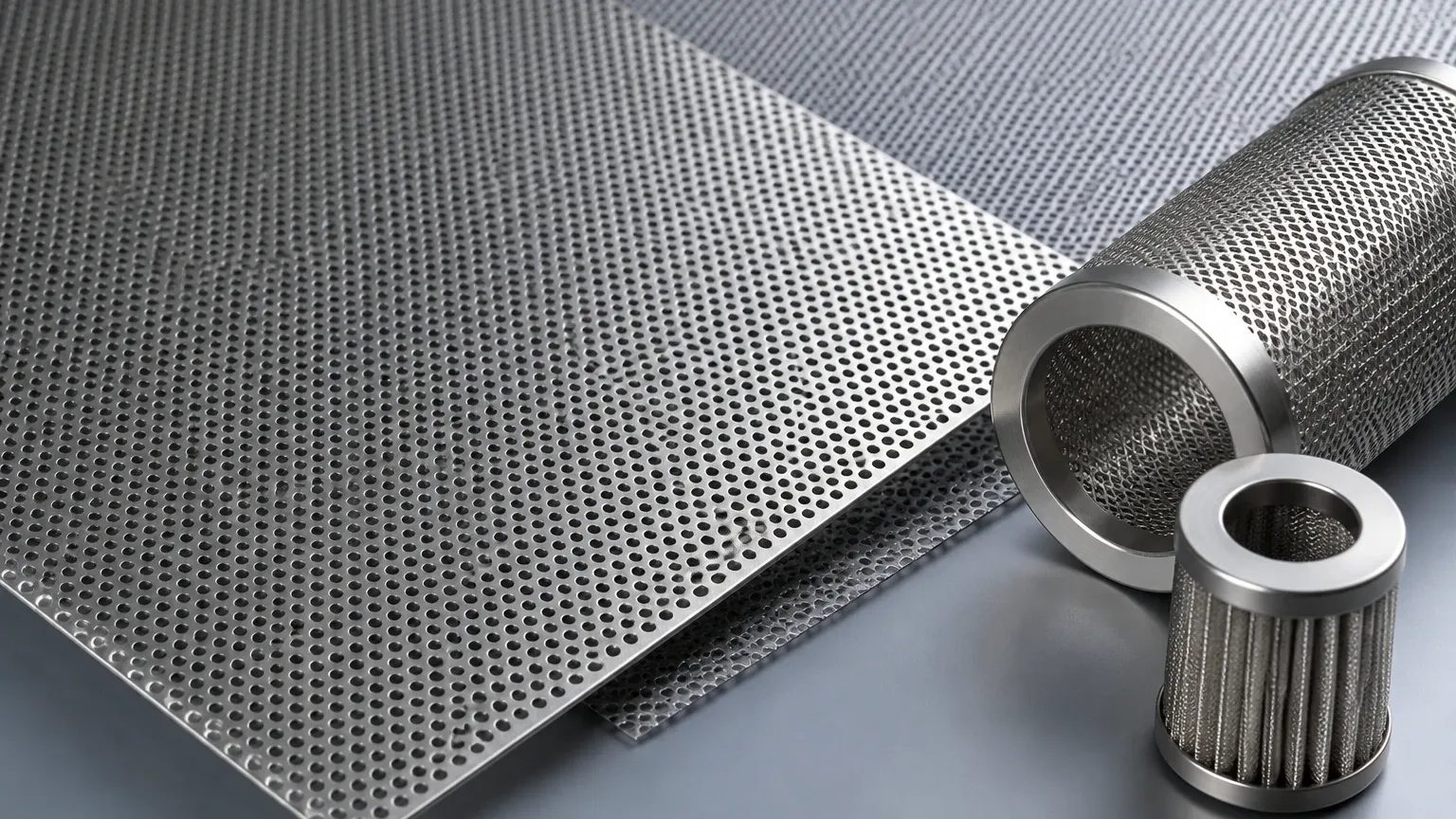
Perforated sheets are frequently rolled into cylinders to create filter cartridges or protective sleeves. When rolling 3/32" perforated metal, the direction of the stagger (parallel or perpendicular to the length of the sheet) affects how the metal bends. Professional manufacturers like Kaifil ensure that the rolling process does not distort the hole geometry, which is critical for maintaining consistent filtration accuracy.
Degreasing and Deburring
The punching process involves lubricants and can leave small metal burrs on the "exit" side of the hole. For pharmaceutical or food-grade applications, the material must undergo ultrasonic cleaning and mechanical deburring to ensure no contaminants or sharp edges remain.
Quality Evaluation: What to Confirm Before Purchase
To avoid project delays or performance failures, technical buyers should confirm the following details with their supplier:
1. Material Certification: Ensure the supplier can provide Mill Test Reports (MTRs) to verify the chemical composition of the stainless steel, especially for 316L requirements.
2. Flatness Tolerances: The punching process introduces internal stresses that can cause the sheet to curl. Confirm that the material will be leveled after perforation to meet flatness specifications.
3. Hole Accuracy: In precision screening, even a small deviation in hole diameter can alter the results. Verify the tolerance levels (standard industry tolerance is typically +/- 0.005").
4. Burr Direction: If the sheet is being used as a guard or a hand-contact surface, specify which side the burrs should be on or request a tumbled finish.
Conclusion
3 32 perforated metal is a versatile and robust solution for a wide range of industrial challenges, from high-flow liquid straining to acoustic management. By understanding the relationship between pitch, open area, and the 1-to-1 rule, engineers can specify components that are both functional and manufacturable.
As a dedicated manufacturer of industrial filtration components, Kaifil provides the technical expertise necessary to move from initial specification to high-volume production. Whether your project requires standard sheets or custom-formed Perforated & Expanded Metal cartridges, focusing on material integrity and precise geometry is the key to long-term operational success.
