


4 X 8 Perforated Metal
In the landscape of industrial fabrication and filtration, the 4 x 8 perforated metal sheet stands as a foundational component. Measuring 48 inches by 96 inches, this standard dimension is widely adopted across chemical processing, food and beverage, and pharmaceutical sectors due to its compatibility with standard material handling equipment and modular design frameworks. As a critical element in both structural and filtration applications, understanding the technical nuances of Perforated & Expanded Metal is essential for engineers and procurement teams tasked with optimizing system performance and durability.
Selecting the right 4 x 8 perforated metal involves more than choosing a hole size; it requires a comprehensive evaluation of material properties, geometric patterns, and the specific demands of the operating environment. This guide examines the engineering considerations that govern the selection and application of these versatile metal sheets.
Understanding the 4 x 8 Perforated Metal Standard in Industrial Applications
The 4 x 8 format is the industry standard for sheet metal for several logistical and engineering reasons. For manufacturers like Kaifil, producing 4 x 8 perforated metal allows for high-volume efficiency while providing a manageable size for secondary processes such as rolling, welding, or CNC forming. In filtration, these sheets are frequently used as the primary substrate for large-scale strainers or as the structural support core for finer wire mesh cartridges.
When specifying a 4 x 8 sheet, engineers must consider the "margins." Margins are the unperforated areas along the edges of the sheet. In a standard 4 x 8 sheet, the perforated area might not cover the entire surface to allow for easier welding or mounting into a frame. Specifying "minimum margins" or "no margins" (finished-end patterns) is a critical step in the procurement process to ensure the sheet fits the intended housing without requiring excessive post-production trimming.
Material Selection for Perforated & Expanded Metal
The performance of a 4 x 8 perforated metal sheet is largely dictated by its metallurgy. While carbon steel and aluminum are common, stainless steel remains the preferred choice for demanding industrial filtration and processing environments.
Stainless Steel (304 and 316 Grades)
Stainless steel is the hallmark of Kaifil’s filtration solutions. Grade 304 offers excellent corrosion resistance and is suitable for most food processing and general industrial applications. However, for environments involving chlorides or high-salinity solutions—common in chemical processing and marine applications—Grade 316 is specified due to its molybdenum content, which provides superior pitting resistance.
Carbon Steel and Galvanized Options
For structural applications where corrosion is less of a concern or where the environment is controlled, carbon steel provides a cost-effective, high-strength alternative. Galvanized 4 x 8 perforated metal adds a layer of zinc protection, extending the lifecycle of the component in outdoor or humid industrial settings.
Aluminum
Aluminum is selected when weight reduction is a priority. It offers a high strength-to-weight ratio and natural atmospheric corrosion resistance, making it ideal for architectural filtration covers or lightweight machinery guards.
Technical Specifications: Patterns, Open Area, and Pitch
The functionality of 4 x 8 perforated metal is defined by its hole geometry. The arrangement of these holes determines the sheet's "open area," which directly impacts flow rates, pressure drop, and structural integrity.
Hole Shapes and Arrangements
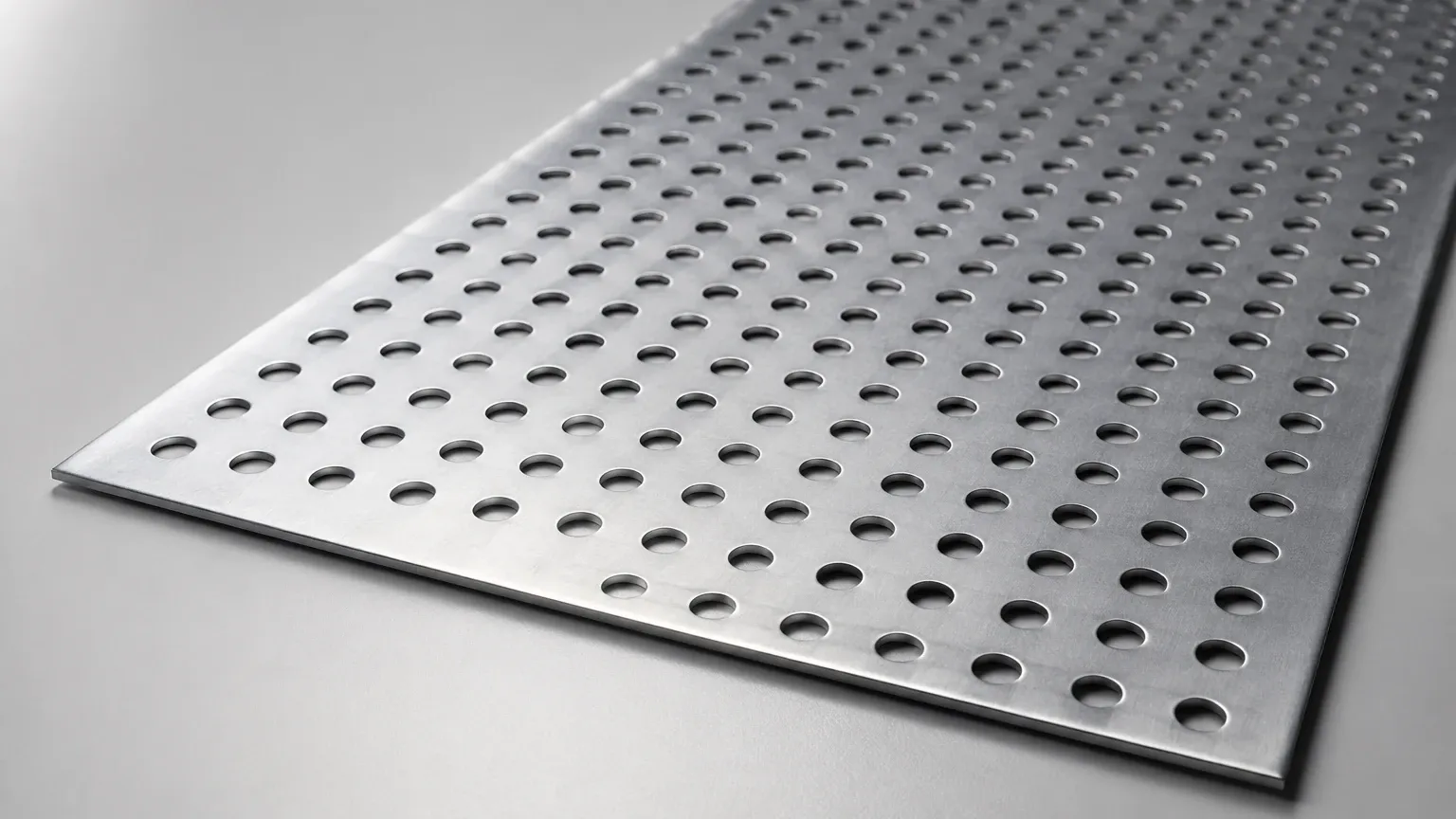
* Round Holes: The most common and efficient pattern for filtration. Round holes offer the best balance of structural strength and ease of cleaning. They are typically arranged in a 60-degree staggered pattern, which maximizes the number of holes per square inch.
* Square Holes: Often used when a higher open area is required for airflow or visibility. However, square holes can create stress concentrations at the corners, making them less ideal for high-pressure hydraulic applications.
* Slotted Holes: Frequently used in sorting and sifting applications where the shape of the media (such as grain or chemical pellets) requires a specific orientation for passage.
Calculating Open Area
The percentage of open area is a vital metric for engineers. For a 60-degree staggered round hole pattern, the formula is:
Open Area % = (D² × 90.69) / P²
Where *D* is the hole diameter and *P* is the pitch (the distance from the center of one hole to the center of the adjacent hole). In a 4 x 8 perforated metal sheet, maintaining a consistent open area across the entire 32-square-foot surface is essential for ensuring uniform flow in large-scale filtration systems.
Engineering Considerations for Filtration and Structural Support
When integrating 4 x 8 perforated metal into an industrial system, engineers must account for the mechanical stresses the sheet will encounter.
The One-to-One Rule
A fundamental rule in perforation engineering is that the hole diameter should generally not be smaller than the material thickness. For example, if a 4 x 8 sheet is 1/8 inch thick, the holes should ideally be 1/8 inch or larger. Attempting to punch holes smaller than the material thickness increases the risk of tool breakage and can lead to internal stresses that cause the sheet to warp or lose flatness.
Pressure Drop and Flow Resistance
In filtration, the perforated metal often acts as a "coarse" filter or a support for a "fine" wire mesh. The 4 x 8 sheet must be engineered to handle the maximum expected differential pressure ($ΔP$). If the open area is too low, the velocity of the fluid increases, leading to higher turbulence and potential erosion of the filter media. Conversely, if the open area is too high, the structural rigidity of the sheet may be compromised, leading to collapse under pressure.
Flatness and Deburring
During the punching process, the metal is subjected to significant force, which can cause the sheet to bow. High-quality 4 x 8 perforated metal undergoes a leveling process to restore flatness. Additionally, the punching process leaves "burrs" on the exit side of the hole. For pharmaceutical and food-grade applications, Kaifil ensures rigorous deburring and polishing to prevent contaminant entrapment and ensure the safety of the process stream.
Customization and OEM Solutions for 4 x 8 Perforated Metal
While standard 4 x 8 sheets are available, most industrial applications require some level of customization. Kaifil specializes in tailoring Perforated & Expanded Metal to meet specific OEM requirements.
Custom Perforation Patterns
Beyond standard round and square holes, CNC technology allows for complex patterns, including varying hole sizes across a single sheet to manage flow distribution. This is particularly useful in large-scale heat exchangers or chemical reactors where flow must be balanced across a wide surface area.
Secondary Fabrication
A 4 x 8 sheet is rarely used in its flat, raw state. Kaifil provides comprehensive fabrication services, including:
* Shearing and Notching: Cutting the 4 x 8 sheet into precise smaller components.
* Rolling: Forming the sheet into cylinders for use as filter cores or intake screens.
* Welding: Utilizing TIG, MIG, or spot welding to integrate the perforated metal into larger assemblies.
* Surface Finishing: Including electropolishing, pickling, and powder coating to enhance corrosion resistance and aesthetic appeal.
Procurement and Quality Control Benchmarks
For purchasing teams, procuring 4 x 8 perforated metal requires a clear checklist to ensure the delivered product meets engineering specifications. When requesting a quote, the following data points should be confirmed:
1. Material Grade: (e.g., SS316L, SS304, Carbon Steel).
2. Thickness/Gauge: Expressed in inches or standard gauge numbers.
3. Hole Size and Shape: Diameter for round holes, dimensions for square or slotted.
4. Pattern/Pitch: Staggered or straight-line centers.
5. Margins: Specific dimensions for unperforated borders on all four sides.
6. Flatness Requirements: Standard mill flatness or precision leveled.
7. Quantity: Number of 4 x 8 sheets or the number of finished parts derived from them.
Common Risks in Procurement
The most common risk in purchasing 4 x 8 perforated metal is the "oil-canning" effect, where the center of the sheet bulges due to internal stresses. This is often a result of improper leveling or an aggressive perforation-to-margin ratio. Working with an experienced manufacturer like Kaifil ensures that these stresses are managed during the production cycle, resulting in a flat, dimensionally stable product.
Conclusion: Selecting the Right Partner for Metal Filtration
The 4 x 8 perforated metal sheet is a versatile and indispensable tool in the industrial engineer's arsenal. Whether it is serving as a high-strength floor grating, a protective machine guard, or a precision-engineered filter support, its performance is a direct result of material quality and manufacturing precision.
By focusing on technical specifications such as open area, material grade, and the "one-to-one" rule, engineers can ensure their systems operate efficiently with minimal downtime. Kaifil’s expertise in stainless steel fabrication and custom filtration solutions makes them a reliable partner for those requiring high-performance Perforated & Expanded Metal tailored to the most demanding industrial environments. When specifying your next project, confirming these technical details will lead to a more durable, cost-effective, and efficient filtration or structural solution.
