


#9 Expanded Metal 4×8
In industrial fabrication and filtration engineering, the selection of structural media requires a precise balance between mechanical strength, open area, and material longevity. Among the various specifications available, #9 expanded metal 4×8 stands as a heavy-duty standard for applications ranging from security partitions and machine guarding to high-pressure filtration support. Understanding the technical nuances of this specific gauge and sheet size is essential for engineers and procurement teams who must ensure that the material meets the rigorous demands of chemical processing, water treatment, and industrial manufacturing.
Expanded metal is produced by simultaneously slitting and stretching a solid metal sheet, creating a diamond-shaped pattern without the material waste associated with traditional punching processes. The "#9" designation refers to the gauge of the base metal—approximately 0.134 inches thick for carbon steel—while "4×8" denotes the standard sheet dimensions of 4 feet by 8 feet. This guide examines the engineering characteristics, material considerations, and application criteria for #9 expanded metal in professional B2B environments.
Understanding the Technical Specifications of #9 Expanded Metal
When specifying expanded metal, simple dimensional measurements are insufficient. Engineers must define the geometry of the diamond openings and the condition of the metal surface. The #9 gauge is a robust choice, providing significant rigidity compared to lighter #13 or #18 gauges.
Diamond Geometry: SWD and LWD
The performance of a 4×8 sheet is dictated by the Short Way of Design (SWD) and the Long Way of Design (LWD).
* SWD: The distance from the center of one bond to the center of the next bond across the short axis of the diamond.
* LWD: The distance across the long axis of the diamond.
For #9 expanded metal, the most common opening size is 3/4 inch. A "3/4 #9" specification indicates an SWD of approximately 0.923 inches and an LWD of 2.0 inches. The orientation of these diamonds relative to the 4×8 dimensions is critical for load-bearing applications; typically, the LWD runs parallel to the length of the sheet (the 8-foot side) unless otherwise specified.
Raised vs. Flattened Profiles
#9 expanded metal is available in two primary forms:
1. Standard (Raised): The strands are set at a sharp angle to the plane of the sheet. This provides maximum rigidity and a slip-resistant surface, making it ideal for industrial walkways or heavy-duty filtration cages where turbulence is desired.
2. Flattened: The raised metal is passed through a cold-rolling reducing mill, which flattens the strands and bonds into a single plane. This reduces the overall thickness and creates a smooth surface, which is often necessary when the metal serves as a support for finer wire mesh or when it must be safely handled by personnel.
Material Selection: Stainless Steel vs. Carbon Steel for Industrial Use
While #9 expanded metal is widely available in carbon steel, industrial environments often necessitate the use of stainless steel to combat corrosion and maintain structural integrity over long service cycles. At Kaifil, the focus is frequently on stainless steel alloys due to their performance in demanding sectors like food processing and chemical filtration.
304 Stainless Steel
Grade 304 is the most common stainless steel for expanded metal. It offers excellent resistance to atmospheric corrosion and many organic and inorganic chemicals. For a #9 expanded metal 4×8 sheet, 304 stainless provides a high strength-to-weight ratio and is easily welded into larger assemblies.
316 Stainless Steel
In environments involving chlorides, high salinity, or aggressive acids (such as marine or pharmaceutical applications), 316 stainless steel is the preferred choice. The addition of molybdenum enhances pitting resistance. When used in filtration, #9 expanded 316 stainless steel acts as a durable outer guard for filter cartridges that must withstand frequent chemical cleaning or high-pressure backwashing.
Carbon Steel and Galvanized Options
For structural applications where corrosion is less of a concern, or where the material will be painted or powder-coated, carbon steel is a cost-effective alternative. Hot-dipped galvanized #9 expanded metal is also common for outdoor security fencing, providing a thick layer of zinc protection against oxidation.
Structural Integrity and Load-Bearing Capabilities
One of the primary reasons engineers specify #9 expanded metal 4×8 is its inherent strength. Unlike woven wire mesh, expanded metal is a single piece of material; there are no joints or welds to fail under stress. The "bonds" (where the strands intersect) provide a bridge-like structure that distributes weight efficiently.
Load Tables and Deflection
For industrial walkways or platforms, the #9 gauge (standard raised) can support significant point loads. However, deflection must be calculated based on the span between supports. A 4-foot wide sheet typically requires support every 24 to 36 inches depending on the anticipated weight. Because the stretching process work-hardens the metal, expanded steel often exhibits a higher yield strength than the original flat sheet from which it was made.
Impact Resistance
In machine guarding, #9 expanded metal is thick enough to resist impact from debris or accidental contact with heavy equipment. The 4×8 sheet size allows for large, seamless protective panels that minimize the number of attachment points, thereby reducing labor costs during installation.
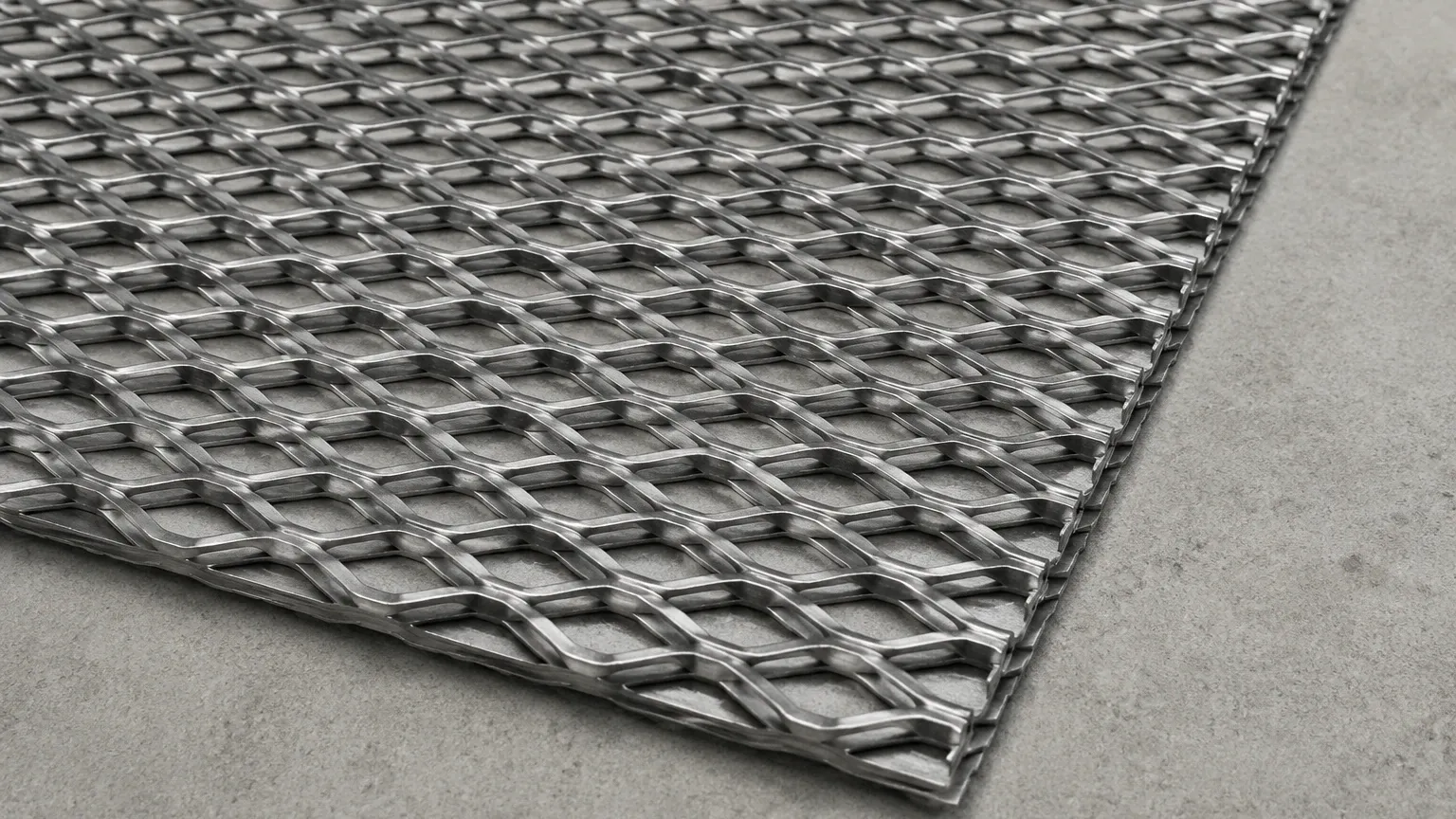
Comparing Perforated & Expanded Metal for Filtration Support
In the context of industrial filtration, choosing between Perforated & Expanded Metal is a common engineering crossroad. Both materials serve as essential support structures for pleated media or fine wire cloth, but they offer different performance profiles.
* Material Efficiency: Expanded metal is generally more economical because the manufacturing process involves stretching rather than punching out holes. This means there is zero scrap loss, which is particularly beneficial when using expensive alloys like 316L stainless steel.
* Flow Dynamics: Expanded metal creates more turbulence than perforated metal due to the angled strands of the raised variety. In certain chemical mixing or filtration applications, this turbulence can be advantageous. However, if a laminar flow is required, perforated metal with a high open area may be superior.
* Open Area Consistency: Perforated metal allows for highly precise open area percentages (e.g., exactly 40% or 60%). While #9 expanded metal provides a high open area (typically around 60-80% for 3/4" openings), the geometry is fixed by the expansion ratio.
For heavy-duty industrial cartridges, #9 expanded metal is often used as the outer cage because its structural rigidity protects the internal filter media from mechanical damage during handling and operation.
Key Engineering Considerations for 4×8 Sheet Integration
Integrating a #9 expanded metal 4×8 sheet into a larger system requires attention to edge conditions and tolerances. Because the material is expanded, the edges can be "open" (randomly cut diamonds) or "closed" (a solid border).
Edge Treatment and Safety
Raw expanded metal edges are extremely sharp. In B2B applications where the sheets are used for partitions or guards, specifying a U-edging (a C-channel trim) is standard practice. This not only protects personnel but also adds additional perimeter stiffness to the 4×8 panel.
Welding and Fabrication
Welding #9 gauge stainless steel requires expertise to avoid warping, especially with flattened expanded metal. TIG (Tungsten Inert Gas) welding is preferred for stainless steel filtration components to ensure clean, slag-free joints that meet hygienic standards in food and beverage or pharmaceutical applications.
Weight Considerations
A standard 4×8 sheet of #9 raised carbon steel expanded metal weighs approximately 58 to 60 pounds (approx. 1.8 lbs per square foot). Stainless steel versions will have a similar weight profile. This weight must be factored into the design of support frames and the ergonomics of manual installation.
Procurement and Quality Assurance Standards
When ordering #9 expanded metal 4×8, purchasing teams should confirm that the material adheres to industrial standards such as EMMA (Expanded Metal Manufacturers Association) or ASTM F1267. These standards define the allowable tolerances for thickness, strand width, and diamond size.
Verification Checklist for Engineers:
1. Material Grade: Confirm if 304, 316, or carbon steel is required based on the chemical environment.
2. Style: Specify "Standard" for maximum strength or "Flattened" for a smooth surface.
3. Opening Size: Confirm the SWD and LWD (e.g., 3/4" #9 vs. 1-1/2" #9).
4. Direction of Diamond: Ensure the LWD is oriented correctly for the intended load direction.
5. Surface Finish: Determine if the material requires passivation (for stainless), galvanizing (for carbon steel), or is to be left mill-finish.
By focusing on these technical parameters, engineers can ensure that the #9 expanded metal they integrate into their projects provides the necessary durability and performance. Whether used as a robust support for complex filtration systems or as a structural component in industrial facilities, the #9 gauge remains a versatile and reliable choice for modern engineering challenges.
