


Amico Perforated Metal
In the landscape of industrial materials, perforated and expanded metals serve as foundational components for a vast array of applications, ranging from architectural facades to high-precision filtration systems. Among the industry standards often cited by engineers and procurement specialists is Amico perforated metal, a product line synonymous with the Alabama Metal Industries Corporation (AMICO). For technical professionals tasked with selecting the right media for industrial processes, understanding the specifications, manufacturing nuances, and performance boundaries of these materials is essential for ensuring operational efficiency and long-term durability.
Selecting the appropriate metal configuration requires more than a cursory glance at a catalog. It involves a deep dive into metallurgy, hole geometry, open area calculations, and the specific environmental stressors of the application. Whether the goal is to provide structural support in a hydraulic system or to act as a primary screening layer in a chemical processing plant, the choice between standard inventory and custom-engineered solutions remains a critical decision point.
Technical Specifications of Perforated & Expanded Metal
When evaluating Perforated & Expanded Metal, the first consideration is the manufacturing method and the resulting physical properties. Perforated metal is created through a cold-punching process where a series of holes are mechanically pressed into a solid sheet. This allows for precise control over hole diameter, spacing, and pattern.
Hole Patterns and Geometry
Industrial applications typically utilize three primary hole patterns:
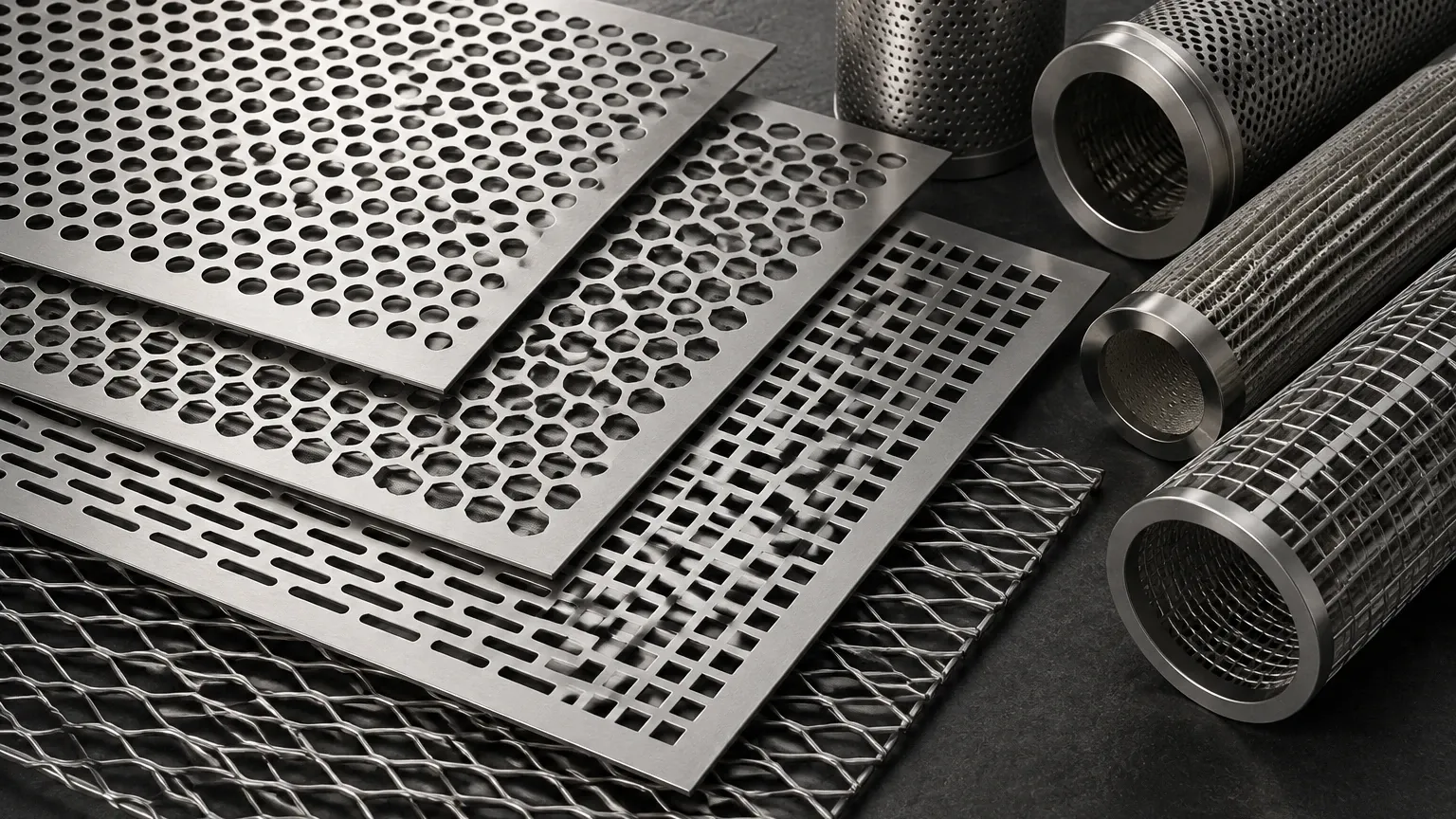
1. Staggered Patterns: Usually set at 60-degree angles, this is the most popular configuration because it offers high open area and inherent structural strength. It provides a uniform flow for air or liquids, making it ideal for filtration.
2. Straight Patterns: Holes are aligned in parallel rows and columns. While aesthetically pleasing and useful for certain sorting tasks, straight patterns generally offer lower structural integrity than staggered ones under heavy loads.
3. Specialty Shapes: Beyond round holes, manufacturers can produce square, slotted, hexagonal, and decorative shapes. Slotted holes are particularly effective for vibrating screens and sieving applications where elongated particles must be oriented or blocked.
Expanded Metal vs. Perforated Metal
Unlike perforated metal, expanded metal is produced by simultaneously slitting and stretching the material. This process creates diamond-shaped openings and results in no material waste, as the metal is expanded rather than punched out. While expanded metal is excellent for walkways, security partitions, and coarse pre-filtration, perforated metal remains the preferred choice for high-precision industrial filtration due to the exactness of the hole dimensions.
Material Selection and Corrosion Resistance
The performance of Amico perforated metal or any industrial-grade metal component is heavily dependent on the alloy selected. In B2B environments where chemical exposure, high temperatures, or moisture are present, material selection is the primary factor in determining the total cost of ownership.
* Stainless Steel (304 and 316L): This is the gold standard for filtration. Grade 304 offers excellent corrosion resistance for general industrial use, while Grade 316L contains molybdenum, providing superior resistance to chlorides and pitting, which is essential in marine or chemical processing environments.
* Carbon Steel: Frequently used in dry environments or where the material can be coated (galvanized or powder-coated). It offers high strength at a lower price point but lacks the inherent longevity of stainless steel in corrosive settings.
* Aluminum: Chosen for its high strength-to-weight ratio and natural resistance to atmospheric corrosion. It is common in architectural and aerospace applications but may lack the hardness required for abrasive filtration media.
Evaluating Performance for Industrial Filtration
For engineers focusing on filtration and fluid dynamics, the most critical metric is the "Percentage of Open Area." This figure determines the flow capacity and the pressure drop across the media.
Calculating Open Area
The formula for a 60-degree staggered round hole pattern is:
`Percent Open Area = (D² × 90.69) / P²`
*(Where D = Hole Diameter and P = Center-to-Center Pitch)*
A higher open area reduces the resistance to flow but can compromise the structural rigidity of the sheet. In high-pressure hydraulic or water treatment applications, the perforated metal often acts as a support core for finer wire mesh layers. In these cases, the perforated sheet must be thick enough to resist collapsing under the differential pressure, while the holes must be spaced to provide maximum support to the mesh.
The Rule of Thumb: Hole Size vs. Thickness
A critical engineering constraint in perforated metal production is the relationship between the hole diameter and the material thickness. Generally, the hole diameter should not be less than the thickness of the material (a 1:1 ratio). Attempting to punch holes smaller than the material thickness increases the risk of tool breakage and can lead to irregularities in the hole edges, which may snag debris or cause turbulence in high-velocity flows.
Customization vs. Standard Inventory
While standard amico perforated metal sheets are available in common sizes (such as 4'x8' or 4'x10'), many industrial filtration projects require custom-fabricated components. Standard sheets often come with "minimum margins" (the unperforated area along the edges). However, for a filter cartridge or a precision strainer, "finished margins" or specific unperforated zones are required to facilitate welding and assembly.
Custom fabrication capabilities allow for:
* Precision Shearing and Notching: Ensuring the piece fits perfectly into a housing or frame.
* Rolling and Forming: Converting flat sheets into cylindrical filter cores or conical strainers.
* Surface Finishing: Electropolishing or passivating stainless steel to enhance corrosion resistance and ensure a smooth, burr-free surface that prevents bacterial growth in food and beverage applications.
By opting for customized solutions, engineers can specify the exact margin widths needed for seam welding, which prevents the deformation that often occurs when welding through a perforated area.
Engineering Challenges and Solutions
When integrating perforated metal into a system, several technical challenges must be addressed during the design phase:
1. Burrs and Surface Integrity
The punching process naturally creates a "die side" and a "punch side." The punch side typically has slightly rounded edges, while the die side may have small burrs. In sensitive filtration applications, these burrs must be removed through deburring or sanding to prevent them from breaking off and contaminating the downstream flow.
2. Flatness and Stress Relieving
Perforating a metal sheet introduces internal stresses that can cause the material to curl or bow. High-quality industrial filters undergo a leveling process to ensure the sheet remains flat. This is particularly important if the metal is to be automatically welded or integrated into a tight-tolerance assembly.
3. Pressure Drop (Delta P)
Engineers must balance the need for fine filtration with the allowable pressure drop. If the perforated metal is the primary filter, the hole size must be small enough to catch the target particles. If it is a support structure, the holes should be as large as possible to minimize flow restriction without allowing the secondary mesh to migrate or fail.
Procurement Checklist for Engineers
Before finalizing a purchase order for amico perforated metal or custom alternatives, technical teams should confirm the following data points to avoid costly project delays or premature component failure:
* Material Grade: Is the specific alloy (e.g., 316L vs. 304) verified for the chemical environment?
* Hole Diameter and Pitch: Are these dimensions optimized for the required open area and particle retention?
* Sheet Thickness: Is the gauge sufficient to handle the expected mechanical load and pressure?
* Margin Requirements: Are unperforated borders needed for welding or mounting?
* Flatness Tolerances: Does the application require a specific level of flatness for automated assembly?
* Quantity and Lead Time: Does the project require a one-off custom prototype or a high-volume production run?
Maintenance and Total Cost of Ownership
In industrial settings, the initial purchase price of perforated metal is often eclipsed by the costs of maintenance and downtime. Stainless steel perforated components are favored because they can be cleaned and reused multiple times. Unlike disposable synthetic filters, metal media can withstand backwashing, ultrasonic cleaning, or chemical sterilization.
Evaluating the replacement cycle is vital. If a filter is prone to blinding (clogging) due to irregular hole shapes or poor surface finish, the labor costs for frequent cleaning will quickly exceed the savings of a cheaper initial component. Investing in precision-manufactured perforated metal ensures a consistent flow rate and extends the interval between maintenance cycles.
For those seeking reliable, high-performance filtration components, the focus should remain on technical precision and material integrity. Whether you are replacing existing Amico perforated metal or designing a new system from the ground up, understanding these engineering principles ensures that the chosen media will perform reliably under the most demanding industrial conditions.
