


Brass Perforated Metal
In the landscape of industrial materials, brass perforated metal stands out as a versatile solution that bridges the gap between high-performance engineering and specialized functional requirements. Unlike standard carbon steel or even some grades of stainless steel, brass offers a unique combination of corrosion resistance, electrical conductivity, and acoustic properties. For engineers and procurement specialists, selecting the right perforated material involves understanding the intersection of metallurgy, mechanical design, and application-specific demands.
As a specialized manufacturer of filtration and precision metal components, Kaifil recognizes that the choice of material in Perforated & Expanded Metal products directly impacts the longevity and efficiency of industrial systems. This guide examines the technical characteristics of brass perforated metal, its role in filtration, and the critical factors that influence its performance in demanding environments.
Understanding the Metallurgy of Brass for Perforation
Brass is an alloy primarily composed of copper and zinc. The specific ratio of these two elements, along with trace amounts of other metals like lead or tin, determines the alloy's mechanical properties and its suitability for the perforation process. In industrial contexts, several grades are commonly utilized for brass perforated metal:
* C26000 (70/30 Brass): Often referred to as "Cartridge Brass," this is the most common alloy for perforation. It possesses excellent ductility and strength, allowing it to undergo the intense mechanical stress of high-speed punching without cracking. It offers superior corrosion resistance compared to lower-zinc alloys.
* C27000 (Yellow Brass): Containing approximately 65% copper and 35% zinc, yellow brass is frequently used for industrial components where a balance of cost and formability is required. It is well-suited for applications involving cold working.
* C28000 (Muntz Metal): With a higher zinc content (approx. 40%), this alloy is stronger and harder but less ductile. It is often selected for structural components within filtration housings or architectural industrial panels where rigidity is a priority.
From an engineering perspective, the choice of alloy affects the "work hardening" that occurs during the perforation process. As the punch penetrates the metal, the area around the hole becomes harder and more brittle. Understanding these metallurgical shifts is essential for ensuring the final component can withstand vibration or pressure cycles in a hydraulic or chemical processing system.
Technical Specifications and Hole Patterns
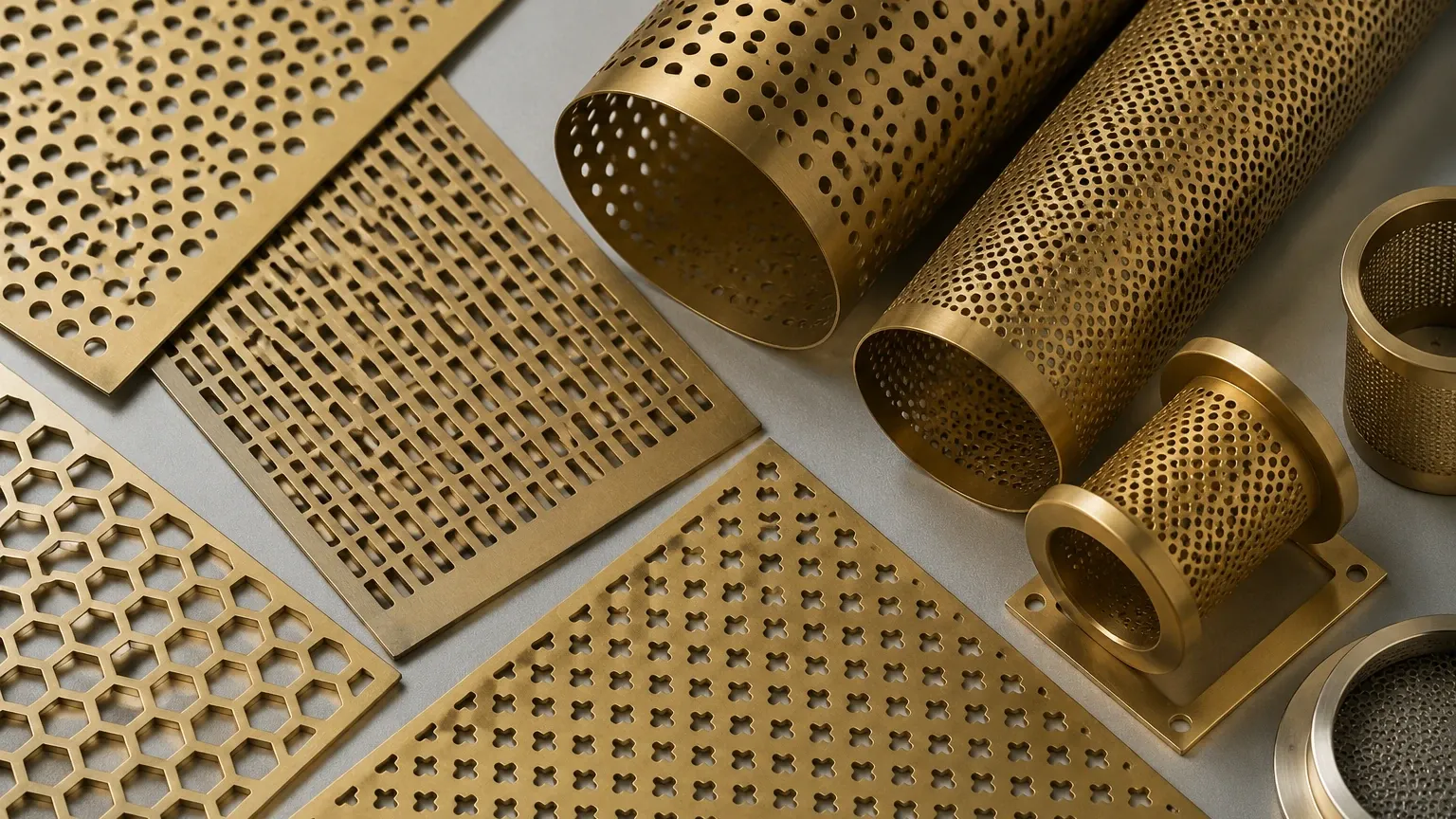
The performance of brass perforated metal is largely defined by its geometric configuration. The arrangement, size, and shape of the perforations dictate the material’s open area, which is the primary metric for flow rate and filtration efficiency.
Hole Shapes and Their Functions
* Round Holes: The most common and cost-effective pattern. Round holes provide the best structural integrity and are the easiest to manufacture with high precision. They are ideal for liquid filtration and air diffusion.
* Square Holes: These provide a higher open area than round holes, which is beneficial for high-volume airflow or when maximum visibility/transparency is required in industrial guards.
* Slotted Holes: Often used in specialized sorting or sieving applications, slotted perforations are effective for filtering elongated particles or managing fluid dynamics in specific directions.
The Importance of Open Area
The "open area" is the percentage of the sheet that is occupied by holes. For a staggered 60-degree round hole pattern—the industrial standard—the open area is calculated using the formula:
`Open Area % = (D² x 90.69) / P²`
*(Where D is the hole diameter and P is the pitch/center-to-center distance).*
In filtration applications, a higher open area reduces pressure drop but can compromise the structural strength of the sheet. Engineers must balance the need for flow with the requirement for the filter media to withstand differential pressure without deforming.
Industrial Applications of Brass Perforated Metal
While stainless steel is often the default for many filtration tasks, brass perforated metal is selected for specific technical advantages that other metals cannot provide.
1. Filtration and Strainers
In the oil and gas industry, as well as in marine environments, brass is valued for its resistance to biofouling. Copper-based alloys naturally inhibit the growth of marine organisms, making brass perforated components ideal for intake strainers and seawater filtration systems. Furthermore, in certain chemical processing environments where stainless steel might be prone to stress corrosion cracking in the presence of chlorides, specific brass alloys offer a more stable alternative.
2. EMI and RFI Shielding
Due to its high electrical conductivity, brass is an excellent material for Electromagnetic Interference (EMI) and Radio Frequency Interference (RFI) shielding. Perforated brass sheets allow for ventilation and heat dissipation in electronic enclosures while maintaining a conductive barrier that protects sensitive components from external interference.
3. Acoustic Damping
In industrial machinery and HVAC systems, brass perforated metal acts as a functional facing for sound-absorbing materials. The hole pattern is engineered to allow sound waves to pass through into an absorbent core, where the energy is dissipated. Brass is often preferred in these settings for its non-sparking properties, which is a critical safety requirement in environments with volatile gases or dust.
4. Heat Exchange and Diffusion
The thermal conductivity of brass is significantly higher than that of stainless steel. This makes it a preferred material for components involved in heat dissipation or gas diffusion, where the metal must quickly equilibrate with the surrounding temperature or facilitate the even spread of a heated medium.
Engineering Considerations for Customization
When specifying brass perforated metal for an OEM project, several technical factors must be confirmed to ensure the product meets the application's demands. At Kaifil, we emphasize the following criteria during the design phase:
Edge Requirements and Margins
Industrial sheets can be produced with "finished" or "unfinished" margins. A finished margin means the perforation stops before the edge of the sheet, leaving a solid border. This is crucial for welding the perforated component into a filter housing or frame. Unfinished margins (where the pattern is cut off at the edge) are generally used when the sheet will be further trimmed or where edge aesthetics and safety (due to sharp points) are not a concern.
Flatness and Leveling
The perforation process inherently introduces internal stresses into the metal, which can cause the sheet to bow or curl. For precision filtration components, secondary leveling processes are required to ensure the material remains flat within specified tolerances. This is particularly important when the perforated brass is used as a support structure for finer wire mesh layers.
Surface Finishes and Protection
Brass naturally oxidizes over time, developing a patina. In many industrial applications, this oxide layer provides a protective barrier against further corrosion. However, for applications in the food and beverage or pharmaceutical industries, the surface may require specialized cleaning, degreasing, or even tin-plating to meet hygiene and compatibility standards.
Common Risks and Quality Assurance
Procuring brass perforated metal requires a focus on quality control to avoid common pitfalls that can lead to system failure:
1. Burrs and Sharp Edges: In filtration, internal burrs can trap particles prematurely or damage delicate filter membranes. High-quality perforation involves precision tooling and deburring processes to ensure a smooth finish.
2. Material Consistency: Variations in the copper-zinc ratio can lead to inconsistent corrosion resistance. Sourcing from manufacturers who provide material certifications ensures that the alloy meets the specific ASTM or international standards required for the project.
3. Hole Distortion: In very thin gauges or high-open-area designs, the holes can become elongated during the punching process. Maintaining tight tolerances on hole sphericity is essential for accurate filtration sizing.
Selection Guide: What to Confirm Before Ordering
To ensure the successful integration of brass perforated metal into your industrial project, engineers should have the following data points prepared:
* Material Grade: Specify the exact brass alloy (e.g., C26000).
* Thickness: Usually measured in gauge or millimeters. Consider the pressure the material must withstand.
* Hole Diameter and Pitch: Define the filtration rating or the required open area percentage.
* Pattern Orientation: Staggered (60 or 45 degrees) or straight rows.
* Sheet Dimensions and Margins: Provide detailed drawings if specific solid borders are needed for mounting.
* Post-Processing: Indicate if the material requires degreasing, leveling, or forming into cylindrical filter cartridges.
Conclusion
Brass perforated metal remains a vital component in modern industrial engineering, offering a unique set of properties that stainless steel and plastic cannot replicate. Whether it is utilized for its antimicrobial properties in water treatment, its conductivity in electronics, or its durability in heavy machinery, the success of the material depends on precise manufacturing and informed selection.
As a partner in industrial filtration, Kaifil provides the technical expertise and manufacturing capabilities needed to produce high-performance Perforated & Expanded Metal solutions. By focusing on material integrity, geometric precision, and application-specific customization, we help engineers achieve reliable results in the most demanding environments. When evaluating your next filtration or component design, consider the functional advantages of brass and ensure your specifications align with the mechanical realities of the perforation process.
