


Bunnings Perforated Metal
In the procurement process for industrial filtration and structural components, engineers often evaluate various sourcing options ranging from local retail hardware suppliers to specialized original equipment manufacturers (OEMs). A common starting point for preliminary prototyping or general-purpose maintenance is exploring retail availability, such as bunnings perforated metal. While retail outlets provide immediate access to standard metal sheets for architectural or light-duty DIY applications, industrial-scale filtration and high-precision engineering require a deeper understanding of material science, hole geometry, and structural integrity that often exceeds standard retail specifications.
This guide examines the technical distinctions between general-purpose perforated metal and industrial-grade components, helping technical professionals determine when a standard retail product suffices and when a custom-engineered solution is necessary for operational efficiency.
Understanding the Application Scope of Retail vs. Industrial Perforated Metal
Perforated metal is a versatile material created by punching or stamping holes into metal sheets. In a retail context, products like bunnings perforated metal are typically stocked for aesthetic or light structural uses, such as ventilation covers, decorative screens, or basic garden projects. These products are usually available in a limited range of materials, such as aluminum, galvanized steel, or basic stainless steel grades, with fixed dimensions and hole patterns.
In contrast, industrial applications—particularly in chemical processing, food and beverage production, and hydraulic systems—demand specific performance characteristics. Industrial-grade Perforated & Expanded Metal is engineered to withstand high-pressure environments, corrosive chemicals, and extreme temperatures. For an engineer, the choice between a retail product and a manufactured component depends on the required tolerances, the specific alloy grade, and the intended filtration accuracy.
Key Technical Specifications for Industrial Filtration
When transitioning from a general-purpose sheet to a technical filtration component, several engineering parameters must be calculated. Retail products often provide a "nominal" hole size, but industrial applications require precise data on the following:
1. Hole Pattern and Orientation
Hole patterns significantly influence both the strength of the sheet and the flow characteristics. The most common patterns include:
* Round Holes (Staggered): The industry standard for filtration, offering the best balance of open area and structural strength. A 60-degree staggered pattern is typically preferred for its uniform stress distribution.
* Round Holes (Straight): Used primarily for aesthetic purposes or where specific alignment with other components is required, though it offers lower structural integrity than staggered patterns.
* Square and Slotted Holes: Often used for sieving bulk materials or in applications where high flow rates are prioritized over mechanical strength.
2. The Open Area Calculation
The "open area" is the percentage of the sheet that is comprised of holes. This is a critical metric for engineers calculating pressure drop and flow velocity. For a 60-degree staggered round hole pattern, the formula is:
Open Area % = (D² × 90.69) / P²
Where *D* is the hole diameter and *P* is the pitch (the distance between the centers of two adjacent holes). Retail sheets like bunnings perforated metal may not always provide these precise calculations, which are essential for ensuring that a filter does not cause excessive backpressure in a hydraulic or pneumatic system.
3. Pitch and Bridge Width
The "bridge" is the solid material between the holes. In industrial filtration, the bridge width must be sufficient to prevent the sheet from deforming under the weight of the filtered media or the pressure of the fluid. Custom manufacturing allows for the adjustment of the pitch to optimize the ratio between flow capacity and mechanical durability.
Material Selection: Beyond General Purpose Hardware
One of the primary limitations of retail-grade perforated metal is the restricted selection of alloys. While a retail shelf might offer "stainless steel," industrial environments often require specific grades to prevent premature failure.
* SS304/304L: Suitable for general corrosion resistance in food processing or standard industrial environments.
* SS316/316L: Contains molybdenum, providing superior resistance to chlorides and pitting, making it essential for marine environments and chemical processing.
* Specialty Alloys: For high-temperature or highly acidic environments, materials like Monel, Inconel, or Hastelloy may be required. These are rarely found in retail inventories but are standard in custom OEM manufacturing.
Furthermore, industrial components often undergo specialized surface treatments. Passivation, electropolishing, or specialized coatings ensure that the perforated metal does not introduce contaminants into the process stream—a critical requirement in the pharmaceutical and food industries.
Evaluating Perforated & Expanded Metal for Custom Filtration Systems
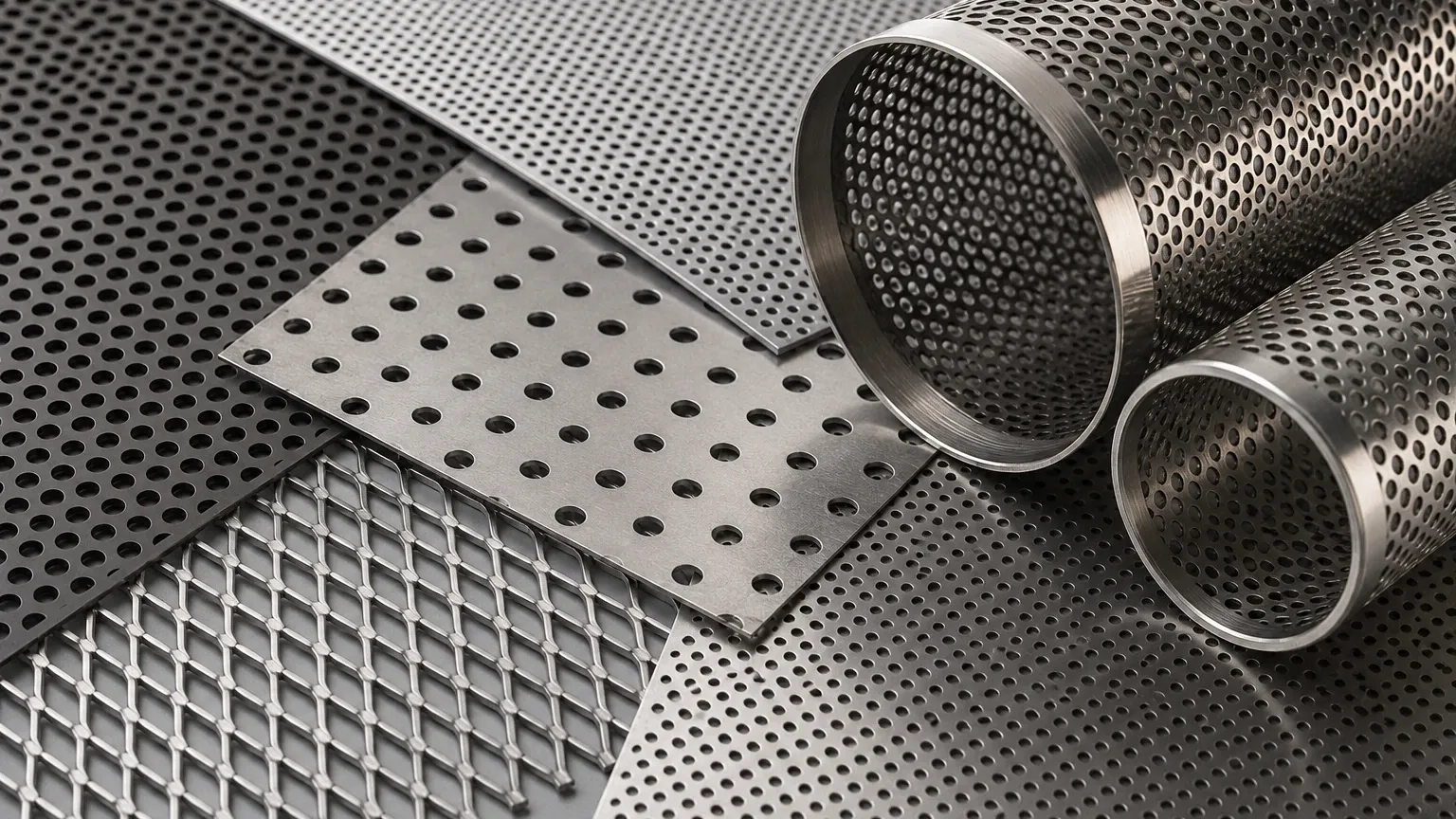
In many advanced filtration systems, perforated metal does not act alone. It often serves as the structural support for finer filter media, such as multi-layered wire mesh. This is where the distinction between a simple sheet and a precision component becomes clear.
The Role of Perforated Support Cores
In high-pressure filter cartridges, a perforated metal tube acts as the inner core. It must resist collapsing under external pressure while providing maximum open area for the fluid to pass through. If the perforation is inconsistent or the welding is subpar—risks often associated with modifying off-the-shelf retail sheets—the entire filtration system can fail, leading to downstream contamination and equipment damage.
Expanded Metal vs. Perforated Metal
While perforated metal is created by removing material, expanded metal is slit and stretched, creating a diamond-shaped pattern with no material waste. Expanded metal is often lighter and provides a unique structural rigidity. Engineers must decide between the two based on the weight-to-strength ratio and the specific flow turbulence required by the application. Custom manufacturers can provide both options tailored to the exact dimensions of the housing unit.
Common Risks in Using Off-the-Shelf Perforated Metal for Industrial Processes
Attempting to adapt retail products like bunnings perforated metal for industrial use carries several risks that can impact the total cost of ownership:
1. Inconsistent Tolerances: Retail sheets are often produced with wider tolerances. In a precision-engineered filter housing, a discrepancy of even a millimeter can lead to bypass, where unfiltered fluid escapes around the edges of the filter.
2. Burrs and Sharp Edges: Standard punching processes can leave burrs on the "exit" side of the hole. In industrial filtration, these burrs can trap particles, cause turbulence, or even break off and damage sensitive downstream equipment. Industrial manufacturers utilize deburring and leveling processes to ensure a smooth, clean finish.
3. Material Certification: Industrial projects usually require Mill Test Reports (MTRs) to verify the chemical composition and physical properties of the metal. Retail products rarely come with this level of traceability, which is a mandatory requirement for many ISO-certified facilities and regulated industries (such as aerospace or medical manufacturing).
4. Limited Customization: Retail sheets come in fixed sizes (e.g., 600mm x 900mm). For industrial applications, this leads to significant material waste and additional labor costs for cutting, shaping, and welding. Custom OEM solutions provide "near-net-shape" components that are ready for immediate installation.
Choosing the Right Supplier for High-Performance Requirements
For engineers and purchasing teams, the decision to move beyond retail options is driven by the need for reliability and specific performance metrics. While a local hardware store is an excellent resource for a quick fix or a non-critical guard, industrial systems depend on components that meet rigorous engineering standards.
When selecting a partner for Perforated & Expanded Metal, it is essential to confirm their ability to provide:
* Custom Hole Patterns: Tailoring the open area to specific flow requirements.
* Precision Fabrication: Ensuring the component fits perfectly within existing industrial housings.
* Material Traceability: Providing the necessary documentation for quality assurance and regulatory compliance.
* Technical Support: Assisting in the calculation of pressure drops and the selection of the appropriate alloy for the specific operating environment.
By focusing on these technical factors, procurement professionals can ensure that their filtration systems operate at peak efficiency, reducing maintenance cycles and preventing costly unscheduled downtime.
Conclusion
While products like bunnings perforated metal serve a valuable purpose in the consumer and light trade markets, they are rarely the optimal choice for demanding industrial filtration applications. The complexities of fluid dynamics, chemical compatibility, and structural stress require a more specialized approach. For projects where filtration accuracy and component longevity are paramount, transitioning to an industrial OEM ensures that every aspect of the perforated or expanded metal—from the alloy grade to the micron-level tolerance—is optimized for the task at hand.
