


Expanded Mesh 6
In the landscape of industrial filtration and structural support, expanded metal stands as a versatile and resource-efficient material. Among the various specifications available to engineers and procurement specialists, expanded mesh 6 represents a specific dimensional category often utilized for its balance of structural rigidity and open area. Unlike perforated metal, which is created by punching holes and generating scrap, expanded metal is produced by simultaneously slitting and stretching the base material. This process results in a continuous, jointless mesh that maintains the inherent strength of the original metal sheet.
For industrial applications—ranging from chemical processing to heavy-duty hydraulic systems—understanding the nuances of expanded mesh 6 is critical for optimizing filtration efficiency and equipment longevity. As a specialized manufacturer, Kaifil provides precision-engineered Perforated & Expanded Metal solutions tailored to meet the rigorous demands of global industrial sectors.
Understanding the Role of Expanded Mesh 6 in Industrial Filtration
Expanded mesh 6 is characterized by its diamond-shaped openings, which are defined by specific measurements: the Long Way of the Diamond (LWD) and the Short Way of the Diamond (SWD). In the context of industrial filtration, the "6" typically refers to a nominal measurement in millimeters or a specific gauge classification, depending on the regional standard applied.
In filtration systems, this mesh serves two primary purposes. First, it can act as a coarse filter medium, capturing large particulates in water treatment or air intake systems. Second, and perhaps more commonly, it serves as a high-strength support structure for finer wire mesh layers. In multi-layer filter cartridges, the expanded mesh 6 provides the necessary mechanical reinforcement to prevent the fine filtration media from collapsing under high differential pressure. Its three-dimensional structure also promotes turbulent flow, which can be advantageous in certain chemical mixing or heat exchange applications.
Technical Specifications: LWD, SWD, and Open Area Calculations
When specifying expanded mesh 6 for a project, engineers must look beyond the nominal size and evaluate the precise geometric properties that will dictate performance. The performance of the mesh is governed by several key variables:
1. LWD (Long Way of Diamond): The distance from a point on a diamond to the corresponding point on the next diamond measured across the long axis.
2. SWD (Short Way of Diamond): The distance measured across the short axis.
3. Strand Width: The amount of metal fed into the precision dies between slits.
4. Strand Thickness: The thickness of the original base material.
5. Open Area Percentage: This is the most critical factor for filtration. It determines the flow rate and the pressure drop across the mesh.
For expanded mesh 6, the open area is typically calculated based on the relationship between the strand width and the SWD. A larger open area reduces resistance to fluid flow but may compromise the structural integrity of the component. Conversely, a narrower opening provides better support but increases the likelihood of pressure build-up. At Kaifil, we assist engineering teams in calculating these values to ensure the mesh meets the specific flow requirements of their hydraulic or chemical processing systems.
Comparing Perforated & Expanded Metal for Support Structures
One of the most frequent questions encountered during the design phase is whether to use perforated or expanded metal. While both fall under the category of Perforated & Expanded Metal, they offer distinct mechanical advantages.
* Material Efficiency: Expanded metal is produced without any material waste. Every square inch of the original sheet is utilized in the final mesh. Perforated metal, by contrast, can lose up to 40-60% of its weight in the form of "slugs" or scrap, which often increases the raw material cost.
* Structural Integrity: Because expanded metal is not punched, the structural bonds remain intact. The diamonds are oriented at an angle to the plane of the sheet, providing inherent stiffness that perforated metal lacks unless it is significantly thicker.
* Flow Dynamics: The angular strands of expanded mesh 6 can break up laminar flow, which is beneficial in applications requiring fluid dispersion. Perforated metal provides a more direct, straight-through flow path, which is often preferred for high-velocity gas filtration where turbulence must be minimized.
Material Selection: Enhancing Durability with Stainless Steel
The environment in which the expanded mesh 6 will operate dictates the material selection. For industries such as pharmaceutical manufacturing, food and beverage processing, and marine applications, stainless steel is the standard.
* Grade 304 Stainless Steel: This is the most common grade used for expanded mesh. It offers excellent corrosion resistance and is suitable for most atmospheric conditions and many organic and inorganic chemicals.
* Grade 316L Stainless Steel: For more demanding environments, such as those involving chlorides or high-salinity water treatment, 316L is preferred. The addition of molybdenum provides superior resistance to pitting and crevice corrosion. The "L" (low carbon) designation ensures that the mesh remains corrosion-resistant even after welding, which is a common requirement for custom filter cartridge assembly.
Kaifil specializes in these high-performance alloys, ensuring that the expanded mesh 6 maintains its filtration accuracy and structural form even in corrosive or high-temperature industrial settings.
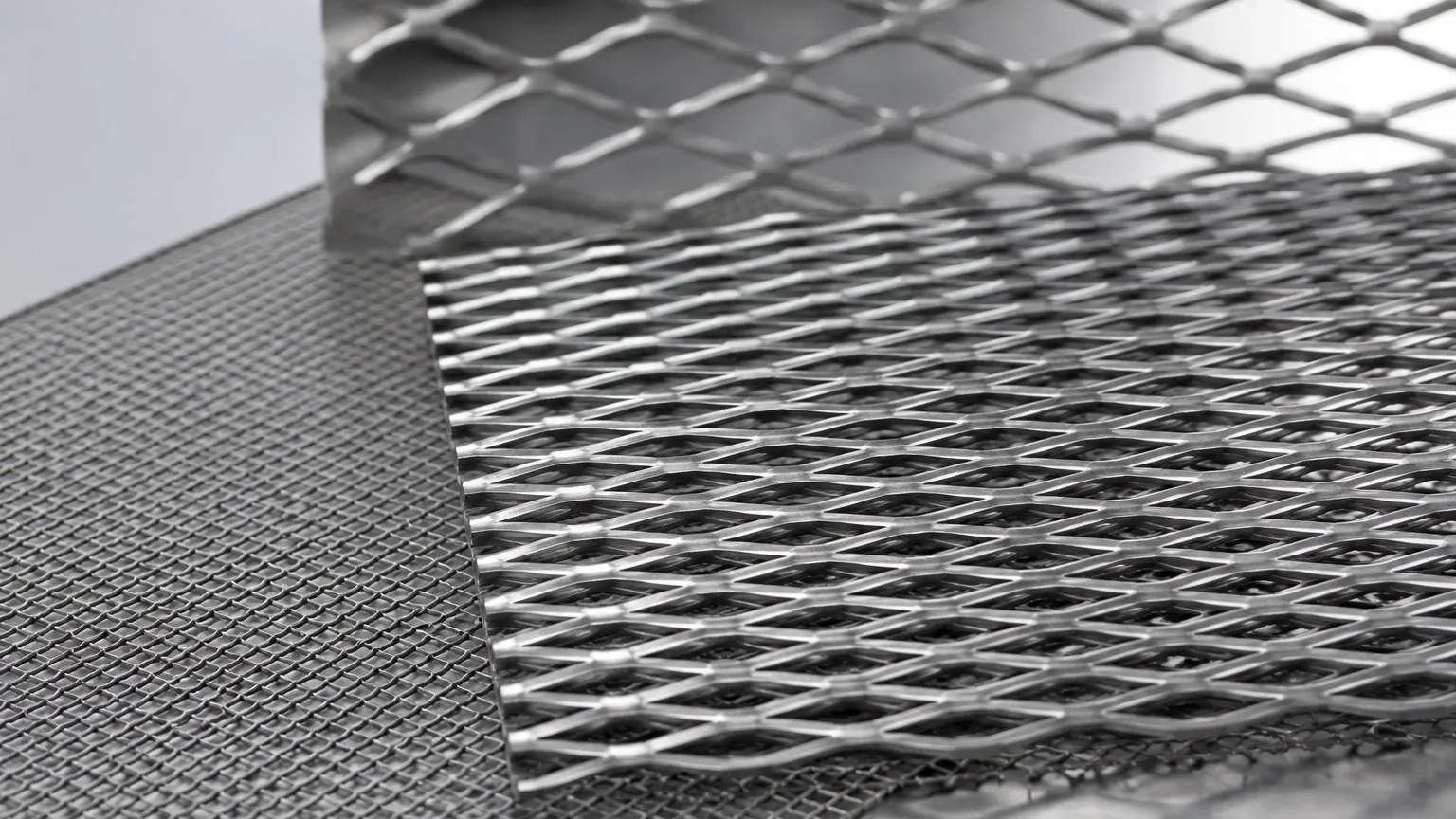
Raised vs. Flattened Expanded Mesh
Another critical engineering consideration is whether the mesh should be "raised" or "flattened."
* Raised Expanded Metal: This is the mesh as it comes off the machine. The strands and bonds are set at a uniform angle to the plane of the sheet. This creates a textured surface that adds strength and provides excellent grip or fluid dispersion. In filtration, raised mesh is often used as an outer guard for filter elements to protect the inner media from mechanical damage.
* Flattened Expanded Metal: After the expansion process, the mesh is passed through a cold-rolling reducing mill. This flattens the strands and bonds into the same plane as the sheet. Flattened expanded mesh 6 is smoother and thinner, making it easier to pleat or wrap around a filter core. It is the preferred choice when the mesh needs to be in direct contact with a delicate wire cloth or synthetic filter membrane, as it reduces the risk of abrasion.
Customization Options for OEM Filtration Components
Industrial filtration is rarely a one-size-fits-all field. OEM requirements often demand specific modifications to standard expanded mesh 6. Customization options typically include:
* Dimensional Accuracy: Precise shearing to specific lengths and widths to fit into existing filter housings without additional onsite modification.
* Edge Treatment: Providing mesh with "random" edges (where diamonds are cut through) or "bonded" edges (where the edge consists of a solid stringer of metal) to facilitate welding or mechanical fastening.
* Surface Finishes: Beyond standard mill finishes, expanded mesh can be electropolished to meet the stringent hygienic standards of the food and pharmaceutical industries. Electropolishing removes surface impurities and creates a microscopically smooth surface that resists bacterial growth and is easier to clean during CIP (Clean-in-Place) cycles.
Installation and Maintenance for Extended Service Life
The longevity of expanded mesh 6 depends significantly on proper installation and a consistent maintenance schedule. When used as a support core in a filter cartridge, it is essential that the mesh is securely welded or bonded to the end caps. Any movement or vibration can lead to mechanical fatigue and eventual failure of the mesh strands.
Maintenance professionals should regularly inspect the mesh for signs of "blinding" (clogging of the openings) or erosion. While stainless steel expanded mesh is highly durable, high-velocity fluids containing abrasive particulates can eventually wear down the strands, altering the open area and filtration performance. If the mesh is used as a primary filter, regular backwashing or ultrasonic cleaning is recommended to maintain the design flow rate and prevent excessive pressure drops.
Procurement Checklist for Engineering and Purchasing Teams
Before finalizing a purchase order for expanded mesh 6, technical teams should confirm the following details with their manufacturer to ensure the product is fit for purpose:
1. Material Grade: Is 304 sufficient, or does the chemical environment require 316L?
2. Mesh State: Is raised or flattened mesh required for the specific assembly?
3. Dimensional Tolerances: What are the allowable variances in LWD, SWD, and overall sheet size?
4. Load Requirements: Will the mesh be subject to high differential pressures, and does the strand thickness support these loads?
5. Compliance: Does the material meet industry-specific standards (e.g., FDA compliance for food contact or ISO standards for industrial manufacturing)?
By addressing these factors during the selection process, purchasing teams can avoid costly downtime and ensure that their filtration systems operate at peak efficiency. Kaifil’s expertise in Perforated & Expanded Metal manufacturing provides the technical foundation necessary to support these complex industrial requirements, delivering reliable components that meet the exact specifications of global engineering projects.
