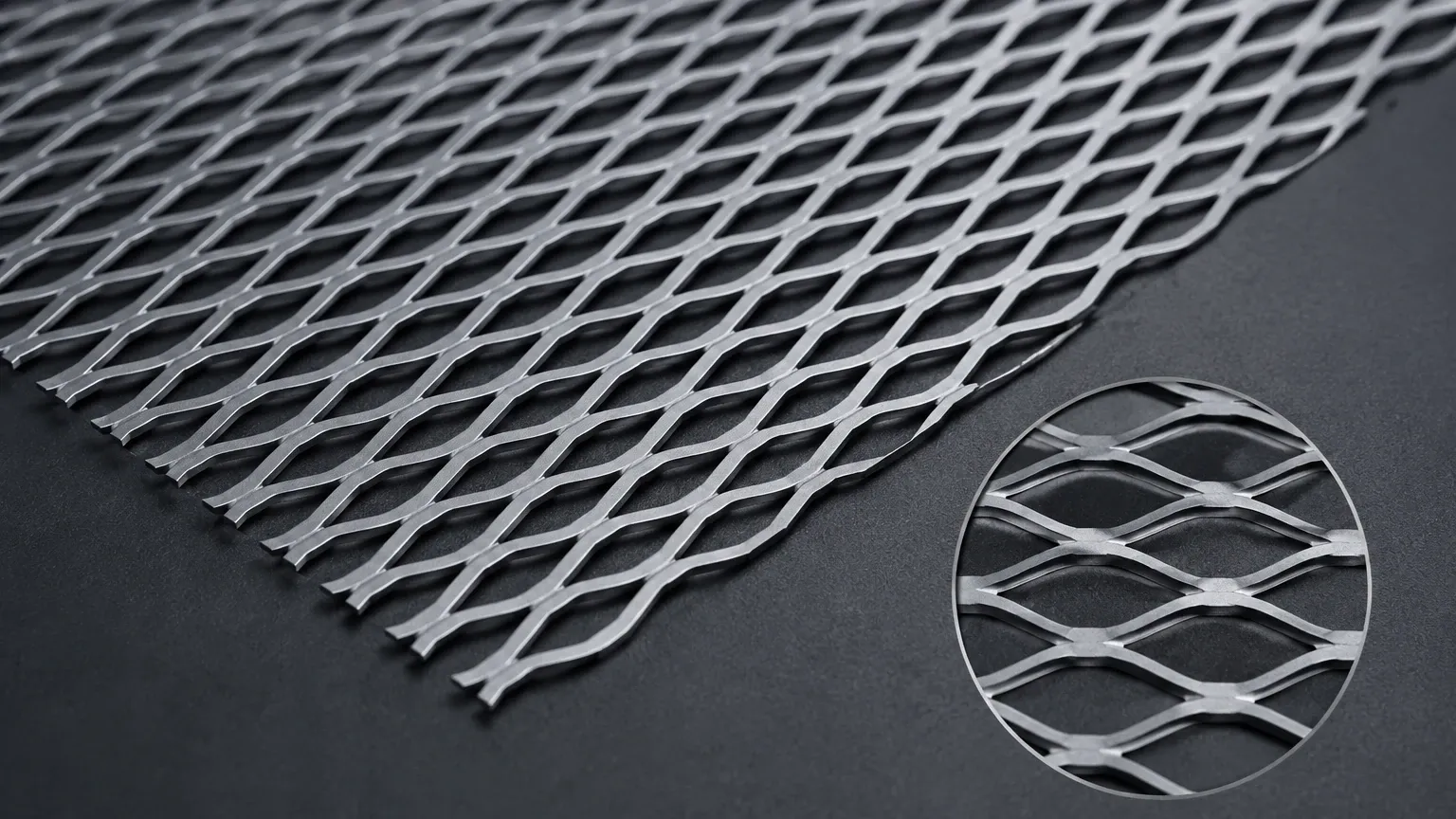
Expanded Mesh 6mm
In the landscape of industrial filtration and structural support, expanded mesh 6mm represents a versatile specification utilized across diverse sectors, from chemical processing to hydraulic systems. Unlike perforated metal, which is produced by punching holes and creating scrap, expanded mesh is manufactured through a simultaneous slitting and stretching process. This method results in a diamond-shaped aperture that maintains structural integrity while providing a high strength-to-weight ratio. When specifying a 6mm aperture, engineers must consider the orientation of the diamond—specifically the Long Way of the Diamond (LWD) and the Short Way of the Diamond (SWD)—as these dimensions dictate the mesh's filtration efficiency and mechanical properties.
Understanding the Geometry of Expanded Mesh 6mm
The designation "6mm" in expanded mesh typically refers to one of the primary dimensions of the diamond opening. In most technical contexts, this refers to the SWD, which is the distance from the center of the bond on one side to the center of the bond on the opposite side across the short axis.
For filtration applications, the SWD is the critical metric for determining the size of particulates that can pass through the medium. A 6mm short-way opening is often paired with a larger LWD (for example, 12mm or 18mm) to create a rigid structure. The resulting geometry is not merely a flat hole; because the metal is stretched, the strands are set at an angle to the original plane of the sheet. This three-dimensional profile creates a "raised" mesh that offers unique flow characteristics and mechanical grip, which can be further processed into "flattened" mesh if a smooth surface is required for secondary laminations.
Material Selection and Engineering Durability
Selecting the correct alloy for expanded mesh 6mm is paramount to ensuring the longevity of the filtration component. At Kaifil, the focus is predominantly on stainless steel grades due to their superior resistance to corrosion and thermal stress.
* Stainless Steel 304: The standard choice for general industrial applications. It provides excellent forming and welding characteristics, making it suitable for filter cages and support structures in non-corrosive environments.
* Stainless Steel 316/316L: Specified for more demanding environments, such as chemical processing or marine applications. The addition of molybdenum enhances resistance to pitting and crevice corrosion in chloride-rich environments.
* Specialty Alloys: For high-temperature or highly acidic applications, materials like Monel or Inconel may be utilized in the expansion process, though stainless steel remains the industry benchmark for balance between cost and performance.
When evaluating Perforated & Expanded Metal options, engineers must balance the material thickness (gauge) with the strand width. A thicker strand increases the pressure rating of the filter but reduces the overall open area, which directly impacts the flow rate and pressure drop across the system.
Technical Specifications: Raised vs. Flattened Mesh
One of the most significant decisions in the procurement of expanded mesh 6mm is the choice between raised and flattened profiles.
Raised Expanded Mesh: This is the immediate product of the expanding machine. The strands and bonds are set at a uniform angle to the plane of the sheet. This adds significant structural rigidity and creates a larger surface area, which can be beneficial in certain depth filtration scenarios or when the mesh is used as a high-friction support for other filter media.
Flattened Expanded Mesh: After the expansion process, the mesh is passed through a cold-rolling reducing mill. This flattens the strands and bonds back into the original plane of the sheet. Flattened 6mm mesh is approximately 5% to 10% longer than the original raised sheet and is slightly thinner. In B2B filtration manufacturing, flattened mesh is often preferred when the expanded metal serves as an inner or outer support core for fine wire mesh or pleated filter elements, as the smooth surface prevents the delicate fine mesh from being abraded or punctured under high-pressure pulses.
Applications in Industrial Filtration Systems
The 6mm aperture is a "medium-coarse" specification that serves several critical roles in industrial fluid and gas management:
1. Coarse Pre-filtration: In water treatment and food processing, expanded mesh 6mm acts as a primary barrier to remove large debris, protecting downstream precision filters and pumps from mechanical damage.
2. Filter Element Support: In high-pressure hydraulic systems, the 6mm mesh provides the necessary skeleton for synthetic or fine stainless steel wire mesh. It prevents the finer media from collapsing under the force of the fluid flow.
3. Catalyst Support: In chemical reactors, expanded metal sheets are used to hold catalyst beds in place. The 6mm diamond allows for high gas or liquid throughput while maintaining the structural stability of the bed.
4. Centrifuge Liners: The mechanical strength of expanded metal allows it to withstand the high G-forces in centrifugal separation, where it supports the filter cloth or fine mesh used to separate solids from liquids.
Calculating Open Area and Flow Performance
For engineering teams, the "Open Area Percentage" is the most critical value for calculating the efficiency of an expanded mesh 6mm component. Unlike perforated metal, where the open area is easily calculated by the ratio of hole area to total area, expanded mesh calculations must account for the strand width and the angle of the expansion.
A typical expanded mesh with a 6mm SWD might offer an open area ranging from 40% to 70%. A higher open area results in a lower initial pressure drop (ΔP), which reduces the energy requirements for pumps and compressors. However, if the open area is too high, the mesh may lack the mechanical strength to resist deformation under heavy particulate loading. Kaifil’s engineering approach involves analyzing the specific flow velocity and fluid viscosity of the application to recommend the optimal strand-to-aperture ratio.
Customization and OEM Integration
Standard off-the-shelf expanded metal often fails to meet the precise tolerances required for high-performance industrial filters. Customization is essential when integrating expanded mesh 6mm into complex assemblies.
Key customization parameters include:
* Sheet Dimensions: Precision shearing to specific lengths and widths to fit filter housings without the need for on-site trimming.
* Cylindrical Forming: Roll-forming the mesh into precise diameters for use as filter cartridges, followed by specialized welding (such as spot welding or seam welding) that maintains the integrity of the 6mm pattern.
* Edge Treatment: Providing "random sheared" edges or "bond sheared" edges depending on how the mesh will be seated within a frame or end cap.
* Surface Finishing: Electropolishing or passivating the stainless steel mesh to ensure it meets the sanitary requirements of the pharmaceutical or food and beverage industries.
Selection Criteria: Perforated vs. Expanded Metal
When deciding between Perforated & Expanded Metal for a 6mm application, several factors should guide the procurement process. Expanded mesh is generally more cost-effective because the manufacturing process involves no material waste; a single sheet of metal can be expanded into a much larger area of mesh. This makes it an ideal choice for large-scale filtration projects where budget is a primary concern.
However, perforated metal offers more precise control over hole geometry and spacing. If the application requires a very specific circular hole or a staggered pattern that cannot be achieved with a diamond aperture, perforated metal may be the necessary choice. For most industrial support and coarse filtration needs, however, the 6mm expanded mesh provides a superior strength-to-weight ratio and better mechanical bonding for secondary processes.
Quality Assurance and Procurement Considerations
Before finalizing a purchase order for expanded mesh 6mm, purchasing teams should confirm several technical details with the manufacturer to avoid integration issues:
* Tolerance Standards: Confirm the allowable variance in SWD and LWD dimensions. In precision filtration, even a 0.5mm deviation can affect the retention characteristics of the filter.
* Flattening Uniformity: If specifying flattened mesh, ensure the thickness is consistent across the entire sheet to prevent gaps when the mesh is fitted into filter end caps.
* Material Certification: Request Mill Test Reports (MTRs) to verify the chemical composition of the stainless steel, particularly the chromium and nickel content, to ensure corrosion resistance matches the application environment.
* Load Bearing Requirements: Provide the manufacturer with the expected pressure differentials. This allows the engineering team to calculate if the 6mm strand thickness is sufficient to prevent "blinding" or structural failure during backwashing cycles.
By focusing on these technical boundaries, engineers can leverage the unique properties of expanded mesh 6mm to create durable, efficient, and cost-effective filtration solutions tailored to the specific demands of their industrial processes.