


Expanded Metal 1/2
In industrial filtration and structural engineering, the selection of support materials is as critical as the selection of the primary filtration media. Expanded metal 1/2 refers to a specific size designation within the broader category of Perforated & Expanded Metal products. This material is characterized by its diamond-shaped openings, where the "1/2" typically denotes the nominal dimension of the short way of the diamond (SWD). For engineers and procurement specialists, understanding the technical nuances of expanded metal 1/2 is essential for ensuring structural integrity, flow efficiency, and long-term durability in demanding environments.
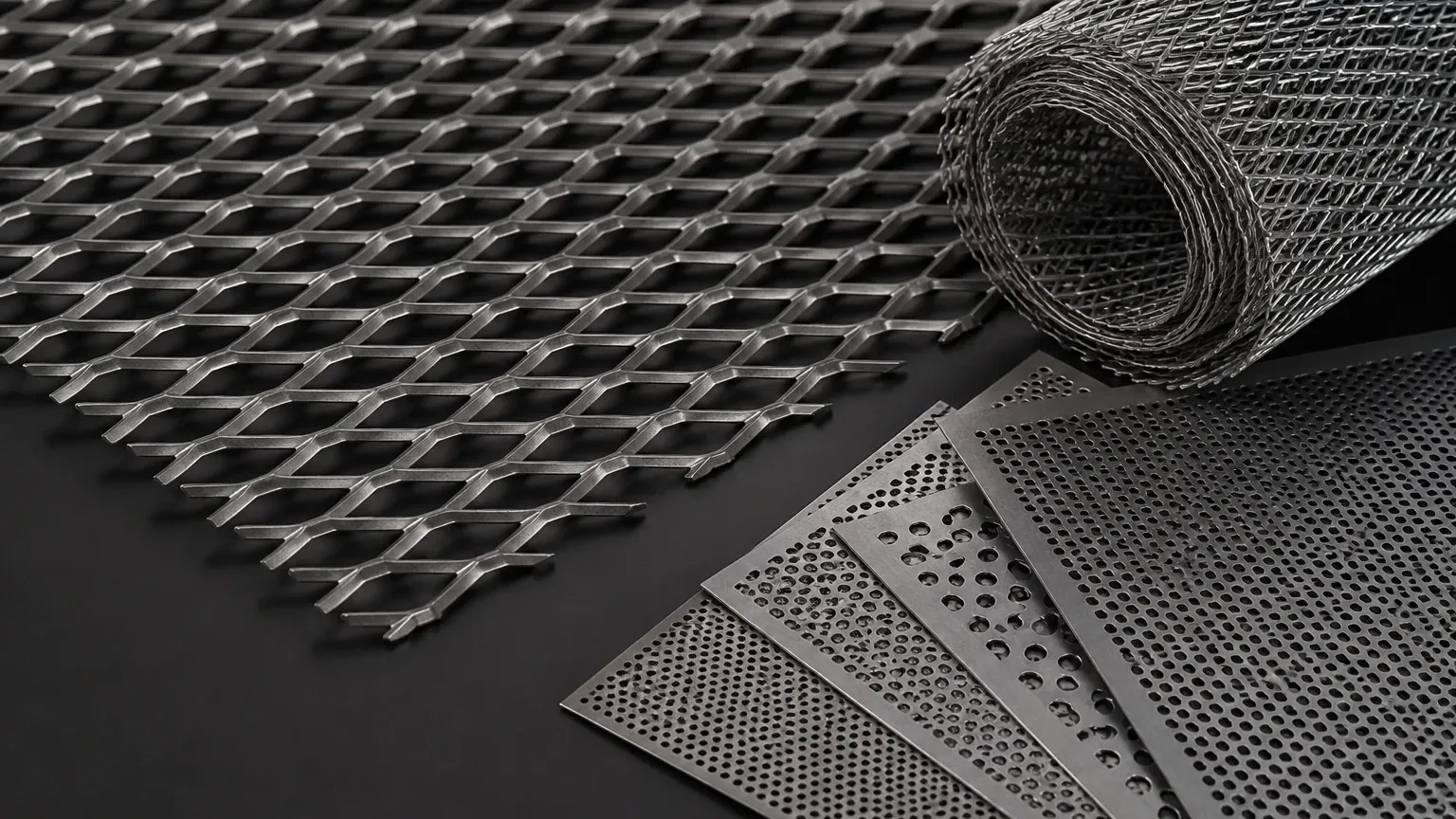
Unlike perforated metal, which is created by punching holes and removing material, expanded metal is produced by simultaneously slitting and stretching a solid sheet of metal. This process creates a continuous mesh without joins or welds, resulting in a high strength-to-weight ratio. In applications ranging from hydraulic filter cores to chemical processing strainers, expanded metal 1/2 provides the necessary rigidity to withstand high differential pressures while maintaining a high percentage of open area.
Understanding the Geometry and Specifications of Expanded Metal 1/2
To specify expanded metal 1/2 correctly, one must understand the four primary measurements that define its geometry: the Short Way of Design (SWD), the Long Way of Design (LWD), the strand width, and the strand thickness. In a standard 1/2" designation, the SWD is nominally 0.5 inches, measured from the center of one bond to the center of the next. The LWD is typically longer, often ranging from 1.0 to 1.25 inches depending on the specific style.
There are two primary forms of expanded metal 1/2 used in industrial settings:
1. Standard (Raised) Expanded Metal: This is the product as it comes off the expanding machine. The strands and bonds are set at a uniform angle to the plane of the sheet. This creates a three-dimensional surface that offers excellent grip and structural stiffness. In filtration, raised expanded metal is often used as a protective outer guard for heavy-duty filter elements.
2. Flattened Expanded Metal: This is standard expanded metal that has been cold-rolled through a reducing mill. The process flattens the strands and bonds into the same plane as the sheet, reducing the overall thickness and creating a smooth surface. Flattened expanded metal 1/2 is preferred when the material must be in direct contact with delicate filter media, such as non-woven fabrics or fine wire mesh, as it eliminates sharp edges that could cause mechanical wear or puncturing.
Material Selection for Corrosive and High-Temperature Environments
At Kaifil, the emphasis on stainless steel filtration solutions means that material grade is a primary consideration for expanded metal 1/2. While carbon steel and aluminum are available for general industrial use, stainless steel is the standard for chemical, pharmaceutical, and food processing applications.
* Grade 304/304L: The most common stainless steel grade, providing excellent corrosion resistance and weldability. It is suitable for most water treatment and general industrial filtration applications.
* Grade 316/316L: Contains molybdenum, which provides superior resistance to chlorides and pitting. This is the required specification for marine environments, pharmaceutical manufacturing, and aggressive chemical processing.
* Specialty Alloys: For extreme environments involving high temperatures or highly acidic/alkaline fluids, expanded metal can be produced from Monel, Inconel, or Hastelloy. These materials ensure that the support structure does not fail due to chemical degradation before the filter media reaches the end of its service life.
Applications in Industrial Filtration Systems
Expanded metal 1/2 serves several critical functions within an industrial filter assembly. It is rarely the primary medium for fine particle separation; instead, it acts as the structural backbone of the filter.
Filter Cartridge Cores
In hydraulic and lubrication systems, filter cartridges are subjected to significant inward pressure. A central core made of expanded metal 1/2 provides the necessary hoop strength to prevent the filter media from collapsing. The diamond pattern allows for a high flow rate with minimal pressure drop, ensuring that the pump system operates efficiently.
Pleat Support and Spacing
For pleated filter elements, expanded metal is often used as a support layer sandwiched between layers of fine wire mesh or synthetic media. It helps maintain uniform pleat spacing under flow fluctuations, preventing "pleat bunching" which can reduce the effective filtration area and lead to premature clogging.
Protective Outer Guards
In heavy-duty industrial environments, filters are often exposed to mechanical impact or turbulent flow. An outer wrap of expanded metal 1/2 protects the internal delicate media from large debris and physical damage during installation, operation, and cleaning cycles.
Engineering Considerations: Open Area and Flow Dynamics
When integrating expanded metal 1/2 into a system design, engineers must calculate the percentage of open area. This figure determines the total flow capacity and the initial pressure drop ($ΔP$) across the filter.
A typical 1/2" #13 flattened expanded metal may offer an open area of approximately 60% to 70%, depending on the strand width. If the strand width is increased to improve structural strength, the open area decreases, which may necessitate a larger filter housing to maintain the desired flow velocity. Conversely, a thinner strand increases the open area but may require additional support ribs to prevent deformation under high pressure.
Furthermore, the orientation of the diamonds (SWD vs. LWD) relative to the flow direction can influence turbulence. In most cylindrical filter applications, the LWD is oriented circumferentially to maximize the burst strength of the tube.
Customization and Manufacturing Precision
Standard off-the-shelf expanded metal sheets often do not meet the rigorous tolerances required for precision filtration components. Kaifil provides customized solutions that address specific engineering challenges:
* Custom Slitting and Shearing: Providing exact widths for seamless integration into automated filter assembly lines.
* Cylindrical Forming and Welding: Expertly rolling expanded metal 1/2 into tubes with precise diameters. The welding of expanded metal requires specialized techniques to ensure a strong bond without obstructing the mesh openings.
* Surface Finishing: For food and beverage or pharmaceutical applications, expanded metal components may undergo electropolishing. This process removes microscopic burrs and creates a passive, ultra-smooth surface that resists bacterial growth and is easier to clean (CIP/SIP).
* Varied Weights: The "#number" designation (e.g., 1/2" #16 or 1/2" #13) refers to the gauge of the starting material. Choosing the correct weight is a balance between the required rigidity and the weight constraints of the overall system.
Procurement and Quality Evaluation Criteria
When sourcing expanded metal 1/2 for industrial projects, purchasing teams should confirm several technical factors to ensure the product is fit for purpose:
1. Dimensional Tolerance: Confirm the tolerance for SWD, LWD, and overall sheet flatness. Variations in diamond size can lead to inconsistent support for the filter media.
2. Edge Condition: Specify whether "random sheared" or "bond sheared" edges are required. Bond shearing provides a closed-diamond edge that is safer to handle and easier to weld into frames.
3. Material Certification: Ensure that Mill Test Reports (MTRs) are provided to verify the chemical composition of the stainless steel, particularly for applications requiring FDA or high-purity compliance.
4. Burr Levels: For flattened expanded metal, the level of acceptable burr must be defined. Excessive burrs can damage synthetic filter membranes during the pleating or assembly process.
Conclusion
Expanded metal 1/2 is a foundational component in the world of industrial filtration. Its unique combination of high open area, structural rigidity, and material versatility makes it an ideal choice for support cores, pleat spacers, and protective guards. By selecting the appropriate material grade, weight, and finish, engineers can significantly enhance the performance and lifespan of their filtration systems.
As a specialist in custom stainless steel filtration, Kaifil provides the technical expertise and manufacturing precision necessary to deliver high-performance Perforated & Expanded Metal components tailored to the most demanding industrial environments. Whether you are designing a new hydraulic system or optimizing a chemical processing strainer, confirming the exact specifications of your expanded metal components is a vital step toward operational reliability.
