


Expanded Metal Cage
In industrial filtration and mechanical protection, the structural integrity of a component is often as critical as its functional surface. For engineers and procurement specialists managing high-pressure fluid systems or harsh chemical environments, the expanded metal cage serves as a fundamental building block. These cages provide the necessary rigid framework for delicate filter media, ensuring that filtration systems maintain their geometry and performance under significant operational stress.
As a specialized manufacturer of stainless steel filtration solutions, Kaifil understands that the selection of a support structure is not merely a secondary consideration. Whether used as an internal core to prevent media collapse or an external shroud to protect against mechanical impact, the design and material composition of an expanded metal cage directly influence the efficiency, lifespan, and safety of the entire industrial process.
The Role of Expanded Metal Cages in Industrial Filtration
In most industrial filtration applications, the primary filter media—whether it is a fine stainless steel wire mesh, a pleated polymer membrane, or a sintered fiber felt—lacks the inherent structural strength to withstand the differential pressures encountered during high-flow operations. This is where the expanded metal cage becomes essential.
Structural Support and Rigidity
The primary function of the cage is to act as a skeleton. In a typical cylindrical filter cartridge, fluid flows from the outside in (out-to-in) or from the inside out (in-to-out). In an out-to-in flow configuration, the internal expanded metal cage prevents the filter media from crushing inward as the pressure drop across the media increases. Conversely, an outer cage or shroud protects the media from external turbulence and provides a handling surface that prevents accidental damage during installation or maintenance.
Flow Optimization
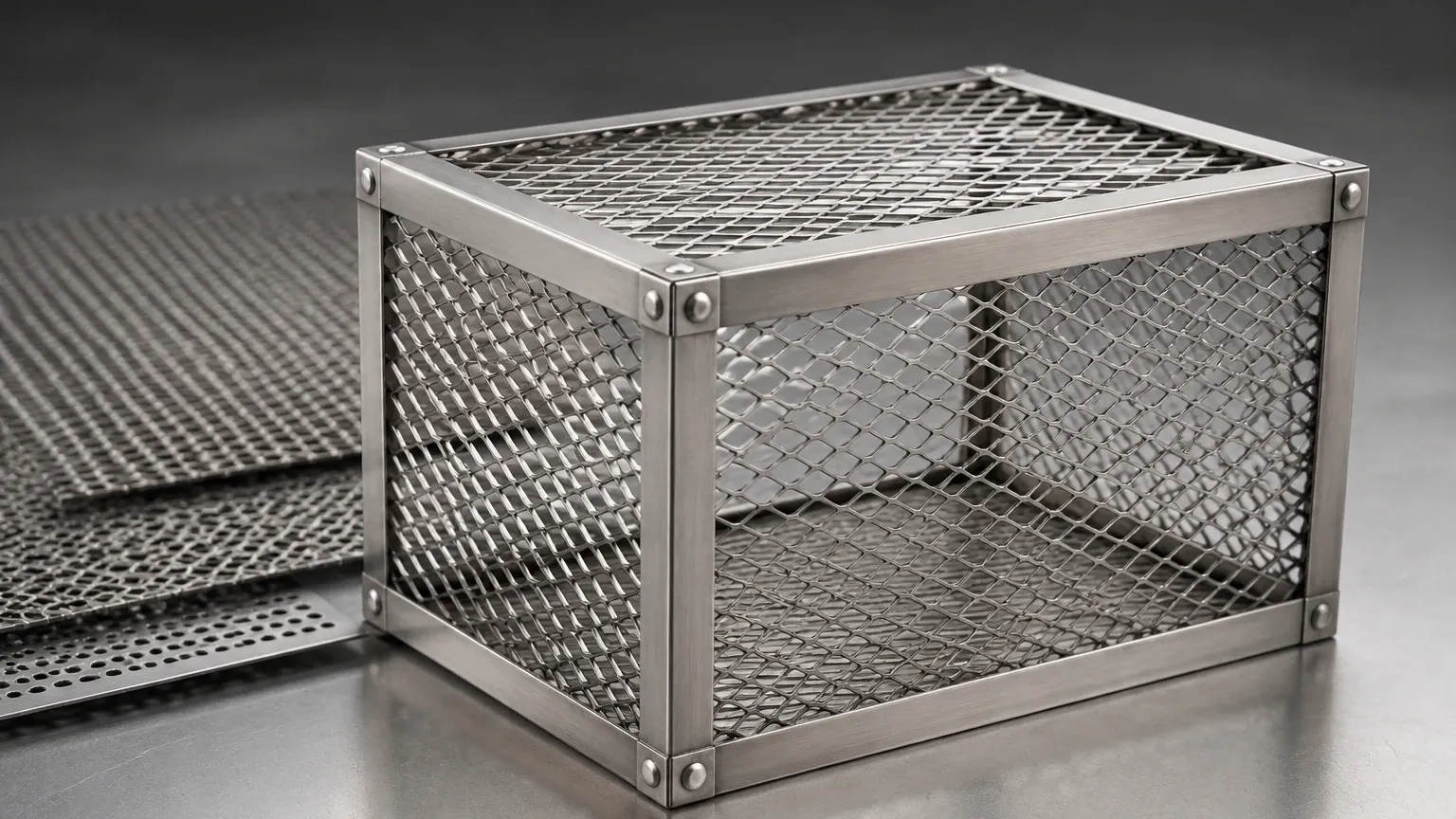
While strength is paramount, a cage must also allow for maximum fluid throughput. The diamond-shaped openings characteristic of expanded metal provide a high percentage of open area. This ensures that the cage does not become a secondary source of pressure drop, which would otherwise reduce the overall efficiency of the system and increase energy consumption in pumping operations.
Engineering Characteristics of Expanded Metal
Understanding how Perforated & Expanded Metal is manufactured is key to evaluating its suitability for specific industrial cages. Unlike perforated metal, which is created by punching holes and removing material (creating scrap), expanded metal is produced through a simultaneous slitting and stretching process.
The Manufacturing Process
A metal sheet is fed through a machine equipped with a reciprocating knife. As the knife slits the metal, it also stretches it, creating a series of interconnected diamond-shaped openings. Because no material is removed, the process is highly resource-efficient and cost-effective. The resulting structure is a single piece of metal without joins or welds within the mesh itself, providing superior strength-to-weight ratios compared to traditional wire mesh or perforated sheets of the same thickness.
Raised vs. Flattened Expanded Metal
For an expanded metal cage, engineers must choose between "raised" and "flattened" varieties:
* Raised Expanded Metal: The strands are set at an angle to the plane of the sheet. While this provides excellent grip and rigidity, the sharp edges can potentially damage delicate filter media if not handled correctly.
* Flattened Expanded Metal: The raised mesh is passed through a cold-rolling mill, which flattens the strands into the same plane as the original sheet. This creates a smooth surface that is ideal for supporting pleated media or fine meshes, as it eliminates the risk of abrasion or puncturing.
Material Selection for Harsh Environments
In B2B industrial sectors, particularly in chemical processing, pharmaceuticals, and food production, material compatibility is non-negotiable. Kaifil specializes in utilizing high-grade alloys to ensure that every expanded metal cage meets the specific chemical and thermal requirements of the application.
Stainless Steel 304 and 316L
Stainless steel is the industry standard for expanded metal cages due to its exceptional corrosion resistance.
* Grade 304: Suitable for general industrial use, including water treatment and hydraulic oil filtration where extreme chemical resistance is not required.
* Grade 316L: The "L" denotes low carbon, which improves weldability and resistance to intergranular corrosion. This grade is essential for marine environments, pharmaceutical processing, and applications involving high-chloride concentrations or acidic fluids.
Specialized Alloys
For extreme environments involving high temperatures or highly aggressive chemicals, cages can be manufactured from specialized materials such as Duplex stainless steel, Monel, or Inconel. These materials ensure that the structural support remains intact even when the filter media is subjected to temperatures exceeding 500°C or exposure to concentrated caustic solutions.
Design Parameters: SWD, LWD, and Open Area
When specifying an expanded metal cage, engineers must define several geometric parameters that dictate the performance of the component. These are typically measured in terms of the diamond opening dimensions.
1. SWD (Short Way of Design): The distance from the center of one bond to the center of the next bond across the short axis of the diamond.
2. LWD (Long Way of Design): The distance across the long axis of the diamond.
3. Strand Width and Thickness: These dimensions determine the overall strength of the cage. A thicker strand provides higher crush resistance but reduces the percentage of open area.
4. Open Area Percentage: This is the ratio of the area of the openings to the total area of the sheet. For filtration cages, an open area of 60% to 80% is common, balancing the need for structural support with the requirement for low flow resistance.
By manipulating these variables, Kaifil can customize cages to meet specific "crush strength" requirements. In hydraulic systems, for instance, a cage may need to withstand surge pressures that momentarily exceed the standard operating range, necessitating a design with narrower diamonds and thicker strands.
Manufacturing Precision: Welding and Finishing
The transition from a flat expanded metal sheet to a cylindrical expanded metal cage requires precision manufacturing. At Kaifil, we employ advanced forming and welding techniques to ensure that the finished product meets rigorous industrial standards.
Seam Welding Techniques
The most common method for forming a cage is to roll the expanded metal into a cylinder and weld the longitudinal seam. We utilize TIG (Tungsten Inert Gas) and plasma welding to create clean, strong, and consistent bonds. For OEM applications where aesthetics and hygiene are paramount (such as in the food and beverage industry), the weld seam must be burr-free and smooth to prevent the accumulation of bacteria or contaminants.
Surface Finishing and Passivation
Post-welding, stainless steel cages often undergo additional treatments:
* Passivation: This chemical process removes free iron from the surface and enhances the protective chromium oxide layer, significantly increasing corrosion resistance.
* Electropolishing: This electrochemical process removes a fine layer of material, resulting in a mirror-like finish. It is often required in pharmaceutical and biotech applications to ensure the surface is ultra-smooth and easy to clean (CIP/SIP compatible).
* Deburring: Essential for expanded metal, deburring ensures that any sharp edges created during the slitting process are removed, protecting both the filter media and the personnel handling the equipment.
Applications Across Industries
The versatility of the expanded metal cage makes it a staple in various high-stakes industrial sectors:
* Chemical and Petrochemical Processing: Cages support sintered metal filters used to recover catalysts or remove impurities from aggressive solvents and high-temperature gases.
* Food and Beverage: Used in the filtration of syrups, juices, and dairy products, where the cage must be made of food-grade stainless steel and withstand frequent high-pressure washdowns.
* Hydraulic and Lubrication Systems: Cages protect hydraulic components by supporting high-efficiency glass fiber media that removes microscopic particulates from oil under high flow rates.
* Water Treatment: In desalination and wastewater management, expanded metal cages serve as the outer protection for pre-filtration elements, shielding them from large debris and turbulent intake flows.
Selection Criteria for Engineers and Procurement
Before finalizing a purchase or design for an expanded metal cage, technical teams should confirm several key factors to ensure the component is fit for purpose:
* Differential Pressure Requirements: What is the maximum expected pressure drop across the filter? The cage must be engineered with a crush strength that exceeds this value by a safety margin (typically 1.5x to 2x).
* Media Compatibility: Is the cage surface smooth enough to avoid damaging the specific filter media being used? If using thin membranes, flattened expanded metal is mandatory.
* Chemical Environment: Will the cage be exposed to halides, acids, or high-temperature steam? This determines whether 304, 316L, or a more exotic alloy is required.
* Dimensional Tolerances: For OEM integration, precise outer and inner diameters are critical for ensuring a proper seal within the filter housing. Even a millimeter of deviation can lead to bypass, where unfiltered fluid escapes the system.
* Cleaning Protocols: Will the filter be cleaned via backpulsing, ultrasonic cleaning, or chemical soaking? The cage must be robust enough to withstand these repetitive stresses without fatigue.
Conclusion: Optimizing Filtration Performance
An expanded metal cage is more than just a container; it is a critical engineering component that defines the reliability of industrial filtration systems. By selecting the correct material, diamond geometry, and finishing process, engineers can significantly enhance the performance and longevity of their filtration equipment.
Kaifil remains committed to providing high-performance, customized Perforated & Expanded Metal solutions that meet the demanding needs of global industries. From material selection and precision welding to final surface treatment, our focus is on delivering dependable filtration components that ensure operational continuity in the most challenging environments. When the structural integrity of your filtration process is on the line, a well-engineered expanded metal cage is the foundation of success.
