


Expanded Metal Explained
In the landscape of industrial manufacturing and filtration, expanded metal serves as a fundamental component for structural support, protective screening, and fluid dynamics management. Unlike woven wire mesh or perforated sheets, expanded metal offers a unique combination of structural integrity and cost-efficiency due to its specific manufacturing process. For engineers and procurement specialists, having expanded metal explained through a technical lens is essential for selecting the correct material for high-pressure or corrosive environments.
At its core, expanded metal is a versatile material produced by simultaneously slitting and stretching a solid metal sheet. This process creates a diamond-shaped pattern of openings, resulting in a continuous piece of metal that lacks joins or welds. Because the material is stretched rather than punched, there is virtually no waste during production, making it a highly sustainable and economical choice compared to other metal processing methods.
The Manufacturing Process: How Expanded Metal is Produced
The production of expanded metal is a precision engineering feat that transforms a solid metal plate or coil into a mesh-like structure. The process begins with a heavy-duty expanding machine equipped with a specialized knife. This knife moves in a reciprocating motion, slitting the metal at specific intervals while the machine’s bed moves forward.
As the knife descends, it creates a row of slits. Simultaneously, the machine stretches the metal, opening the slits into diamond shapes. The knife then shifts laterally and repeats the process, creating a staggered pattern. This "slit and stretch" method ensures that the strands and bonds (the intersections of the diamonds) are part of a single, unified piece of material.
One of the primary advantages of this process is the retention of material strength. Since the metal is not removed—as it is in the production of Perforated & Expanded Metal—the structural integrity of the original sheet is largely maintained, and in some cases, the directional strength is actually enhanced by the orientation of the strands.
Key Terminology and Dimensional Specifications
To accurately specify expanded metal for industrial applications, engineers must be familiar with the industry-standard terminology used to define its dimensions. These measurements dictate the flow rate, filtration accuracy, and mechanical strength of the component.
* SWD (Short Way of Design): This refers to the distance from the center of one bond to the center of the next bond, measured across the short axis of the diamond.
* LWD (Long Way of Design): This is the distance from the center of one bond to the center of the next bond, measured across the long axis of the diamond.
* SWO (Short Way of Opening): The actual width of the opening, measured from the inside edge of one bond to the inside edge of the opposite bond.
* LWO (Long Way of Opening): The actual length of the opening, measured from the inside edge of one bond to the inside edge of the opposite bond.
* Strand Width: The amount of metal fed into the expanding machine between the slits. This determines the thickness of the "wires" that form the diamond.
* Strand Thickness: The original thickness of the metal sheet or coil used for production.
* Bond: The intersection where two strands meet. In expanded metal, the bond is twice as thick as the strand thickness, providing significant rigidity.
Understanding these metrics allows for precise calculation of the open area, which is critical for determining pressure drop in filtration systems.
Standard vs. Flattened Expanded Metal: Structural Differences
When reviewing expanded metal explained in technical manuals, you will encounter two primary forms: standard (raised) and flattened. Each serves distinct purposes in industrial filtration and structural design.
Standard Expanded Metal
Standard expanded metal, also known as "raised" expanded metal, comes directly off the expanding machine. The strands and bonds are set at a uniform angle to the plane of the sheet. This creates a three-dimensional surface with high slip resistance and exceptional strength-to-weight ratios. In filtration, standard expanded metal is often used as a support cage or outer guard because its angled strands provide superior resistance to external crushing forces.
Flattened Expanded Metal
Flattened expanded metal is produced by passing standard expanded metal through a cold-rolling reducing mill. This process flattens the strands and bonds into a single plane, resulting in a smooth, flat surface. While flattening slightly reduces the overall thickness and mechanical rigidity compared to the raised version, it is often preferred when the metal needs to be bonded to other layers, such as fine wire mesh or filter paper. The smooth surface prevents the expanded metal from cutting into or damaging delicate filtration media during pressure fluctuations.
Perforated & Expanded Metal: A Comparative Analysis for Engineers
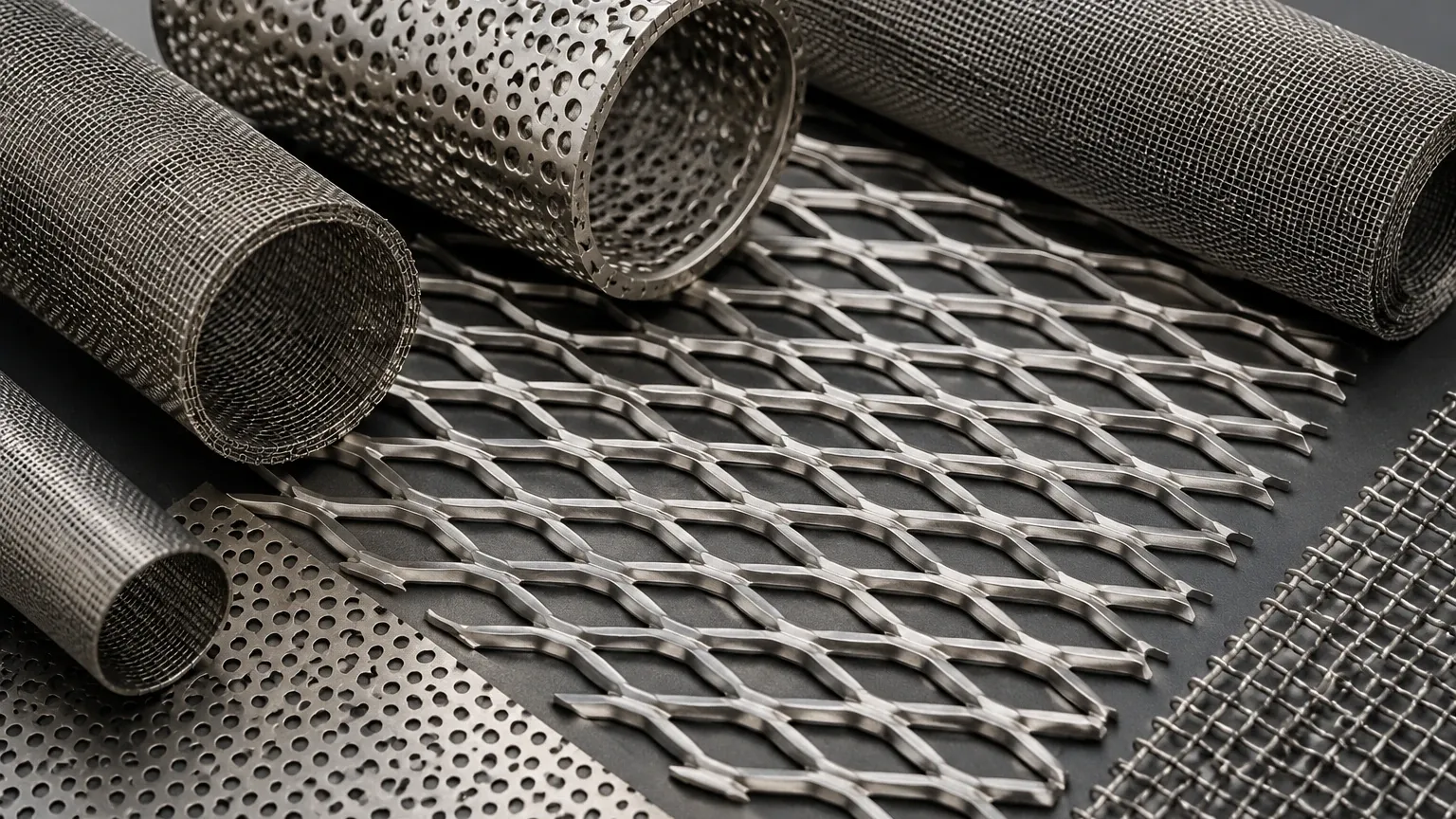
Selecting between Perforated & Expanded Metal is a common challenge for engineers designing filtration housings or support cores. While both provide open areas for fluid or gas passage, their physical properties and manufacturing economics differ significantly.
1. Material Utilization:
Expanded metal is produced with zero waste. In contrast, perforated metal is manufactured by punching holes out of a sheet, which can result in 10% to 60% material loss depending on the hole pattern. For expensive alloys like Stainless Steel 316L or Monel, the cost savings associated with expanded metal are substantial.
2. Structural Integrity:
Expanded metal is a continuous piece of material. The bonds are not welds, but integral parts of the metal. This makes it highly resistant to unraveling or structural failure under vibration. Perforated metal, while also strong, relies on the "bridge" of material between holes. If a bridge fails, the integrity of the entire sheet can be compromised.
3. Flow Characteristics:
The three-dimensional profile of standard expanded metal can induce turbulence, which may be desirable in certain mixing applications but detrimental in high-velocity laminar flow systems. Perforated metal provides a more predictable, linear flow path. Engineers must weigh the benefits of turbulence against the requirement for low pressure drop when choosing between the two.
Material Selection for Demanding Filtration Environments
The performance of expanded metal is heavily dependent on the alloy chosen. In industrial filtration, where exposure to corrosive chemicals, high temperatures, and high pressures is common, material selection is the most critical step in the design process.
* Stainless Steel 304: The most common choice for general industrial use. It offers good corrosion resistance and excellent formability. It is widely used in water treatment and hydraulic filtration.
* Stainless Steel 316/316L: Contains molybdenum, which provides superior resistance to chlorides and pitting. This is the standard for marine environments, chemical processing, and pharmaceutical applications where hygiene and corrosion resistance are paramount.
* Aluminum: Lightweight and corrosion-resistant in specific environments, though it lacks the mechanical strength and temperature resistance of stainless steel.
* Galvanized Steel: A cost-effective option for non-corrosive environments or temporary filtration setups, though it is generally avoided in high-purity food and beverage or pharmaceutical processes.
At Kaifil, we focus on high-performance alloys to ensure that our custom filtration solutions can withstand the rigors of demanding industrial cycles without premature failure.
Application in Industrial Filtration and Support Systems
Expanded metal is rarely the primary filtration medium for fine particles; instead, it serves as the backbone of complex filtration assemblies. Its primary roles include:
Support Cores for Filter Cartridges
In high-pressure hydraulic or chemical systems, pleated filter media can collapse under the force of the fluid. Expanded metal tubes are used as internal support cores, providing the necessary rigidity to keep the pleats open and functional. The high open area ensures that the support core does not significantly contribute to the overall pressure drop of the cartridge.
Outer Guards and Protective Wraps
To protect delicate wire mesh or fiberglass media from mechanical damage during installation or backwashing, expanded metal is often used as an outer wrap. This guard prevents large debris from impacting the primary filter layer and provides a handleable surface for maintenance personnel.
Pre-Filtration and Trash Racks
In water intake systems or large-scale industrial effluent treatment, heavy-duty expanded metal acts as a pre-filter. It captures large solids, branches, or plastic waste before the fluid reaches more sensitive downstream filtration components. Its ability to be manufactured in thick gauges makes it ideal for these high-impact roles.
Engineering Considerations: Open Area and Pressure Drop
When integrating expanded metal into a filtration system, the "Open Area Percentage" is the most vital calculation. This figure represents the ratio of the area of the openings to the total area of the sheet.
Calculating the open area for expanded metal is more complex than for perforated metal because of the strand angle. The formula typically involves the strand width and the SWD. A higher open area results in a lower pressure drop (ΔP), which improves energy efficiency in pumping systems. However, increasing the open area usually requires thinner strands, which reduces the structural load-bearing capacity.
Engineers must find the "Golden Mean" where the expanded metal provides enough support to prevent media migration or collapse while maintaining an open area that meets the flow requirements of the process. In many OEM applications, Kaifil works closely with engineering teams to prototype different strand widths to optimize this balance.
Procurement Checklist: Confirming Specifications for Custom Orders
Before finalizing a purchase order for expanded metal components, technical professionals should confirm the following parameters to ensure the product meets the application requirements:
1. Material Grade: Is the alloy compatible with the chemical composition of the fluid? (e.g., SS316L for acidic environments).
2. Dimensional Accuracy: Have SWD and LWD been defined based on the center of the bonds?
3. Raised vs. Flattened: Does the application require the structural rigidity of raised metal or the surface smoothness of flattened metal?
4. Direction of the Diamond: In cylindrical filters, the orientation of the LWD (parallel or perpendicular to the axis) affects the tube’s crush strength.
5. Edge Requirements: Should the edges be "random sheared" (leaving open diamonds) or "bond sheared" (leaving a solid edge)? Bond shearing is often safer for manual handling.
6. Cleaning Standards: For food, beverage, or pharmaceutical use, does the metal require ultrasonic cleaning or passivation to remove oils and residues from the expanding process?
By addressing these factors, purchasing teams can avoid common pitfalls such as material incompatibility or structural failure under operating loads.
For those seeking precision-engineered components, exploring the full range of Perforated & Expanded Metal options is the first step toward optimizing industrial filtration performance. Whether you require a custom support core for a hydraulic system or a durable pre-filter for chemical processing, understanding the technical nuances of expanded metal ensures a reliable, cost-effective solution.
