


Expanded Metal for Grill Grate
In industrial food processing, commercial kitchen equipment manufacturing, and heavy-duty outdoor cooking applications, the selection of grate materials is a critical engineering decision. While various options exist, expanded metal has emerged as a primary choice due to its structural efficiency, cost-effectiveness, and thermal properties. Understanding the technical nuances of expanded metal for grill grate applications is essential for engineers and purchasing teams who must balance performance, durability, and food safety compliance.
Expanded metal is not a woven or welded product; rather, it is manufactured by simultaneously slitting and stretching a solid sheet of metal. This process creates a diamond-patterned mesh that is integral to the original sheet, ensuring there are no joints or welds to fail under thermal stress. When sourcing Perforated & Expanded Metal, technical professionals must evaluate material grades, pattern geometries, and surface finishes to ensure the final product meets the rigorous demands of industrial environments.
The Role of Expanded Metal in Industrial Grilling and Food Processing
Expanded metal serves a dual purpose in grilling applications: it provides a stable structural surface to support the product being processed and acts as a medium for heat distribution. In industrial settings, such as large-scale smokehouses or commercial dehydrators, the grate must withstand constant thermal cycling without warping or losing its structural integrity.
One of the primary advantages of using expanded metal for grill grate construction is the "truss-like" characteristic of the diamond pattern. Each strand of the mesh acts as a structural member, distributing weight across the entire sheet. This allows for a high strength-to-weight ratio, which is particularly beneficial in large-scale installations where reducing the weight of removable grates improves ergonomic safety for operators. Furthermore, because the manufacturing process involves no waste—unlike perforated metal where the holes are punched out—expanded metal is often a more cost-effective solution for large-volume OEM projects.
Material Selection: Balancing Durability and Food Safety
The choice of alloy is perhaps the most significant factor in the longevity and safety of a grill grate. In the B2B sector, materials must comply with international standards for food contact surfaces, such as those set by the FDA or NSF.
Stainless Steel (304 and 316 Grades)
For most professional and industrial applications, stainless steel is the gold standard. Grade 304 stainless steel offers excellent corrosion resistance and can withstand the high temperatures typical of grilling without significant oxidation. For environments involving high salt concentrations (such as brining operations) or exposure to harsh cleaning chemicals, Grade 316 stainless steel is preferred due to its molybdenum content, which provides superior resistance to pitting and crevice corrosion.
Carbon Steel
Carbon steel expanded metal is frequently used in heavy-duty industrial smokers and large outdoor grills where cost is a primary constraint. While carbon steel has excellent thermal conductivity, it is highly susceptible to oxidation (rust). In a B2B context, carbon steel grates require a seasoning process or specialized coatings to remain functional and safe for food contact. However, for high-volume industrial filtration or support components that are not in direct contact with food, carbon steel remains a viable, budget-friendly option.
Technical Specifications: Raised vs. Flattened Expanded Metal
When specifying expanded metal for grill grate use, engineers must choose between "raised" (standard) and "flattened" varieties. This distinction significantly impacts both the performance of the grate and the ease of maintenance.
Raised Expanded Metal
Raised expanded metal is the product as it comes off the expanding machine. The strands and bonds are set at a uniform angle to the plane of the sheet. This creates a textured surface that provides excellent grip and allows for maximum airflow. However, in a grilling context, the sharp edges of the raised strands can make cleaning difficult and may cause food to stick or tear. Raised metal is often used as a secondary support layer or in industrial drying racks where airflow is prioritized over surface smoothness.
Flattened Expanded Metal
Flattened expanded metal is produced by passing the raised expanded sheet through a cold-rolling reducing mill. This process flattens the strands and bonds into a single plane, resulting in a smooth, level surface. For grill grates, flattened metal is almost always the superior choice. It provides a larger surface area for heat transfer to the food, reduces the risk of sticking, and is significantly easier to clean with industrial scraping tools. Additionally, the flattening process increases the overall stability of the sheet, making it easier to weld into frames.
Geometry and Airflow: Optimizing Filtration and Heat Distribution
The geometry of the diamond opening is defined by two primary measurements: the Long Way of the Diamond (LWD) and the Short Way of the Diamond (SWD). These dimensions, combined with the strand width and thickness, determine the "open area" percentage of the grate.
In industrial grilling, the open area percentage is a critical variable. An open area that is too small will restrict airflow and heat convection, leading to uneven cooking and potential grease buildup. Conversely, an open area that is too large may lack the structural strength to support heavy loads or may allow smaller food items to fall through.
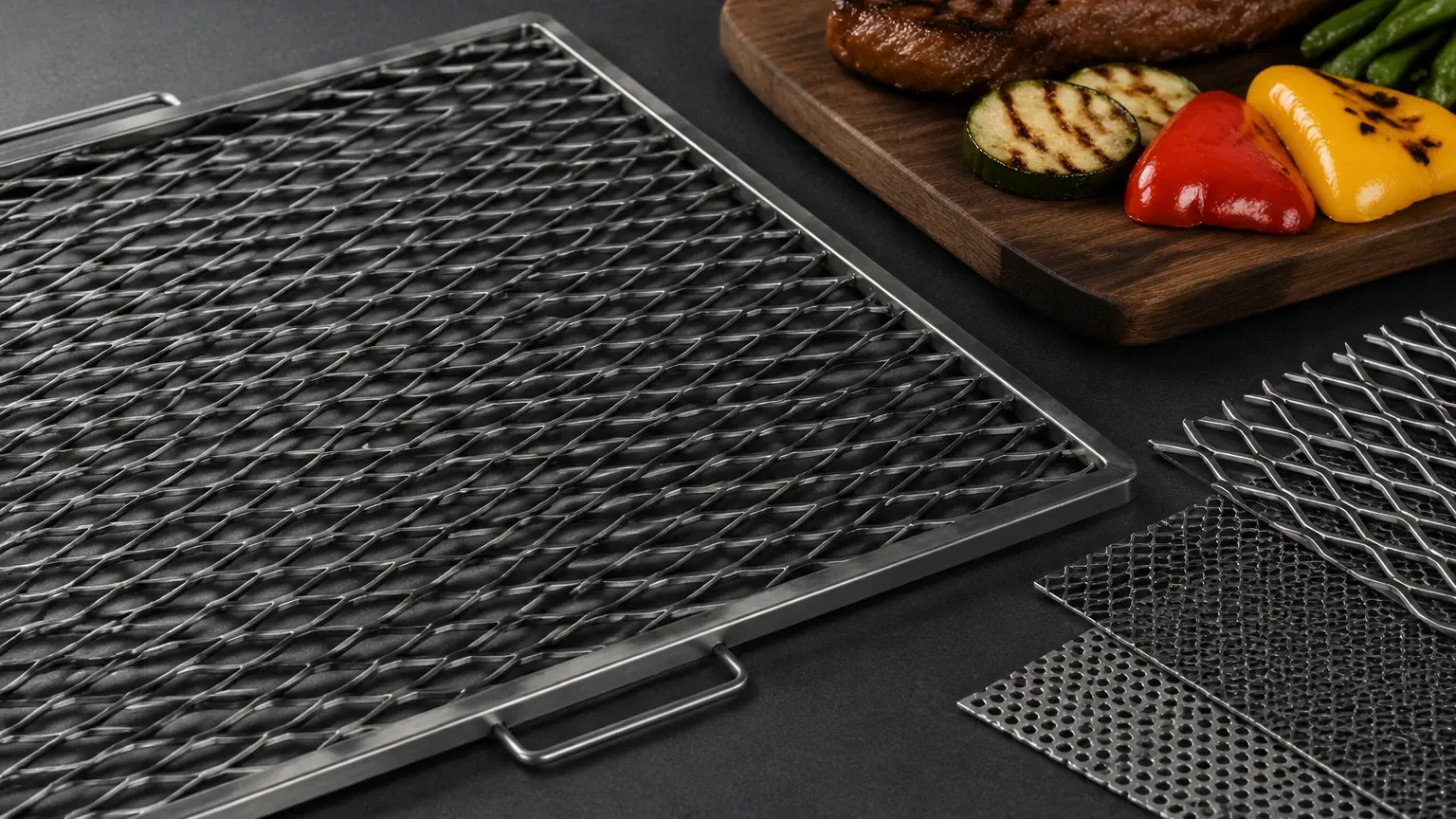
Common specifications for expanded metal for grill grate applications include:
* Small Diamond Patterns: Used for delicate items like seafood or vegetables in industrial dehydrators.
* Medium Diamond Patterns: The standard for commercial grill grates, providing a balance between airflow and structural support.
* Large Diamond Patterns: Typically reserved for heavy-duty charcoal grates or fire pit liners where the primary goal is to allow ash to fall through while supporting heavy fuel loads.
Structural Integrity and Load-Bearing Considerations
Engineers must calculate the load-bearing capacity of expanded metal based on the span of the grate and the expected weight of the product. Because expanded metal is directional, its strength varies depending on how the diamonds are oriented. The LWD should generally run perpendicular to the support members to maximize the load-bearing capacity.
Thermal expansion is another critical engineering consideration. In high-heat environments, metal expands. If a grill grate is rigidly fixed within a frame without accounting for this expansion, it may buckle or warp. Designing grates with floating supports or using materials with lower coefficients of thermal expansion can mitigate these risks. Stainless steel, while excellent for corrosion resistance, has a higher rate of thermal expansion than carbon steel, requiring careful tolerance planning during the design phase.
Customization and Manufacturing Precision
For OEM manufacturers, the ability to customize expanded metal components is vital. Standard off-the-shelf sheets rarely meet the specific requirements of complex industrial equipment. Customization options typically include:
1. Precision Shearing: Cutting the expanded metal to exact dimensions to fit specific grill frames or filtration housings.
2. Framing and Edging: Attaching U-edging, angle iron, or flat bars to the perimeter of the expanded metal. This not only increases the structural rigidity but also covers sharp edges, improving safety for end-users.
3. Surface Finishing: For stainless steel grates, electropolishing is a common requirement. This process removes surface contaminants and creates a microscopically smooth finish that enhances corrosion resistance and makes the grate easier to sanitize.
4. Custom Patterns: While diamond patterns are standard, variations in strand width and opening size can be engineered to meet specific filtration or heat transfer requirements.
Total Cost of Ownership and Maintenance Cycles
When evaluating expanded metal for grill grate applications, purchasing teams should look beyond the initial acquisition cost and consider the total cost of ownership (TCO). A lower-cost carbon steel grate may require frequent replacement due to corrosion or high maintenance costs associated with cleaning and seasoning.
In contrast, a high-quality stainless steel grate manufactured with precision-flattened expanded metal may have a higher upfront cost but will offer a significantly longer service life. In industrial food processing, reducing downtime for equipment maintenance or grate replacement is a key driver of profitability. Furthermore, the ease of cleaning a properly finished stainless steel grate reduces the labor costs associated with daily sanitation protocols.
Conclusion: Selecting the Right Solution
Selecting the appropriate expanded metal for grill grate applications requires a deep understanding of material science, mechanical engineering, and food safety standards. By focusing on flattened stainless steel with optimized diamond geometries, manufacturers can produce grates that offer superior performance, longevity, and ease of use.
As a professional manufacturer of filtration and metal components, Kaifil provides the technical expertise necessary to support complex industrial projects. Whether you require custom-sized sheets or fully framed OEM components, our focus on quality and precision ensures that your filtration and structural needs are met with the highest standards of engineering excellence. Before proceeding with a purchase, engineers should confirm the specific load requirements, temperature ranges, and cleaning protocols to ensure the selected specification is fit for the intended application.
