


Expanded Metal Is
In the landscape of industrial filtration and structural engineering, understanding exactly what expanded metal is involves more than just recognizing its diamond-shaped pattern. For engineers and procurement specialists, expanded metal represents a unique category of material that balances structural rigidity with high open-area ratios, often serving as the backbone for complex filtration systems. Unlike other mesh types, expanded metal is produced through a precise process of slitting and stretching, which ensures that no material is lost during fabrication, making it an exceptionally cost-effective and sustainable choice for demanding industrial environments.
At Kaifil, we specialize in integrating high-performance Perforated & Expanded Metal into custom filtration solutions. This article provides a technical deep dive into the properties, manufacturing nuances, and selection criteria for expanded metal, specifically tailored for B2B applications in chemical processing, hydraulics, and water treatment.
The Fundamental Manufacturing Process
To understand why this material is favored in industrial design, one must first understand the mechanical process behind its creation. Expanded metal is manufactured by taking a solid sheet of metal—typically stainless steel, carbon steel, or aluminum—and feeding it through a machine equipped with a specialized knife. This knife performs a series of precise slits while simultaneously stretching the metal sheet in a single motion.
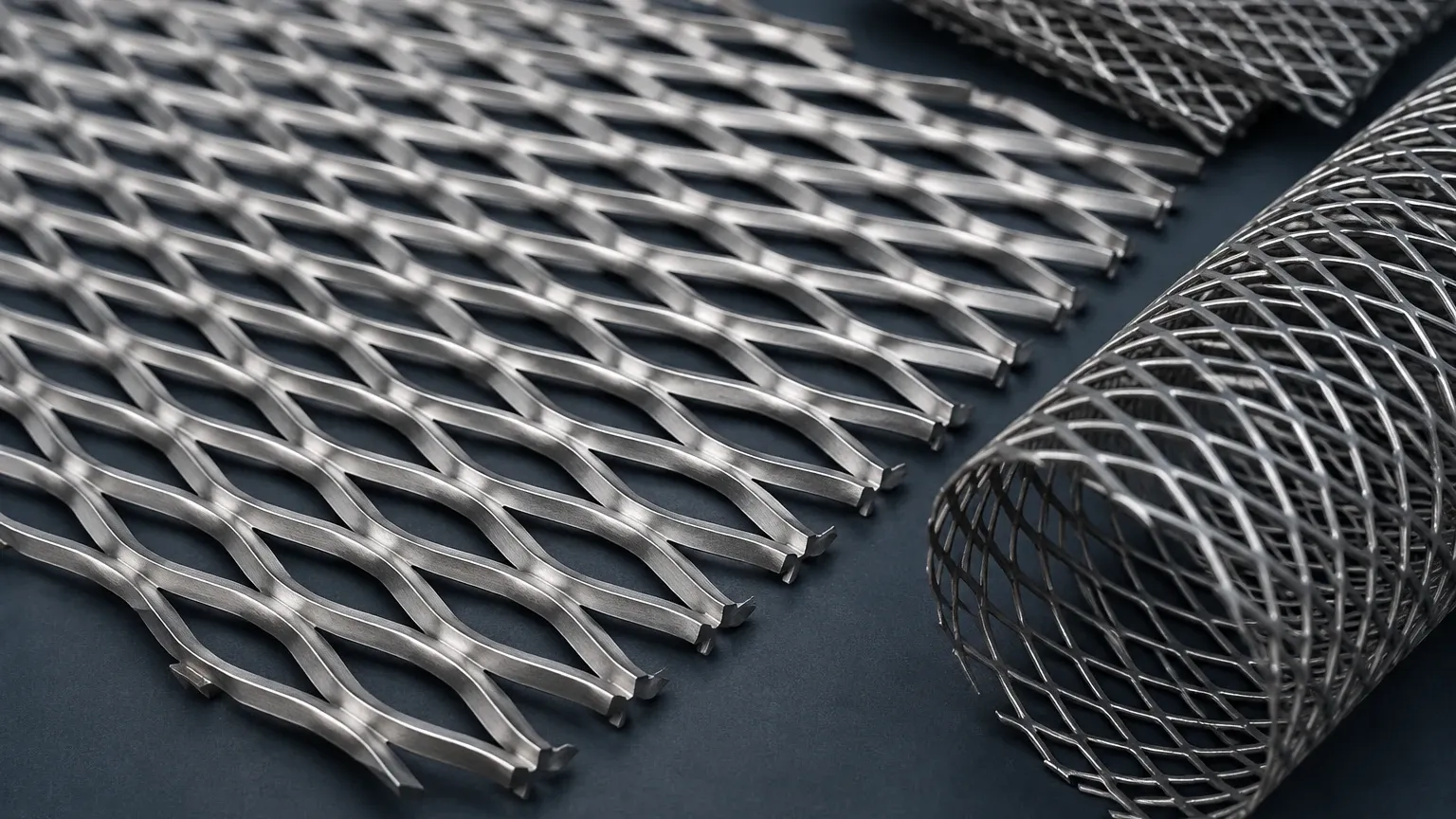
This "slitting and stretching" mechanism creates a series of interconnected diamonds. Because the metal is stretched rather than punched, the structural integrity of the original sheet is maintained. There are no welds or joints in the mesh; the "bonds" (the points where the diamonds meet) are part of the original solid metal. This lack of joints is a critical engineering advantage, as it eliminates potential points of failure that are common in woven or welded wire meshes. For filtration applications, this means the material can withstand significant pressure differentials without the risk of the strands separating or the mesh unravelling.
Structural Variations: Raised vs. Flattened
When specifying expanded metal for a project, engineers must decide between two primary forms: standard (raised) and flattened. Each offers distinct performance characteristics in a filtration or support context.
Standard (Raised) Expanded Metal
In its raw form immediately following the stretching process, the strands are set at an angle to the plane of the sheet. This creates a three-dimensional surface. The primary benefit of raised expanded metal is its superior strength-to-weight ratio and its ability to provide mechanical grip. In filtration, the raised strands can help break up flow patterns, potentially reducing laminar flow and increasing turbulence, which can be beneficial in certain mixing or pre-filtration stages. However, the thickness of the sheet is significantly increased in this state, which must be accounted for in housing tolerances.
Flattened Expanded Metal
Flattened expanded metal is produced by passing the standard raised sheet through a cold-roll reducing mill. This process flattens the strands and bonds back into the original plane of the sheet. The result is a smooth, flat surface that is slightly thinner and elongated compared to the original. Flattened expanded metal is often preferred when the material is used as an outer cage for a filter cartridge or as a support layer for fine wire cloth. The flat surface prevents the delicate filter media from being abraded or punctured by the angled strands of a raised mesh.
Key Technical Specifications for Engineers
Selecting the right Perforated & Expanded Metal requires a precise understanding of the terminology used to define its geometry. When requesting a quote or designing a component, the following four metrics are essential:
1. SWD (Short Way of Design): The distance from the center of one bond to the center of the next bond measured across the short diamond diagonal.
2. LWD (Long Way of Design): The distance from the center of one bond to the center of the next bond measured across the long diamond diagonal.
3. Strand Width: The amount of metal fed into the knives to produce one strand.
4. Strand Thickness: The thickness of the base metal sheet.
These dimensions dictate the "open area" of the mesh. In industrial filtration, the open area is a primary calculation for determining flow rate and pressure drop. A higher open area reduces resistance to fluid or gas flow, while a lower open area provides greater mechanical strength and protection for internal filter elements.
Comparing Perforated and Expanded Metal in Filtration
While both materials fall under the broader category of metal screens, the choice between Perforated & Expanded Metal often comes down to the specific requirements of the application.
Perforated metal is created by punching holes into a sheet. This allows for a wide variety of hole shapes (round, square, hexagonal) and highly precise hole placement. However, the punching process creates scrap material (the "slugs"), which increases the cost of the raw material. Furthermore, the structural integrity of the sheet is reduced because metal is removed.
In contrast, expanded metal is more resource-efficient. Since no material is removed, you often get a larger finished sheet than the original raw sheet you started with. From a structural perspective, the interconnected diamond strands distribute loads more effectively than a perforated sheet of the same weight. For heavy-duty hydraulic filters or large-scale water intake screens, expanded metal provides the necessary rigidity to prevent the collapse of the filter assembly under high-pressure surges.
Applications in Industrial Filtration Systems
Kaifil integrates expanded metal into various filtration components, focusing on durability and precision. In many industrial settings, the role of expanded metal is multifaceted:
* Support Cores and Cages: In stainless steel filter cartridges, expanded metal serves as the internal core or the external protective cage. It provides the mechanical strength required to support pleated wire mesh or sintered fiber felt, ensuring the filter maintains its shape under high differential pressure.
* Pre-Filtration Screens: For coarse filtration in water treatment or HVAC systems, expanded metal acts as a primary barrier to remove large debris before the fluid reaches finer, more expensive filtration stages.
* Diffuser Plates: The angled strands of raised expanded metal can be used to diffuse gas or liquid flow, ensuring even distribution across a catalyst bed or a fine filter membrane.
* Flame Arrestors: Due to its high thermal conductivity and ability to break up gas flow, stainless steel expanded metal is frequently used in safety components to dissipate heat and prevent the passage of flames.
Material Selection and Environmental Resistance
The performance of expanded metal is heavily dependent on the alloy selected. For most B2B industrial applications, stainless steel is the gold standard due to its corrosion resistance and mechanical properties at high temperatures.
* Grade 304: Suitable for general industrial use, providing good resistance to atmospheric corrosion and many organic and inorganic chemicals. It is commonly used in food and beverage filtration.
* Grade 316/316L: Contains molybdenum, which provides superior resistance to chlorides and pitting. This is the preferred choice for marine environments, pharmaceutical manufacturing, and aggressive chemical processing.
* Specialty Alloys: For extreme environments, materials like Monel, Inconel, or Titanium can be expanded to meet specific thermal or chemical requirements.
When evaluating material, engineers should also consider the finish. Passivation is often recommended for stainless steel expanded metal to remove surface contaminants and enhance the protective chromium oxide layer, ensuring longevity in corrosive fluids.
Quality Control and Procurement Risks
When sourcing Perforated & Expanded Metal, there are several quality risks that procurement teams must mitigate. Because the material is stretched, there is a risk of "strand thinning" if the process is not controlled correctly. If the strands are too thin, the mesh may fail prematurely under vibration or pressure cycles.
Another common issue is the presence of burrs. The slitting process naturally creates sharp edges. In filtration, these burrs can shed metal particles into the downstream flow (media migration) or damage the fine mesh layers they are intended to support. At Kaifil, we employ rigorous deburring and cleaning processes to ensure that every expanded metal component is safe for use in sensitive applications like pharmaceutical or high-purity chemical production.
Engineers should also confirm the "camber" and "out-of-square" tolerances. If an expanded metal sheet is not perfectly square, it can cause alignment issues during the welding or assembly of filter cartridges, leading to leaks or structural weaknesses.
Customization: Tailoring Expanded Metal to Your Needs
One of the greatest advantages of working with a specialized manufacturer like Kaifil is the ability to customize the expansion parameters. Standard off-the-shelf expanded metal often fails to meet the specific pressure drop or particle retention requirements of specialized industrial equipment.
Customization options include:
* Variable Diamond Sizes: Adjusting the SWD and LWD to match specific flow dynamics.
* Custom Sheet Sizes: Reducing waste by producing sheets that match the exact dimensions of the final filter housing.
* Integrated Borders: Leaving solid metal borders on the edges of the expanded sheet to facilitate easier and stronger welding into a frame or cylinder.
* Multi-Layer Laminates: Combining expanded metal with fine wire mesh through sintering or mechanical bonding to create a single, high-strength filtration element.
Conclusion: Why Expanded Metal Is the Efficient Choice
In summary, expanded metal is a high-efficiency, high-strength material that provides critical support and filtration capabilities across a wide range of industries. Its unique manufacturing process offers a combination of structural integrity and cost-effectiveness that is difficult to match with other materials. By understanding the technical nuances of SWD, LWD, and the differences between raised and flattened forms, engineers can better specify components that will perform reliably in the field.
Whether you are designing a new hydraulic system or looking to optimize the lifespan of your chemical processing filters, choosing the right Perforated & Expanded Metal is a foundational step. At Kaifil, we combine advanced manufacturing expertise with deep engineering knowledge to provide filtration solutions that meet the most demanding specifications. By focusing on material purity, dimensional accuracy, and application-specific design, we help our global partners achieve optimal filtration performance and reduced total cost of ownership.
