


Expanded Metal Okc
In the landscape of industrial manufacturing and filtration, selecting the right material for structural support and media protection is critical to the longevity of a system. When engineers and procurement professionals search for expanded metal okc, they are often looking for high-performance materials that can withstand the rigors of chemical processing, hydraulic systems, or water treatment. Expanded metal is a versatile product created by slitting and stretching a single metal sheet, resulting in a diamond-shaped pattern that offers an exceptional strength-to-weight ratio.
For industrial applications, particularly those involving filtration, understanding the technical nuances of expanded metal is essential. It is not merely a decorative mesh; it is a functional component that provides structural integrity to filter cartridges, protects delicate wire mesh layers, and facilitates specific fluid dynamics within a system. This guide explores the engineering considerations, material properties, and selection criteria necessary for sourcing high-quality expanded metal solutions.
The Role of Expanded Metal in Industrial Filtration and Support
Expanded metal serves several primary functions in industrial environments. Unlike woven wire mesh, which is made of individual wires, expanded metal is a monolithic piece of material. This lack of joints or welds within the mesh structure makes it inherently strong and resistant to unraveling, even when cut into complex shapes.
In filtration systems, expanded metal is frequently used as a support core or an outer protective wrap for filter elements. In high-pressure hydraulic applications, for instance, the filter media (such as fine stainless steel wire mesh) requires a rigid skeleton to prevent collapse under differential pressure. Expanded metal provides this rigidity while maintaining a high percentage of open area, ensuring that flow rates are not significantly restricted.
Furthermore, the "bond"—the point where the strands intersect—is a solid part of the original metal sheet. This provides a level of mechanical stability that is difficult to achieve with other types of metal mesh. For those sourcing expanded metal okc for industrial projects, the focus is often on how these structural properties translate to reduced maintenance costs and extended service life for equipment.
Understanding the Manufacturing Process: Standard vs. Flattened
When specifying expanded metal, engineers must choose between two primary forms: standard (raised) and flattened. Each has distinct characteristics that affect both performance and the physical footprint of the component.
Standard Expanded Metal
Standard expanded metal, also known as raised expanded metal, is the product as it comes off the expanding machine. The strands and bonds are set at a uniform angle to the plane of the sheet. This creates a three-dimensional surface that provides excellent grip and can influence the direction of fluid or air flow. In certain filtration applications, this angularity can be used to create turbulence, which may be desirable in specific mixing or heat exchange processes.
Flattened Expanded Metal
Flattened expanded metal is produced by passing the standard expanded sheet through a cold-roll reducing mill. This process flattens the strands and bonds into a single plane, resulting in a smooth, flat surface. Flattened expanded metal is often preferred for filter support because the smooth surface prevents the fine filter media from being abraded or punctured by the raised edges of a standard mesh. It also results in a thinner overall profile, which is crucial when designing compact filter cartridges with tight tolerances.
Key Technical Specifications for Engineering Selection
To ensure the performance of Perforated & Expanded Metal in a specific application, several technical parameters must be defined. These specifications determine the mesh's strength, weight, and filtration characteristics.
1. SWD (Short Way of Design): This is the distance from the center of one bond to the center of the next bond measured across the short diamond diagonal.
2. LWD (Long Way of Design): The distance from the center of one bond to the center of the next bond measured across the long diamond diagonal.
3. SWO (Short Way of Opening): The actual width of the opening, measured across the short diagonal.
4. LWO (Long Way of Opening): The actual length of the opening, measured across the long diagonal.
5. Strand Width: The amount of metal fed into the machine to produce one strand.
6. Strand Thickness: The thickness of the original base metal.
Engineers must calculate the Open Area Percentage based on these dimensions. The open area is a critical factor in determining the pressure drop across a filter. A higher open area reduces resistance to flow but may decrease the structural strength of the mesh. Balancing these two factors is a core part of the design process for any custom filtration solution.
Material Considerations: Why Stainless Steel Dominates Demanding Environments
While expanded metal can be manufactured from carbon steel, aluminum, or copper, stainless steel remains the gold standard for industrial filtration. The choice of material is dictated by the operating environment, including temperature, chemical exposure, and pressure requirements.
* Stainless Steel 304: This is the most common grade used in industrial settings. It offers excellent corrosion resistance and is suitable for most food and beverage, pharmaceutical, and general industrial applications.
* Stainless Steel 316/316L: Containing molybdenum, Grade 316 provides superior resistance to chlorides and marine environments. It is the preferred choice for chemical processing and applications where the metal will be exposed to aggressive solvents or acids.
* High-Temperature Alloys: For specialized applications like exhaust filtration or high-heat chemical reactors, alloys such as Inconel or Monel may be used to maintain structural integrity at temperatures where standard stainless steel would fail.
Using stainless steel for expanded metal components ensures that the system remains free from rust contamination, which is vital in high-purity industries. Furthermore, stainless steel's durability allows for repeated cleaning and sterilization, supporting a longer replacement cycle and lower total cost of ownership.
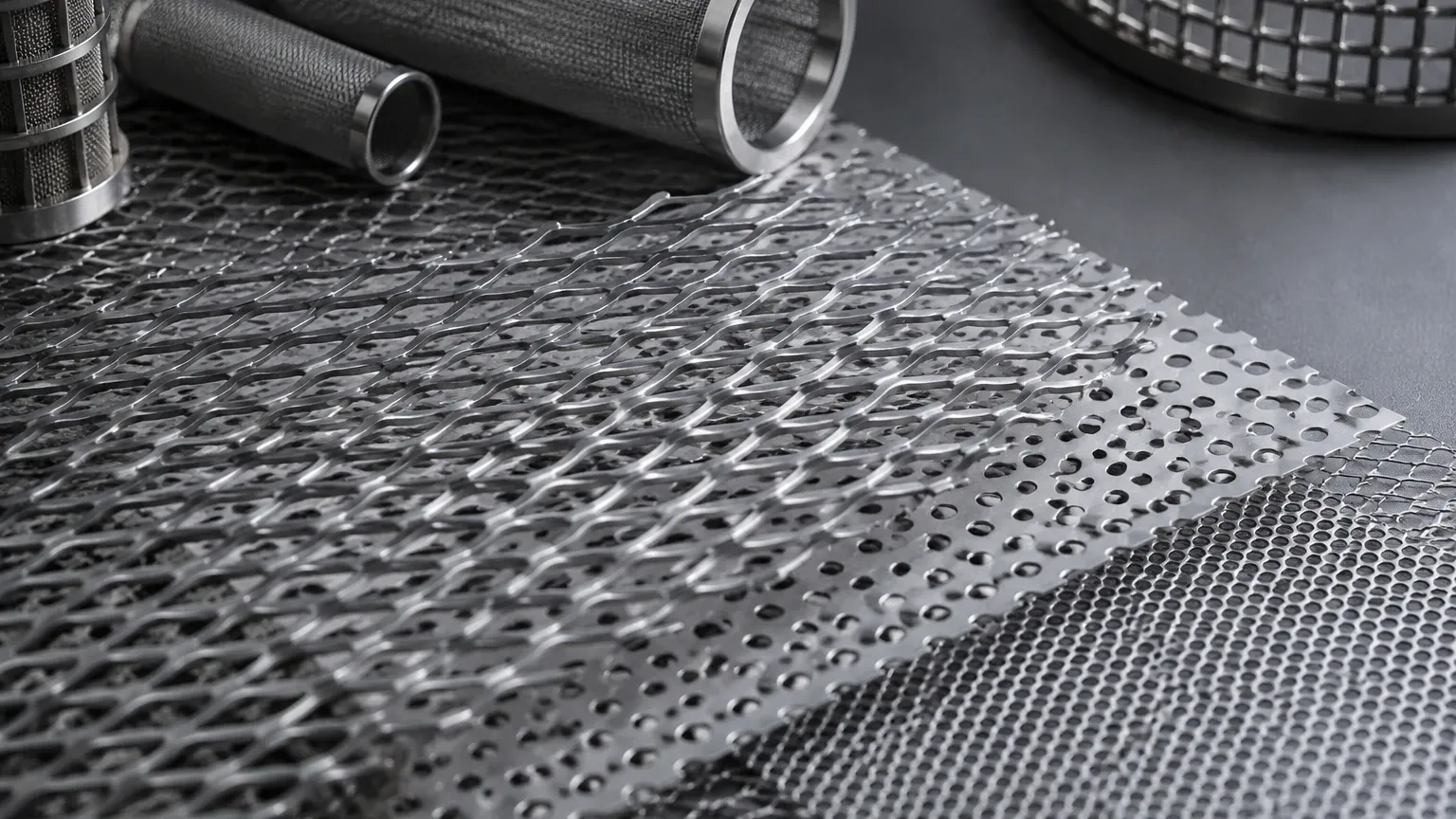
Perforated & Expanded Metal: Choosing the Right Media for Your Application
When evaluating options for metal filtration components, engineers often compare perforated metal with expanded metal. While both serve similar roles, their mechanical properties and manufacturing efficiencies differ.
Perforated Metal is created by punching holes into a solid sheet. This allows for extremely precise hole patterns and sizes, making it ideal for fine filtration where exact particle retention is required. However, the punching process creates scrap metal (the "slugs"), which can increase the material cost.
Expanded Metal, by contrast, is produced by slitting and stretching, which means there is virtually no material waste. This makes it a more cost-effective solution for many structural and support applications. While it may not offer the same level of micro-precision in hole size as perforated metal, its strength and economy make it the preferred choice for secondary support layers and protective cages.
In many advanced filtration designs, both materials are used in tandem. A perforated metal core might provide the primary support for a fine mesh, while an outer layer of expanded metal protects the entire assembly from mechanical damage during installation or cleaning.
Engineering Considerations for Custom Filtration Solutions
Sourcing expanded metal okc for specialized industrial use requires more than just picking a part number from a catalog. Customization is often necessary to meet the specific demands of a system. When working with a manufacturer like Kaifil, engineers should consider the following:
Dimensional Tolerances
In precision machinery, even a fraction of a millimeter can affect the assembly of a filter cartridge. Specifying tight tolerances for the LWD and SWD, as well as the overall sheet dimensions, is essential for ensuring a proper fit within the housing.
Edge Configurations
Expanded metal can be supplied with "random sheared" edges or "bond sheared" edges. Random shearing leaves open diamonds and potentially sharp points, whereas bond shearing cuts through the solid intersections to provide a cleaner, safer edge. For components that will be handled frequently or integrated into delicate assemblies, edge treatment is a significant consideration.
Surface Finish
Depending on the application, expanded metal may require additional finishing. Electropolishing is common in the pharmaceutical and food industries to remove surface imperfections and enhance corrosion resistance. For other applications, pickling and passivation may be sufficient to ensure the stainless steel remains resistant to oxidation.
Sourcing and Quality Assurance for Industrial Projects
For procurement teams, the reliability of the supplier is as important as the technical specifications of the metal. When evaluating providers for expanded metal okc, it is crucial to confirm their quality control processes. This includes material traceability (ensuring the stainless steel meets ASTM or ISO standards) and consistency in the expansion process.
A professional manufacturer provides detailed documentation, including Material Test Reports (MTRs), which verify the chemical composition of the alloy. This level of transparency is vital for industries where material failure could lead to significant downtime or safety risks.
Furthermore, the ability to provide OEM services—where the expanded metal is manufactured to a specific design—allows engineers to optimize their filtration systems for performance rather than being limited by off-the-shelf availability. This includes custom diamond sizes, specialized materials, and unique sheet dimensions tailored to the specific geometry of the industrial equipment.
Conclusion: Optimizing Performance with Precision Expanded Metal
Expanded metal is a cornerstone of industrial filtration and structural support. Its unique manufacturing process provides a combination of strength, open area, and cost-efficiency that is difficult to match with other materials. Whether used as a support core in a hydraulic filter or a protective screen in a chemical reactor, the quality of the expanded metal directly impacts the efficiency and reliability of the entire system.
By focusing on technical specifications such as SWD/LWD, material grades like 316L stainless steel, and the choice between standard and flattened forms, engineers can ensure they are selecting the best possible component for their application. For those seeking high-performance solutions, partnering with a manufacturer that understands the nuances of industrial filtration is the most effective way to achieve long-term success. To explore specific configurations and technical support for your next project, Review product options and application support to find the ideal balance of durability and performance.
