


Expanded Metal Open Area
In industrial engineering and filtration design, the concept of "open area" is a fundamental metric that dictates the performance, efficiency, and structural suitability of a material. When specifying Perforated & Expanded Metal for applications ranging from hydraulic strainers to architectural ventilation, understanding the nuances of the expanded metal open area is critical for ensuring optimal flow rates and mechanical integrity.
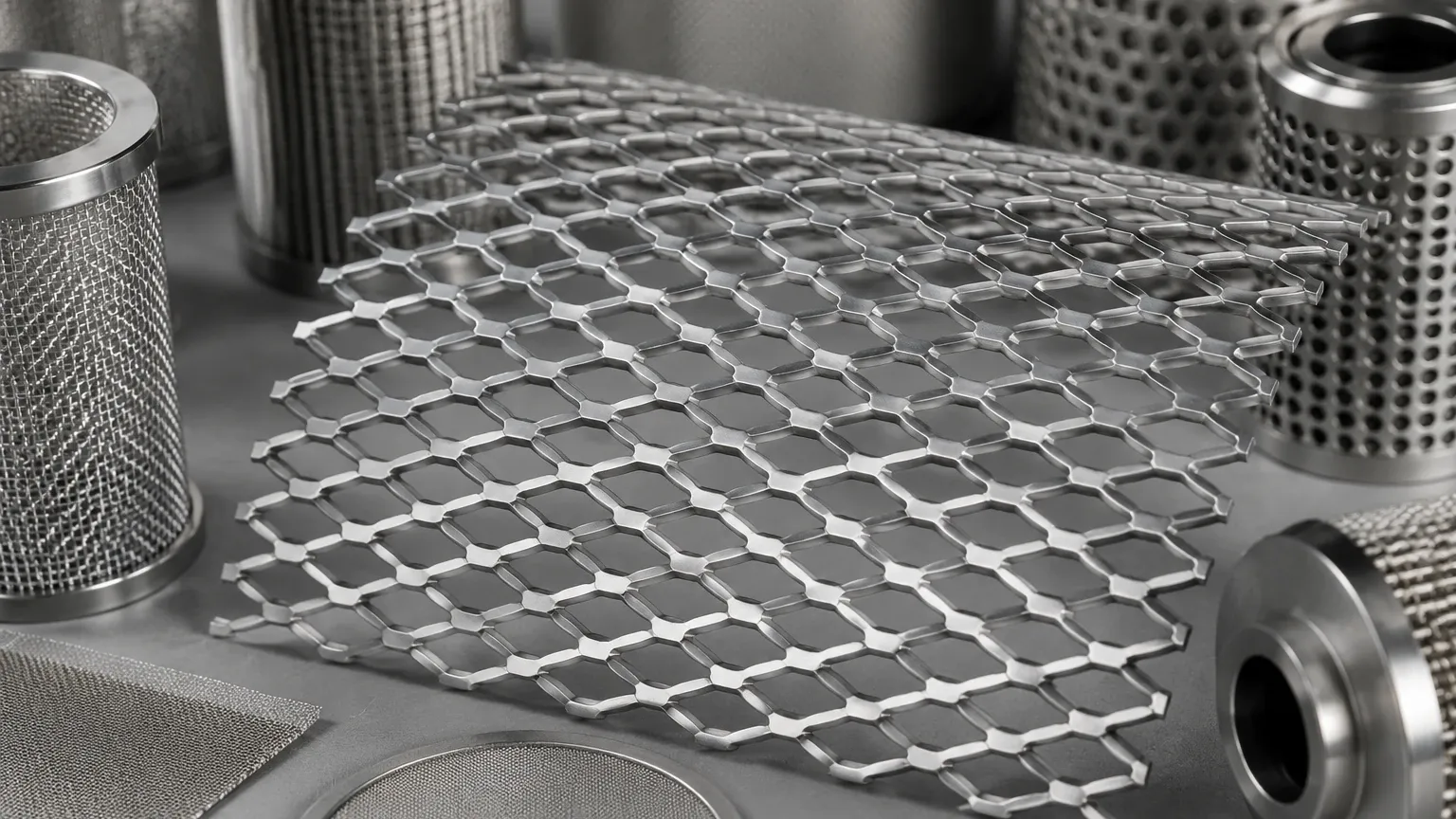
Expanded metal is unique because of its manufacturing process. Unlike perforated metal, which is created by punching holes and removing material, expanded metal is produced by simultaneously slitting and stretching a solid sheet. This process creates a diamond-shaped pattern without any material waste. However, because the material is stretched and the strands are often angled, calculating and selecting the correct open area requires a technical understanding of the mesh geometry.
The Fundamentals of Expanded Metal Geometry
To accurately evaluate the expanded metal open area, one must first master the terminology used to describe its dimensions. The geometry of the diamond opening is defined by four primary measurements:
1. LWD (Long Way of Diamond): The distance from a point on a diamond to the same point on the next diamond, measured across the long axis.
2. SWD (Short Way of Diamond): The distance from a point on a diamond to the same point on the next diamond, measured across the short axis.
3. Strand Width: The amount of metal between the openings; essentially the width of the metal "rib" created during the slitting process.
4. Strand Thickness: The gauge or thickness of the original metal sheet.
In standard "raised" expanded metal, the strands are set at an angle to the plane of the sheet. This creates a three-dimensional profile that provides high rigidity but also complicates the calculation of the open area. When the material is "flattened," it is passed through a cold-rolling mill, which reduces the thickness and levels the strands into a single plane. The choice between raised and flattened profiles significantly impacts the effective open area and the way fluids or air pass through the medium.
Calculating Expanded Metal Open Area
The open area of expanded metal is expressed as a percentage of the total sheet area that is not occupied by metal. This percentage determines how much light, air, or liquid can pass through the mesh. For engineers, this is the primary variable used to calculate pressure drop and filtration velocity.
For a standard diamond pattern, the simplified formula for calculating the percentage of open area is:
**Open Area % = (1 – (Strand Width * 2 / SWD)) * 100**
However, this formula primarily applies to the "projected" open area—the area visible when looking directly perpendicular to the sheet. In raised expanded metal, the effective open area can change depending on the angle of incidence. If air or liquid is flowing at an angle, it may encounter more or less resistance based on the orientation of the strands.
When specifying requirements for high-precision industrial filters, it is essential to distinguish between the nominal open area and the actual flow area. For instance, in liquid filtration, the strand thickness and the sharpness of the bond (where the diamonds intersect) can create micro-turbulences that affect the total cost of operation by increasing energy consumption at the pump.
Engineering Significance: Flow Rate and Pressure Drop
In B2B industrial procurement, the expanded metal open area is rarely a standalone requirement; it is a means to achieve a specific performance goal. The most common engineering consideration is the relationship between open area and pressure drop (delta P).
Flow Resistance
A higher percentage of open area generally results in a lower pressure drop. In hydraulic systems or chemical processing lines, minimizing pressure drop is vital for maintaining system efficiency and preventing cavitation in pumps. If the open area is too low, the filter becomes a bottleneck, forcing the system to work harder and increasing the frequency of maintenance cycles.
Filtration Efficiency
While a large open area is beneficial for flow, it must be balanced against the required filtration rating. The SWD and LWD determine the maximum particle size that can pass through the mesh. In many custom filtration solutions, Kaifil utilizes expanded metal as a support structure for finer wire mesh layers. In these "pleated" or multi-layer configurations, the expanded metal provides the structural skeleton, and its open area must be sufficient to ensure it does not impede the flow through the primary filter media.
Structural Integrity vs. Open Area
One of the most challenging aspects of selecting Perforated & Expanded Metal is the inverse relationship between open area and structural strength. As the open area increases (by reducing strand width or increasing diamond size), the mechanical strength of the sheet decreases.
Load-Bearing Capacity
In industrial flooring, catwalks, or heavy-duty strainers, the material must withstand significant physical stress. Engineers must calculate the "bond" strength—the point where the strands join. A larger bond usually indicates a stronger mesh but a smaller open area.
Material Selection and Durability
The choice of material—typically Stainless Steel 304, 316, or 316L—also plays a role in how the open area performs over time. In corrosive environments, such as chemical processing or marine applications, the strands of the expanded metal may undergo surface erosion. If the strands are too thin (to maximize open area), corrosion can lead to premature structural failure. Kaifil recommends a conservative approach to strand width in corrosive settings to ensure a long service life and reliable filtration performance.
Comparing Perforated and Expanded Metal for Industrial Use
When engineers evaluate Perforated & Expanded Metal, they often compare the two based on the required open area and the manufacturing costs.
* Material Efficiency: Expanded metal is often more cost-effective for large-scale applications because there is no scrap material. When you expand a sheet, you are essentially "growing" the area of the metal, which can result in a lower price per square foot for the same percentage of open area compared to perforated metal.
* Customization of Openings: Perforated metal allows for highly specific hole shapes (round, square, slotted) and pitch patterns. Expanded metal is generally limited to diamond or hexagonal shapes, but the degree of expansion can be finely tuned to reach specific open area percentages that might be difficult to achieve with standard punching tools.
* Weight Considerations: Because expanded metal uses less raw material to cover the same surface area, it is significantly lighter than perforated metal with a similar open area. This is a critical factor in aerospace, automotive, and portable filtration equipment where weight reduction is a primary design goal.
Customization and OEM Considerations
For many B2B applications, off-the-shelf expanded metal specifications do not meet the precise needs of specialized industrial equipment. Customization of the expanded metal open area involves adjusting the slitting stroke and the expansion ratio to hit a target percentage.
At Kaifil, the engineering process begins with an analysis of the application’s environment. Key questions for engineers to confirm before procurement include:
* What is the maximum allowable pressure drop across the filter? This dictates the minimum open area required.
* What are the directional flow requirements? Raised expanded metal can be used to deflect flow or create specific turbulence patterns, whereas flattened expanded metal provides a uniform, two-dimensional flow path.
* What is the mechanical load? If the mesh is supporting a heavy filter cake or high-pressure fluid, the strand width must be optimized for strength without sacrificing too much open area.
* What is the total cost of ownership? While a higher open area might increase the initial cost due to more complex manufacturing or thinner, more expensive gauges of stainless steel, it may reduce long-term costs through lower energy consumption and longer intervals between cleanings.
Common Risks in Specifying Open Area
Miscalculating the expanded metal open area can lead to several industrial failures. One common risk is the "blinding" of the filter. If the diamond openings are sized incorrectly for the particulate matter in the fluid, particles can become wedged in the V-shaped corners of the diamond. This reduces the effective open area much faster than it would in a round-hole perforated sheet.
Another risk involves ignoring the "transparency" of the mesh. In applications involving heat exchange or light diffusion, the angle of the strands in raised expanded metal can block more than the calculated percentage of open area if the source is not perpendicular to the sheet. Designers must account for this "louver effect" in their thermal and optical calculations.
Conclusion
The expanded metal open area is a vital specification that bridges the gap between material science and fluid dynamics. By carefully balancing the diamond dimensions, strand width, and material thickness, engineers can specify a product that offers both the necessary structural support and the required flow efficiency.
Whether you are designing a high-pressure hydraulic filter or a large-scale industrial strainer, selecting the right Perforated & Expanded Metal requires a partner who understands the technical complexities of metal expansion. Focusing on precise measurements and application-specific requirements ensures that the resulting filtration solution provides the durability and performance demanded by modern industrial environments.
