


Expanded Metal Table Top
In industrial and commercial environments, the selection of work surfaces is dictated by more than just aesthetics. For facilities dealing with chemical processing, food production, or heavy-duty manufacturing, the surface must provide a balance of structural integrity, drainage capability, and long-term durability. An expanded metal table top serves as a specialized solution for these demanding applications. Unlike solid sheet metal or perforated alternatives, expanded metal offers a unique combination of open area and rigid strength that is essential for specific industrial workflows.
As a professional manufacturer specializing in precision metal components, Kaifil provides high-performance Perforated & Expanded Metal solutions designed to meet rigorous engineering standards. Understanding the technical nuances of expanded metal—from material grades to mesh geometry—is critical for engineers and purchasing teams tasked with optimizing facility equipment.
Engineering Fundamentals of Expanded Metal
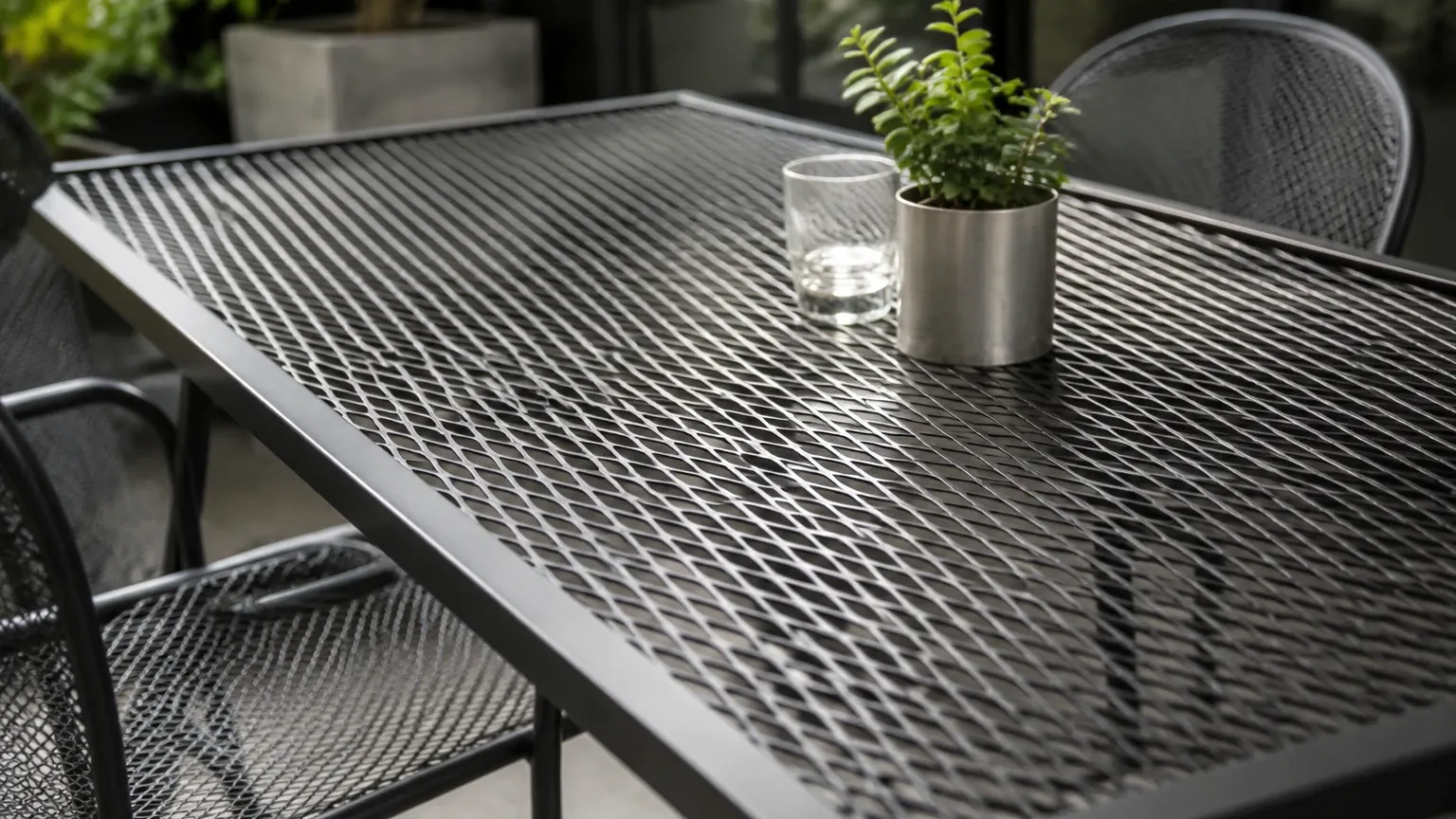
To evaluate the suitability of an expanded metal table top, one must first understand the manufacturing process. Expanded metal is produced by simultaneously slitting and stretching a solid metal sheet. This process creates a diamond-shaped pattern of openings, where the "strands" and "bonds" (the intersections of the strands) form a continuous, one-piece structure.
Because the material is stretched rather than punched, there is zero waste in the production process, making it a cost-effective alternative to perforated metal in many scenarios. However, for table top applications, the distinction between "standard" and "flattened" expanded metal is paramount:
1. Standard Expanded Metal: This version features strands that are set at a sharp angle to the plane of the sheet. While this provides excellent grip and strength, the raised surface is generally unsuitable for worktables where items must sit flat.
2. Flattened Expanded Metal: After the expansion process, the sheet is passed through a cold-roll reducing mill. This flattens the strands and bonds into a single plane, creating a smooth, level surface. For any industrial expanded metal table top, flattened metal is the industry standard to ensure stability for tools, containers, and processed goods.
Material Selection for Industrial Environments
The performance of an expanded metal table top is largely determined by the alloy used in its construction. Industrial environments present various challenges, including moisture, chemical exposure, and mechanical impact.
Stainless Steel (Grades 304 and 316)
Stainless steel is the preferred choice for sectors such as pharmaceutical and food and beverage processing. Grade 304 offers excellent corrosion resistance for general industrial use. However, in environments involving high salinity or exposure to aggressive chemicals, Grade 316 is recommended due to its molybdenum content, which provides superior resistance to pitting and crevice corrosion.
Carbon Steel
For heavy-duty manufacturing or warehouse applications where corrosion is less of a concern, carbon steel provides high tensile strength at a lower price point. These surfaces are often powder-coated or galvanized to provide a protective barrier against oxidation.
Aluminum
Aluminum expanded metal is utilized when weight is a primary concern. While it offers natural corrosion resistance, it lacks the extreme load-bearing capacity of steel or stainless steel. It is frequently seen in mobile workstations or specialized laboratory settings.
Design Considerations for Load and Airflow
When specifying an expanded metal table top, engineers must calculate the required load-bearing capacity and the necessary percentage of open area. These factors are determined by the mesh size and the gauge of the metal.
* SWD and LWD: These terms refer to the "Short Way of Design" and "Long Way of Design," representing the dimensions of the diamond opening. A smaller SWD typically results in a denser mesh with higher weight capacity.
* Strand Thickness and Width: The dimensions of the individual strands dictate the overall rigidity of the table top. For industrial workbenches, a heavier gauge is required to prevent sagging or deformation under the weight of heavy machinery or components.
* Open Area Percentage: One of the primary reasons for choosing an expanded metal table top is the need for airflow or liquid drainage. In wash-down stations, a high open-area percentage allows water and cleaning agents to pass through easily, preventing pooling and bacterial growth. In heat-sensitive applications, this open structure facilitates rapid cooling of parts placed on the surface.
Applications in Industrial and Commercial Sectors
The versatility of expanded metal makes it a staple in several critical industries. Its structural properties allow it to perform roles that solid surfaces cannot.
Food and Beverage Processing
In food production, hygiene is the highest priority. Expanded metal surfaces made from 300-series stainless steel allow for thorough cleaning. Because the surface does not trap liquids, it reduces the risk of cross-contamination. These tables are often used in sorting, washing, and drying stations.
Chemical and Pharmaceutical Labs
Laboratories often require work surfaces that can withstand chemical spills while providing ventilation. An expanded metal table top integrated into a fume hood or specialized workstation ensures that vapors do not collect at the surface level and that any accidental spills drain away from the operator immediately.
Industrial Wash-Down and Drainage Stations
For components that require degreasing or aqueous cleaning, expanded metal provides the ideal substrate. The open mesh allows the cleaning medium to reach all sides of the part while ensuring the fluid drains into a collection basin below, maintaining a clean and safe workspace.
Structural Integrity and Edge Finishing
A common engineering concern with expanded metal is the treatment of the edges. Because the expansion process leaves exposed "cut" strands, the edges of the sheet can be sharp and structurally vulnerable.
To resolve this, an expanded metal table top must be properly framed. Common framing methods include:
* U-Edging: A U-shaped metal channel is fitted over the edge of the expanded metal and welded in place. This provides a smooth, safe perimeter and significantly increases the rigidity of the table.
* L-Angle Framing: The expanded metal sheet is welded into an angle-iron frame. This is the preferred method for heavy-duty tables, as the frame provides the primary structural support for the legs and cross-bracing.
Without proper framing, the expanded metal may experience "racking" or lose its planar alignment over time, especially under cyclical loading.
Maintenance and Total Cost of Ownership
From a procurement perspective, the total cost of ownership (TCO) of an expanded metal table top is often lower than that of solid surfaces in specialized environments. While the initial material cost for high-grade stainless steel may be significant, the durability and reduced maintenance requirements provide long-term value.
Maintenance protocols for expanded metal are straightforward but essential. In food-grade applications, high-pressure washing and enzymatic cleaners are used to ensure no organic matter is trapped in the bonds of the mesh. In industrial settings, regular inspection of the welds between the mesh and the frame is necessary to ensure continued structural integrity. Unlike wood or plastic surfaces, metal does not warp, crack, or absorb contaminants, ensuring a service life that often spans decades.
Customization and Engineering Support
Every industrial application has unique requirements regarding dimensions, weight limits, and environmental resistance. Off-the-shelf solutions rarely meet the precise needs of a specialized production line. Working with a manufacturer like Kaifil allows for the customization of the mesh pattern, material grade, and finishing treatments.
When consulting with a supplier, engineers should be prepared to confirm the following:
* The maximum static and dynamic load the table will support.
* The specific chemicals or cleaning agents the surface will encounter.
* The required smoothness of the surface (degree of flattening).
* The necessity for specialized finishes, such as electro-polishing for improved corrosion resistance and a cleaner surface profile.
By focusing on these technical parameters, organizations can ensure that their investment in an expanded metal table top results in improved operational efficiency and safety. Whether the goal is to enhance drainage in a wash-down area or to provide a robust, breathable surface for chemical processing, the right combination of material and design is essential.
For more information on material specifications and custom fabrication options, professionals can explore the range of Perforated & Expanded Metal solutions available for industrial applications.
