


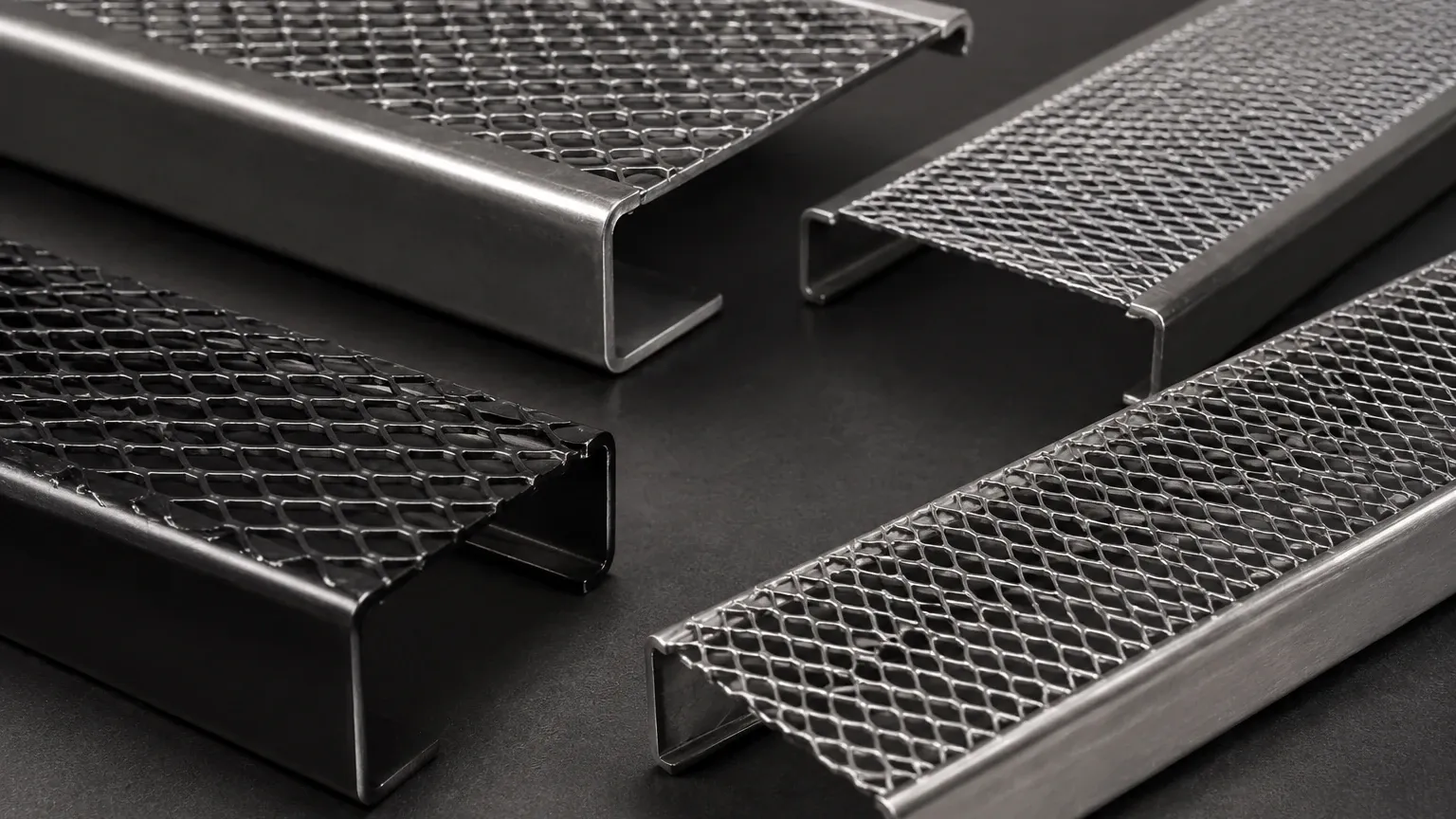
Expanded Metal U Edging
In industrial fabrication and filtration design, the transition from a raw material to a functional component often requires meticulous attention to edge treatment. Expanded metal, characterized by its diamond-shaped apertures and high strength-to-weight ratio, is a staple in industrial environments. However, the manufacturing process—slitting and stretching solid metal sheets—leaves behind sharp, jagged edges known as "knuckles." For engineers and procurement teams, implementing expanded metal u edging is the standard technical solution to address safety, structural integrity, and aesthetic requirements in various applications.
As a specialized manufacturer of stainless steel filtration solutions, Kaifil understands that the performance of a mesh panel is frequently dictated by its frame. Whether used in high-pressure filtration systems or heavy-duty machine guards, the integration of Perforated & Expanded Metal with precision-engineered U-edging ensures that the final assembly meets rigorous industrial standards.
The Engineering Necessity of U Edging in Expanded Metal Systems
Expanded metal is produced by simultaneously slitting and stretching a metal sheet, creating a continuous web of diamonds. This process is efficient and waste-free, but it results in an unfinished perimeter where the metal strands are cut at various angles. These edges present several engineering challenges that u edging is designed to solve.
Personnel Safety and Risk Mitigation
The sharp points of a raw expanded metal sheet are a significant hazard for maintenance personnel and operators. In B2B environments where OSHA compliance and workplace safety are paramount, exposed edges are unacceptable. Expanded metal u edging encapsulates these sharp points within a smooth, rounded or square metal channel, eliminating the risk of lacerations and snagged clothing.
Structural Rigidity and Load Distribution
While expanded metal is inherently strong, a large, unframed panel can be prone to "oil-canning"—a term used to describe the buckling or bowing of the metal under stress or temperature fluctuations. A U-channel frame acts as a perimeter stiffener. By increasing the moment of inertia around the edges, the edging allows the panel to withstand higher lateral loads and vibration without deforming. This is particularly critical in filtration housings where the mesh must remain taut against high-velocity fluid flow.
Protection of Secondary Components
In filtration and HVAC systems, expanded metal often serves as a support layer for finer wire mesh or synthetic filter media. Without proper edging, the sharp knuckles of the expanded metal can puncture or abrade the more delicate primary filter layers. The U-edging provides a secure, recessed area where all layers can be clamped or welded together, preventing internal bypass or media failure.
Technical Specifications: Sizing U-Channels for Expanded Metal
Selecting the correct expanded metal u edging requires a precise understanding of the mesh dimensions. Unlike perforated metal, which has a consistent thickness equal to the original sheet, expanded metal has a "raised" profile unless it has been secondary-processed through flattening rollers.
Determining the Opening Width
The most critical dimension of the U-channel is the internal opening (the "gap"). This must be slightly wider than the overall thickness of the expanded metal. For raised expanded metal, the thickness is significantly greater than the original gauge of the sheet because the strands are turned at an angle. Engineers must specify the "overall thickness" rather than the "material gauge" when sourcing edging.
Leg Length and Overlap
The "legs" of the U-channel provide the surface area for attachment. A longer leg offers more surface area for spot welding or plug welding, which enhances the shear strength of the assembly. However, in filtration applications, excessively long legs may reduce the effective open area of the mesh. Finding the balance between structural attachment and maximum flow area is a key design consideration.
Material Gauge of the Edging
The thickness of the U-channel itself should generally match or exceed the gauge of the expanded metal strands. For heavy-duty industrial grates, a 10-gauge or 12-gauge U-channel may be required. For lightweight filtration screens, a 16-gauge or 18-gauge channel often suffices to provide the necessary stiffness without adding excessive weight to the system.
Material Selection: Ensuring Chemical and Physical Compatibility
At Kaifil, we emphasize the importance of material compatibility to prevent premature failure due to corrosion or thermal stress. The choice of material for expanded metal u edging should almost always match the material of the mesh panel.
Stainless Steel (304 and 316)
For chemical processing, pharmaceutical, and food-grade applications, stainless steel is the industry standard.
* Grade 304: Offers excellent corrosion resistance and weldability for general industrial use.
* Grade 316: Contains molybdenum, providing superior resistance to chlorides and acetic acids. This is the preferred choice for marine environments and aggressive chemical filtration.
Matching the edging to the mesh (e.g., 316 mesh with 316 edging) prevents galvanic corrosion, which occurs when two dissimilar metals are in contact in the presence of an electrolyte. Furthermore, it ensures that the entire component responds uniformly to thermal expansion, reducing the risk of weld cracking in high-temperature environments.
Carbon Steel and Galvanized Options
In less corrosive environments, such as machine guarding or warehouse partitioning, carbon steel or galvanized steel may be used. If the assembly is to be powder-coated or painted, carbon steel provides a cost-effective substrate. However, for long-term durability in outdoor or humid industrial settings, hot-dipped galvanized edging is recommended to protect the cut edges of the mesh from oxidation.
Fabrication Techniques: Integrating Edging with Precision Mesh
The method of attaching expanded metal u edging to the mesh panel significantly impacts the durability and performance of the final product. Industrial fabricators typically employ one of three primary methods.
Welding (Spot, MIG, and TIG)
Welding is the most common attachment method for B2B applications.
* Spot Welding: Ideal for high-volume production where the mesh and edging are thin. It provides a clean finish with minimal heat distortion.
* MIG/TIG Welding: Used for heavier gauges or where a continuous seal is required. TIG welding is preferred for stainless steel filtration components because it offers superior control and a cleaner bead, which is essential for preventing bacterial growth in food and pharma applications.
Mitered vs. Butt-Jointed Corners
The corners of the U-channel frame can be finished in two ways:
1. Mitered Corners: The edging is cut at a 45-degree angle. This provides a professional, high-end appearance and a fully enclosed perimeter. It is the standard for architectural and visible industrial panels.
2. Butt-Jointed/Overlapped: One piece of edging simply ends where the other begins. While faster to fabricate, it leaves a small gap or an uneven corner, which may not be suitable for high-precision filtration housings.
Deburring and Finishing
After fabrication, the assembly must undergo finishing. For stainless steel, this often involves pickling and passivation to restore the chromium oxide layer that may have been damaged during welding. This step is vital for ensuring the long-term corrosion resistance of the Perforated & Expanded Metal assembly.
Industrial Applications: From Filtration to Machine Safety
The versatility of expanded metal u edging makes it an essential component across multiple sectors. By providing a finished edge, the material is transformed from a raw commodity into a functional industrial part.
Industrial Filtration and Strainers
In liquid and gas filtration, expanded metal often serves as the outer cage or inner core for filter cartridges. The U-edging secures the mesh ends, ensuring that the filter maintains its cylindrical or pleated shape under pressure. In large-scale water treatment strainers, edged panels are easier to slide into mounting tracks for quick replacement during maintenance cycles.
Machine Guarding and Enclosures
Safety is the primary driver for U-edging in manufacturing plants. Conveyor guards, fan covers, and electrical enclosures utilize expanded metal for ventilation and visibility. The edging ensures that the guards can be handled safely by workers and provides a flat surface for bolting the guards to the machine frame.
Architectural and Acoustic Panels
In modern industrial architecture, expanded metal is used for sunshades, ceiling panels, and acoustic baffles. Here, the U-edging provides the clean lines required for aesthetic appeal while allowing for hidden fastening systems. The frame also helps dampen vibrations, which is crucial for acoustic performance in noisy environments.
Quality Assurance and Procurement Guidelines for Engineers
When specifying expanded metal u edging for a project, engineers should confirm several technical details with their manufacturer to ensure the product meets the intended application requirements.
Verify the "Overall Thickness"
As mentioned previously, the thickness of expanded metal is not the same as the sheet gauge. Always provide the manufacturer with the measured thickness of the raised diamonds to ensure the U-channel gap is appropriately sized. A gap that is too tight will deform the mesh, while a gap that is too loose will result in weak weld joints.
Specify the Attachment Interval
For structural panels, the frequency of welds between the mesh and the edging is critical. A common specification is "tack weld every 6 inches," but high-vibration environments may require more frequent attachment. Clearly defining this in the technical drawing prevents structural failure in the field.
Confirm Tolerance Requirements
Industrial filtration often requires tight tolerances to ensure a proper seal within a housing. Standard fabrication tolerances for U-edged panels are typically +/- 1/8 inch, but precision applications may require +/- 1/32 inch. Communicating these requirements early in the procurement process allows the manufacturer to implement the necessary jigs and fixtures.
Total Cost of Ownership (TCO)
While raw expanded metal is inexpensive, the labor involved in adding U-edging can be significant. However, the TCO is often lower when considering the reduced installation time, improved safety, and extended service life of a professionally edged panel. For B2B buyers, sourcing pre-fabricated, edged panels from a specialist like Kaifil reduces on-site labor and ensures a higher quality of construction.
Conclusion
Expanded metal u edging is more than just a finishing touch; it is a critical engineering component that enhances the safety, strength, and utility of expanded metal panels. By understanding the nuances of material selection, sizing, and fabrication techniques, engineers can design filtration and guarding systems that stand up to the most demanding industrial environments.
Whether your project requires high-precision stainless steel filter components or robust industrial partitions, choosing the right combination of Perforated & Expanded Metal and professional edging is the key to long-term performance. At Kaifil, we combine technical expertise with advanced manufacturing to deliver customized filtration solutions that meet these exacting standards, helping our global partners achieve efficient and durable results.
