


Expanded Metal Uses
In the landscape of industrial manufacturing and engineering, material selection is often dictated by the balance between structural integrity, weight, and permeability. Expanded metal, a versatile material produced by simultaneously slitting and stretching a metal sheet, offers a unique set of characteristics that make it indispensable in various sectors. Unlike woven wire mesh, expanded metal is a single-piece structure with no joints or welds, providing inherent strength and a high strength-to-weight ratio.
For engineers and procurement professionals, understanding the breadth of expanded metal uses is essential for optimizing system performance and cost-efficiency. Whether used as a support substrate in high-pressure filtration or as a protective barrier in heavy machinery, this material provides a level of durability and versatility that few other metal products can match. This guide explores the technical applications, material considerations, and selection criteria for Perforated & Expanded Metal in demanding industrial environments.
Understanding Expanded Metal: Manufacturing and Structural Characteristics
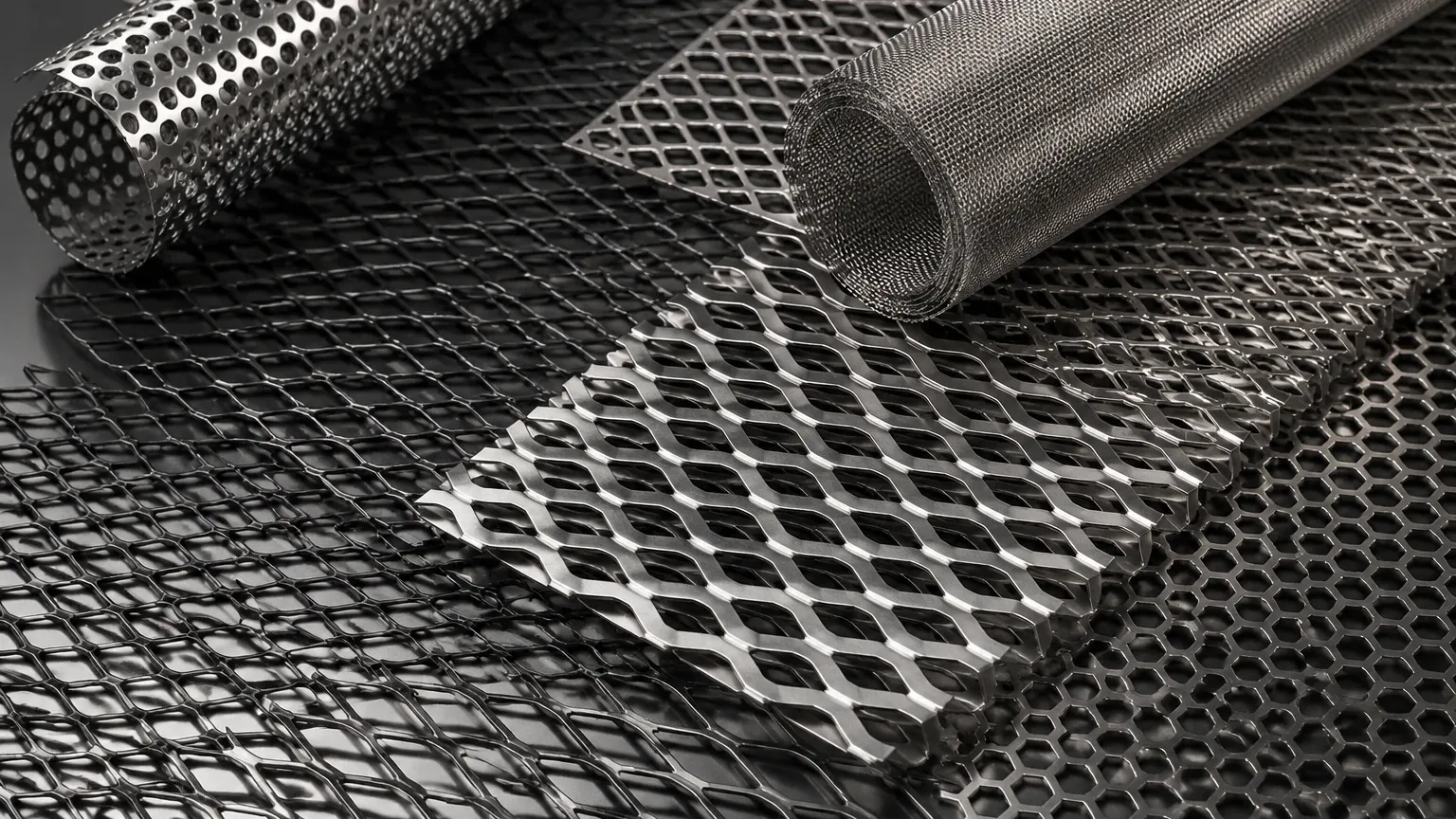
The production of expanded metal is a precision process that involves a pressurized machine slitting the metal sheet while stretching it in a single motion. This results in a diamond-shaped pattern of openings, though hexagonal and square patterns are also possible. Because the material is stretched rather than punched, there is virtually no scrap or waste produced during manufacturing, making it a highly cost-effective alternative to perforated metal in many scenarios.
Raised vs. Flattened Expanded Metal
There are two primary forms of expanded metal used in industrial applications:
1. Standard (Raised) Expanded Metal: In this form, the strands and bonds are set at a uniform angle to the plane of the sheet. This creates a textured surface that provides excellent grip and directional strength. The raised strands are particularly useful in applications requiring high rigidity or specialized airflow characteristics.
2. Flattened Expanded Metal: This is produced by passing the standard expanded metal through a cold-rolling reducing mill. The process flattens the strands and bonds, resulting in a smooth, flat surface. Flattened expanded metal is often preferred for filtration applications where a uniform thickness is required to prevent damage to delicate filter media.
Key Terminology for Specification
When specifying expanded metal for industrial projects, engineers must define several key parameters:
* SWD (Short Way of Design): The distance from the center of one bond to the center of the next bond across the short diamond diagonal.
* LWD (Long Way of Design): The distance from the center of one bond to the center of the next bond across the long diamond diagonal.
* Strand Width: The amount of metal fed into the machine to produce one strand.
* Strand Thickness: The gauge of the original base metal sheet.
Expanded Metal Uses in Industrial Filtration Systems
One of the most critical expanded metal uses is within the filtration industry. As a manufacturer specializing in custom stainless steel filtration solutions, Kaifil utilizes expanded metal as a core component in various filter assemblies. Its structural rigidity makes it an ideal choice for supporting finer mesh layers that lack the mechanical strength to withstand high differential pressures.
Support Cages and Cores
In industrial filter cartridges, expanded metal often serves as the internal core or the external support cage. In hydraulic and chemical processing filters, the medium is subjected to significant fluid velocity and pressure. An expanded metal core prevents the filter media from collapsing inward, while an outer cage protects the media from external mechanical damage during installation and operation. The open area of the expanded metal is carefully calculated to ensure it does not impede flow or contribute significantly to pressure drop.
Pre-Filtration and Coarse Screening
In water treatment and large-scale industrial intake systems, expanded metal acts as a primary or coarse filter. It is used to capture large debris, protecting more sensitive downstream components such as pumps and fine membrane filters. The diamond pattern is particularly effective at catching irregular solids while maintaining a high flow rate.
Media Pleat Support
For pleated filter elements, expanded metal can be laminated or placed adjacent to the filter paper or wire mesh. This ensures that the pleats remain open and evenly spaced under flow, maximizing the effective filtration area and extending the service life of the element. By preventing "pleat bunching," expanded metal ensures consistent performance throughout the filter's lifecycle.
Structural and Safety Applications in Industrial Facilities
Beyond filtration, expanded metal is widely utilized for its structural properties. Its ability to provide visibility and ventilation while maintaining a secure barrier makes it a preferred material for facility management and safety engineering.
Walkways, Catwalks, and Grating
In chemical plants and refineries, standard (raised) expanded metal is frequently used for walkways and stair treads. The raised edges of the diamond pattern provide inherent slip resistance, which is vital in environments where oil, water, or chemicals may be present on the floor. Furthermore, the open design allows liquid and debris to fall through, preventing accumulation on the walking surface.
Machine Guarding and Security Fencing
Safety is paramount in any manufacturing environment. Expanded metal is used to create robust machine guards that protect operators from moving parts without obstructing their view of the equipment. Because it is a single piece of metal, it cannot be easily unraveled or cut with standard wire cutters, making it an excellent choice for security fencing and partitions in warehouses and high-value storage areas.
Acoustic and Thermal Management
In power generation and heavy industrial sectors, expanded metal is used in the construction of acoustic panels and heat shields. When used in conjunction with sound-absorbing materials, the expanded metal provides a durable face that allows sound waves to pass through into the insulating core while protecting the fragile insulation from mechanical impact.
Technical Comparison: Expanded Metal vs. Perforated Metal
Choosing between Perforated & Expanded Metal often comes down to the specific engineering requirements of the project. While both materials provide open areas for flow and ventilation, their manufacturing processes and physical properties differ significantly.
| Feature | Expanded Metal | Perforated Metal |
| :— | :— | :— |
| Material Waste | Minimal to none; the sheet is stretched. | Significant; slugs are punched out of the sheet. |
| Strength-to-Weight | Very high; the strands act as structural trusses. | Moderate; strength is dependent on the remaining bridge width. |
| Cost | Generally lower due to efficient material use. | Generally higher due to material waste and tooling costs. |
| Surface Texture | Naturally textured (raised) or smooth (flattened). | Naturally smooth and flat. |
| Open Area | Highly variable, can reach up to 90%+. | Limited by the physical integrity of the remaining sheet. |
For filtration applications, expanded metal is often chosen for its rigidity and cost-efficiency in large-scale support structures. Perforated metal, however, is sometimes preferred when extremely precise hole geometries or very small, uniform apertures are required that cannot be achieved through the expansion process.
Material Selection: Optimizing Performance in Corrosive Environments
The environment in which the metal will operate dictates the choice of alloy. In the B2B industrial sector, durability and resistance to chemical attack are non-negotiable. Kaifil focuses on high-performance materials to ensure that expanded metal components meet the rigorous standards of the pharmaceutical, food and beverage, and chemical industries.
Stainless Steel (304, 316, and 316L)
Stainless steel is the gold standard for industrial expanded metal uses.
* Grade 304: Offers excellent corrosion resistance for general industrial use and is highly cost-effective for indoor applications or environments with low chemical exposure.
* Grade 316/316L: Contains molybdenum, which provides superior resistance to chlorides and pitting. This is the preferred material for marine environments, pharmaceutical manufacturing, and food processing where aggressive cleaning agents are used.
Specialty Alloys and Carbon Steel
For high-temperature applications or specific chemical resistances, materials such as Inconel, Monel, or Titanium may be used, though these are typically reserved for highly specialized aerospace or petrochemical projects. Galvanized carbon steel is a common choice for structural applications like fencing and walkways where cost is a primary driver and the environment is less corrosive.
Engineering Considerations for Custom Expanded Metal Specification
When sourcing expanded metal for a custom project, technical teams should confirm several factors with the manufacturer to ensure the final product meets the application's demands. At Kaifil, we work closely with engineers to define these parameters during the design phase.
Load-Bearing Requirements
If the expanded metal is intended for a walkway or a structural support core, it is vital to calculate the concentrated and uniform loads it will bear. The orientation of the diamonds (LWD vs. SWD) significantly affects the load-bearing capacity. Generally, the LWD should run perpendicular to the support members for maximum strength.
Airflow and Pressure Drop
In filtration and ventilation, the "percentage of open area" is the most critical metric. Engineers must ensure that the expanded metal provides enough structural support without creating excessive resistance to flow. This is particularly important in high-velocity gas filtration where turbulence can lead to energy inefficiency.
Finishing and Edge Treatment
Expanded metal naturally has sharp edges where the diamonds are cut. For many industrial uses, these edges must be deburred or framed. In filtration cartridges, the edges are often hemmed or welded into end caps to ensure a leak-proof seal and to prevent the strands from puncturing the filter media.
Total Cost of Ownership (TCO)
While the initial purchase price is important, B2B buyers must consider the TCO. Stainless steel expanded metal may have a higher upfront cost than galvanized steel, but its longevity in corrosive environments and reduced maintenance requirements often make it the more economical choice over the equipment's lifespan. Factors such as replacement cycles and the risk of system downtime due to component failure should be integrated into the purchasing decision.
Conclusion
From providing the structural backbone of high-pressure filter cartridges to ensuring the safety of workers on industrial catwalks, the range of expanded metal uses is vast. Its unique combination of strength, permeability, and cost-efficiency makes it a preferred material for engineers across the globe. By selecting the appropriate material grade, diamond configuration, and finishing process, industrial teams can achieve optimized performance in even the most challenging environments.
For those seeking precision-engineered solutions, Kaifil provides comprehensive expertise in the design and manufacture of stainless steel filtration components. To learn more about our capabilities and technical specifications, Review product options and application support to find the right solution for your specific industrial requirements.
