


Expanded Metal Vent
In industrial engineering and facility management, the selection of ventilation components is a critical factor in maintaining equipment longevity, ensuring safety, and optimizing thermal management. An expanded metal vent serves as a specialized solution that balances the need for high-volume airflow with the requirement for structural integrity and debris exclusion. Unlike standard woven wire mesh or perforated sheets, expanded metal offers a unique three-dimensional geometry that provides specific mechanical advantages in demanding environments.
For engineers and procurement teams, understanding the technical nuances of Perforated & Expanded Metal is essential for specifying the correct component for chemical processing, HVAC systems, or industrial machinery enclosures. This guide examines the engineering principles, material considerations, and performance metrics associated with expanded metal ventilation solutions.
The Engineering of Expanded Metal Vents
Expanded metal is manufactured through a process of simultaneous slitting and stretching. A solid metal sheet is fed through a machine where a reciprocating knife cuts and expands the material into a uniform diamond-shaped pattern. This process is unique because it involves no material waste; the final product covers a significantly larger area than the original sheet while retaining the structural continuity of the base metal.
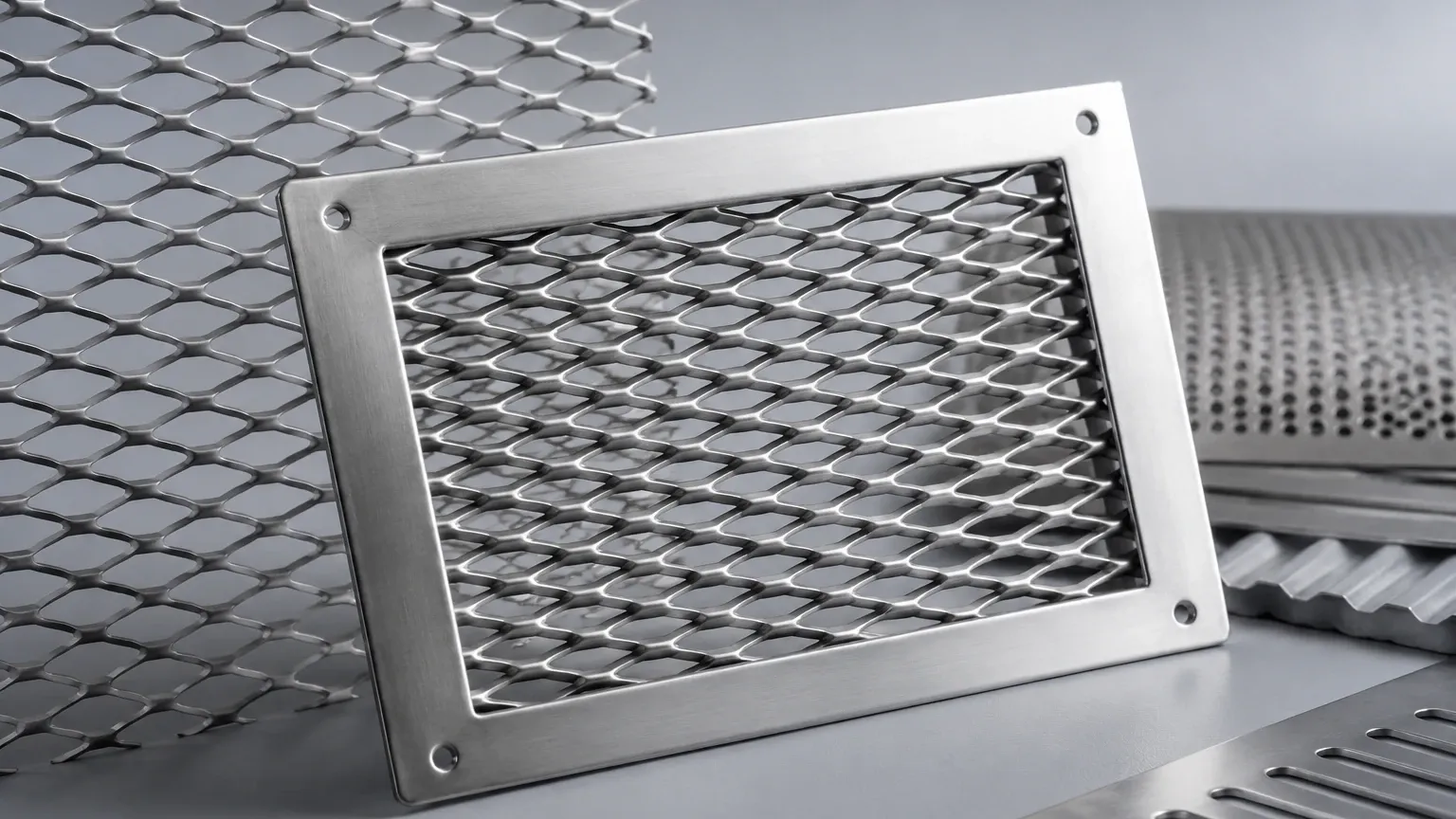
In the context of an expanded metal vent, this manufacturing method creates a series of angled strands. These strands are not merely flat; they are tilted at an angle relative to the plane of the sheet. This creates what is known as a "louvered effect," which can be leveraged to direct airflow or provide a degree of visual and physical shielding that flat perforated materials cannot achieve.
Key Geometric Parameters
When specifying an expanded metal vent, engineers must define several critical dimensions that dictate both the airflow and the mechanical strength of the unit:
* Long Way of Design (LWD): The distance from the center of one bond to the center of the next bond across the long axis of the diamond.
* Short Way of Design (SWD): The distance across the short axis of the diamond.
* Strand Width: The amount of metal fed into the knives to produce one strand.
* Strand Thickness: The original thickness of the base metal sheet.
* Bond: The intersection where two strands meet, which remains solid and provides the material's inherent strength.
Airflow Efficiency and Open Area Calculations
The primary function of any vent is to facilitate the movement of air while maintaining a barrier. The performance of an expanded metal vent is largely determined by its "percentage of open area." This metric is vital for calculating pressure drop across the vent and ensuring that cooling systems or exhaust fans operate within their designed parameters.
Unlike perforated metal, where the open area is a simple ratio of hole area to total area, expanded metal calculations are more complex due to the angle of the strands. In a standard expanded metal configuration, the open area is typically higher than that of perforated metal of similar strength. However, the effective open area may change depending on the angle of the air approach. For high-velocity industrial fans, engineers must account for the resistance (static pressure) introduced by the vent to avoid motor strain and reduced cooling efficiency.
The Louver Effect in Ventilation
One of the distinct advantages of using an expanded metal vent is its ability to act as a built-in louver. Because the strands are angled during the expansion process, the vent can be oriented to:
1. Deflect Precipitation: In outdoor applications, such as HVAC intakes or generator housings, the vent can be installed so the strands slope downward, preventing rain or snow from entering the enclosure while allowing air to rise through the openings.
2. Control Visibility: In security-sensitive areas, the angle of the strands can obscure the view into a machine's interior while maintaining full ventilation.
3. Directional Airflow: The vent can be used to diffuse or direct air in a specific path, which is useful in electronic cooling where air must be routed over specific heat sinks.
Material Selection for Industrial Durability
The environment in which the expanded metal vent will operate dictates the material choice. Kaifil specializes in stainless steel solutions, which are often the preferred choice for industrial applications due to their superior resistance to corrosion and thermal stress.
Stainless Steel (304 and 316 Grades)
Stainless steel is the industry standard for vents used in chemical processing, food and beverage production, and pharmaceutical environments.
* Grade 304: Offers excellent corrosion resistance for most general industrial applications. It is durable, easy to clean, and maintains structural integrity at elevated temperatures.
* Grade 316: Contains molybdenum, which provides enhanced resistance to chlorides and marine environments. This is the preferred material for vents located in coastal areas or facilities using aggressive chemical cleaning agents.
Aluminum and Carbon Steel
While stainless steel is the focus for high-performance filtration and ventilation, aluminum is occasionally used where weight is the primary concern, such as in aerospace or portable equipment. Carbon steel is used in dry, non-corrosive environments where cost is the driving factor, though it requires galvanizing or powder coating to prevent oxidation.
Applications Across Industrial Sectors
Expanded metal vents are versatile components found in a wide array of heavy-duty applications. Their ability to withstand impact and vibration makes them superior to plastic or thin-wire alternatives.
1. Machinery Guards and Enclosures
In manufacturing plants, high-speed machinery generates significant heat. Expanded metal vents are integrated into safety guards to allow heat to dissipate while preventing operators from coming into contact with moving parts. The rigid nature of the expanded metal ensures that the guard does not deform under pressure.
2. Electrical and Electronic Cabinets
Power distribution centers and server racks require constant airflow to prevent component failure. Expanded metal vents provide a high open-area ratio for cooling and can also be designed to provide Electromagnetic Interference (EMI) shielding, provided the mesh size is correctly calculated relative to the frequency of the interference.
3. HVAC and Air Filtration Systems
In large-scale HVAC systems, expanded metal is often used as a pre-filter support or as the primary vent cover. It protects sensitive internal components from large debris, birds, and rodents while ensuring that the system's static pressure remains within acceptable limits.
4. Chemical and Food Processing
In environments where hygiene is paramount, stainless steel expanded metal vents are used because they can withstand high-pressure washdowns and exposure to caustic cleaning chemicals without degrading. The lack of woven joints (as found in wire mesh) means there are fewer crevices where bacteria or contaminants can accumulate.
Customization and OEM Considerations
For many industrial projects, standard off-the-shelf vents are insufficient. Customization is often required to meet specific spatial constraints or performance requirements. When partnering with a manufacturer like Kaifil, engineers can specify several custom factors:
* Flattened vs. Raised: Standard expanded metal is "raised," meaning the strands are at an angle. "Flattened" expanded metal is passed through a cold rolling mill to level the strands into the same plane as the sheet. Flattened metal is smoother and easier to clean but has a slightly different open area and structural profile.
* Framing and Integration: Vents often require U-edging, angle iron frames, or flat bar borders for installation. Custom framing ensures the vent can be bolted or welded directly into the target system without further modification on-site.
* Surface Finishes: Beyond the material itself, finishes such as electropolishing (for stainless steel) or specialized coatings can be applied to enhance corrosion resistance or aesthetic appeal.
Evaluation Criteria for Purchasing Teams
When evaluating suppliers for an expanded metal vent project, technical professionals should confirm several points to ensure the final product meets the application's demands:
1. Dimensional Tolerances: Ensure the manufacturer can maintain tight tolerances on LWD, SWD, and overall sheet size to prevent gaps in the enclosure.
2. Load-Bearing Requirements: If the vent is located in an area where it might be stepped on or subjected to physical impact, the strand thickness and bond strength must be verified.
3. Filtration Accuracy: If the vent also serves as a coarse filter, the diamond size must be small enough to exclude the target particle size while maintaining the required airflow.
4. Material Certification: For industries like pharmaceuticals or food processing, request material mill reports to verify the grade of stainless steel used.
Maintenance and Lifecycle Management
The durability of a stainless steel expanded metal vent significantly reduces the total cost of ownership compared to less robust materials. However, regular maintenance is still required to ensure peak performance.
* Cleaning Cycles: In dusty or oily environments, the diamond openings can become clogged. Regular inspection and cleaning with compressed air or high-pressure water (depending on the material and environment) are necessary to maintain airflow.
* Inspection for Fatigue: In high-vibration environments, such as those near large compressors or engines, vents should be inspected for stress fractures at the bonds. Stainless steel's high fatigue strength makes it ideal for these scenarios, but periodic checks remain a best practice.
* Replacement Indicators: A vent should be replaced if there is significant physical deformation that restricts airflow, or if corrosion has compromised the structural integrity of the strands.
Conclusion
The expanded metal vent is a fundamental component in industrial design, offering a balance of protection, strength, and ventilation efficiency. By selecting the appropriate material grade, diamond pattern, and orientation, engineers can solve complex thermal and safety challenges. For those seeking high-performance, customized filtration and ventilation components, focusing on the technical specifications of the material ensures that the final solution will withstand the rigors of the industrial environment.
To explore specific configurations and technical data for your next project, Review product options and application support to determine the optimal expanded metal solution for your requirements.
