


Galvanised Perforated Metal Sheet
In industrial filtration and structural engineering, the selection of base materials determines the longevity and efficiency of the entire system. A galvanised perforated metal sheet serves as a versatile component, offering a balance between mechanical strength, corrosion resistance, and cost-effectiveness. While stainless steel remains the gold standard for high-acid or high-temperature environments, galvanised steel is a primary choice for various industrial applications, ranging from HVAC intake screens to the structural support cores of large-scale filter cartridges.
Understanding the technical nuances of perforated and expanded metal is essential for engineers and procurement teams who must specify components that withstand mechanical stress while maintaining precise flow characteristics. This guide examines the manufacturing processes, technical specifications, and engineering considerations required when integrating galvanised perforated metal into industrial systems.
The Role of Galvanised Perforated Metal Sheet in Industrial Filtration
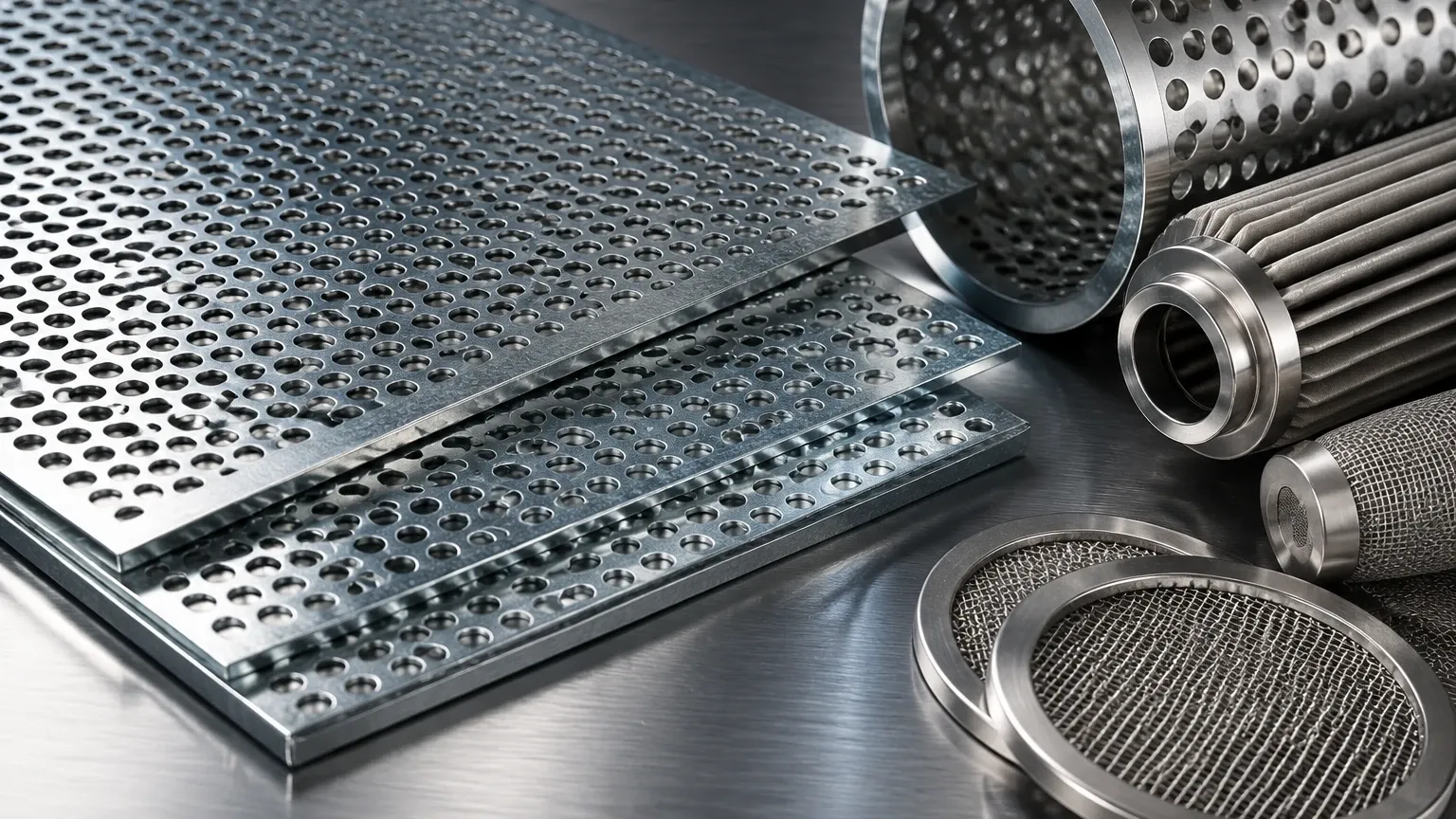
Perforated metal is defined by a series of holes punched into a solid sheet of metal. When that metal is carbon steel treated with a protective zinc coating, it becomes a galvanised perforated metal sheet. In the context of Perforated & Expanded Metal solutions, these sheets are often used as the "backbone" for more delicate filtration media.
In many liquid and gas filtration systems, the primary filtration media—such as fine stainless steel wire mesh—lacks the structural rigidity to withstand high differential pressures. A perforated metal sheet is rolled into a cylinder or formed into a flat panel to provide the necessary support. The galvanised coating ensures that the support structure does not succumb to oxidation (rust) when exposed to moisture or mildly corrosive industrial fluids, thereby preventing the contamination of the process stream with metallic flakes.
Manufacturing Methods: Pre-Galvanised vs. Hot-Dip Galvanised
One of the most critical decisions an engineer must make when specifying a galvanised perforated metal sheet is the timing of the galvanisation process. There are two primary methods, each with distinct performance implications:
1. Pre-Galvanised (PG) Steel
In this process, the steel sheet is galvanised at the mill before it arrives at the perforation facility. The punching process then creates the holes. While this is the most cost-effective method, it leaves the inner edges of the punched holes exposed. Because the protective zinc layer is removed at the point of the punch, these edges are susceptible to edge creep—a phenomenon where corrosion begins at the exposed steel edge and gradually undermines the surrounding zinc coating.
2. Hot-Dip Galvanised (HDG) After Perforation
For more demanding environments, the steel sheet is first perforated and then submerged in a molten zinc bath. This ensures that every surface, including the internal walls of the punched holes and the edges of the sheet, is fully encapsulated in a protective zinc-iron alloy layer. While this provides superior corrosion resistance, the thickness of the zinc can slightly alter the hole diameters and the overall thickness of the sheet, which must be accounted for in precision filtration designs.
Technical Parameters: Patterns, Pitch, and Open Area
The performance of a galvanised perforated metal sheet is governed by its geometry. Engineers must calculate the "Open Area" to determine the flow rate and pressure drop across the component.
Hole Patterns
* Round Holes: The most common and efficient pattern for filtration. Round holes offer the best structural integrity and are the easiest to clean.
* Square Holes: Provide a higher open area percentage but are more prone to structural deformation under high pressure.
* Slotted Holes: Often used for screening elongated particles or in applications where specific directional flow is required.
Pitch and Stagger
* 60° Staggered: This is the industry standard for round holes. It provides the highest strength-to-open-area ratio and ensures uniform stress distribution across the sheet.
* Straight Row: Holes are aligned in both horizontal and vertical directions. This is typically used for aesthetic or specific mechanical alignment purposes but offers lower structural stability than staggered patterns.
Calculating Open Area
For a standard 60-degree staggered round hole pattern, the formula for calculating the percentage of open area (OA) is:
$$OA = \frac{D^2 \times 90.69}{P^2}$$
Where:
* D = Hole Diameter
* P = Pitch (center-to-center distance between holes)
Accurate calculation of the open area is vital for ensuring that the filter does not create an excessive pressure drop, which would increase the energy consumption of pumps and compressors within the system.
Material Performance and Corrosion Resistance
Galvanisation protects the underlying steel through two mechanisms: barrier protection and cathodic (sacrificial) protection. The zinc layer acts as a physical barrier to moisture and oxygen. However, if the surface is scratched, the zinc will preferentially corrode to protect the exposed steel.
In industrial filtration, the chemical compatibility of the galvanised layer must be verified. Galvanised steel performs exceptionally well in environments with a pH range between 6 and 12. Outside of this range, the zinc coating can rapidly deplete. For applications involving highly acidic process fluids or high-salinity marine environments, engineers often transition from galvanised solutions to custom stainless steel filtration components to ensure a longer service life.
Engineering Considerations for Structural Support and Filtration
When designing a system that utilizes a galvanised perforated metal sheet, several engineering factors must be addressed to ensure reliable performance:
1. Gauge and Thickness
The thickness of the sheet (often measured in gauge) must be sufficient to resist the maximum expected differential pressure (ΔP). In high-pressure hydraulic or water treatment applications, a thicker gauge prevents the "ballooning" or bursting of the filter element.
2. Margins and Unfinished Areas
Margins refer to the unperforated area along the edges of the sheet. In B2B procurement, specifying the margins is crucial for subsequent fabrication steps.
* Safe Sides: The sheet has a solid border on the long sides.
* Finished Ends: The perforation pattern continues to the very edge of the sheet.
If the sheet is to be welded into a cylinder for a filter cartridge, a solid margin is often required to provide a clean surface for seam welding.
3. Burrs and Surface Finish
The perforation process naturally creates burrs on the "downside" of the sheet. For filtration applications where the perforated sheet is in direct contact with a fine wire mesh or a synthetic filter membrane, these burrs must be removed through deburring or leveling. Failure to do so can result in the puncturing of the primary filter media, leading to bypass and system failure.
Comparative Analysis: Galvanised Steel vs. Stainless Steel
While Kaifil specializes in high-performance stainless steel filtration, it is important to understand when a galvanised perforated metal sheet is the appropriate choice versus a stainless steel alternative.
| Feature | Galvanised Perforated Steel | Stainless Steel (304/316) |
| :— | :— | :— |
| Cost | Lower initial investment | Higher initial investment |
| Corrosion Resistance | Moderate (best in neutral pH) | Excellent (acid/alkali resistant) |
| Temperature Limit | Up to 200°C (approx.) | Up to 800°C+ |
| Strength | High | Very High |
| Maintenance | Requires monitoring for zinc depletion | Minimal maintenance required |
| Application | HVAC, general industrial, support cores | Chemical processing, Food & Bev, Pharma |
For many non-critical industrial applications where the fluid is non-corrosive, the galvanised option provides a significant cost advantage without sacrificing the mechanical integrity of the filtration unit.
Procurement Guide: Specifying Requirements for Custom Fabrication
To ensure the delivery of a component that meets technical requirements, purchasing teams and engineers should provide the following data points when requesting a quote for perforated and expanded metal products:
1. Material Grade: Specify the base steel grade and the type of galvanisation (Pre-galvanised or Hot-dip after perforation).
2. Hole Size and Shape: Define the diameter (e.g., 2.0mm) and the geometry (Round, Square, etc.).
3. Pitch and Pattern: Define the center-to-center distance and whether it is staggered or straight.
4. Sheet Dimensions: Length, width, and thickness (gauge).
5. Margins: Specify the width of the unperforated borders on all four sides.
6. Post-Processing: Indicate if the sheet requires leveling, deburring, or forming (rolling into cylinders).
Maintenance and Lifecycle Considerations
The replacement cycle for a galvanised perforated metal sheet depends heavily on the environment. In dry, indoor industrial settings, these components can last for decades. However, in applications involving frequent washdowns or exposure to outdoor elements, the zinc coating will eventually thin.
Regular inspection should look for "white rust" (zinc carbonate), which is a sign of the zinc doing its job, and "red rust," which indicates that the base steel is now exposed and the component's structural integrity may be compromised. In filtration systems, the perforated support should be inspected whenever the primary filter media is replaced. If the galvanised surface shows signs of pitting or scaling, the entire support structure should be replaced to prevent particulate shedding into the downstream flow.
By carefully evaluating the mechanical requirements and the chemical environment of the application, engineers can effectively utilize galvanised perforated metal to create durable, high-performance filtration and screening solutions. For applications requiring extreme precision or resistance to aggressive chemicals, consulting with a manufacturer experienced in custom metal filtration ensures that the selected materials and designs align with the total cost of ownership and performance goals of the project.
