


Green Perforated Metal
In the contemporary industrial landscape, the term "green" has evolved from a simple color designation to a comprehensive standard for sustainability, energy efficiency, and environmental responsibility. For engineers and procurement specialists, green perforated metal represents a critical intersection between high-performance filtration and sustainable manufacturing practices. Whether the requirement is for architectural sunshades that reduce building cooling loads or precision industrial filters that minimize energy consumption through optimized flow dynamics, understanding the technical nuances of these materials is essential for modern B2B applications.
As a specialized manufacturer, Kaifil focuses on delivering Perforated & Expanded Metal solutions that align with these rigorous standards. This guide explores the engineering considerations, material properties, and selection criteria necessary to integrate green perforated metal into demanding industrial environments.
Understanding Sustainability in Perforated Metal Production
The sustainability of perforated metal is rooted in its lifecycle and the efficiency of its manufacturing process. Unlike many synthetic materials, metal—particularly stainless steel—is inherently recyclable. In industrial filtration and structural applications, the "green" credentials of a component are often determined by its durability and the environmental impact of its production.
Material Recyclability and Lifecycle
Stainless steel is one of the most recycled materials globally. When a perforated metal filter or screen reaches the end of its service life, it can be melted down and repurposed without loss of physical properties. This closed-loop cycle significantly reduces the carbon footprint of the component. Furthermore, the longevity of stainless steel means fewer replacements over the life of a system, reducing the total volume of material consumed.
Waste Minimization in Manufacturing
The perforation process itself has become increasingly efficient. Advanced CNC (Computer Numerical Control) punching and laser cutting technologies allow for precise hole patterns that maximize the use of the base sheet. The scrap metal generated during the punching process—often referred to as "slugs"—is collected and sent directly back to refineries for recycling, ensuring that nearly 100% of the raw material is utilized in some form.
The Role of Perforated & Expanded Metal in Energy Efficiency
One of the most impactful ways green perforated metal contributes to industrial sustainability is through the optimization of energy consumption. In filtration and ventilation systems, the physical characteristics of the perforated sheet directly influence the energy required to move fluids or air.
Reducing Pressure Drop
In hydraulic and pneumatic systems, every component creates resistance to flow, known as pressure drop. A poorly designed filter or screen forces pumps and fans to work harder, consuming more electricity. By selecting the optimal open area and hole geometry in perforated metal, engineers can minimize this resistance. Precision-engineered hole patterns ensure that the filtration media provides the necessary structural support while allowing for maximum throughput, thereby enhancing the overall energy efficiency of the system.
Thermal Regulation and Ventilation
In architectural and industrial housing applications, green perforated metal serves as a passive cooling solution. Perforated facades and sunshades can block a significant percentage of solar heat gain while still allowing natural light and airflow to penetrate. This reduces the reliance on mechanical HVAC systems, leading to substantial energy savings in large-scale facilities. The "green" aspect here is twofold: the material is sustainable, and its application actively reduces energy demand.
Technical Parameters for "Green" Industrial Applications
When specifying perforated or expanded metal for sustainable projects, engineers must evaluate several technical parameters to ensure the product meets both performance and environmental goals.
Hole Patterns and Open Area
The "open area" is the percentage of the sheet that is occupied by holes. This is a critical calculation for both filtration efficiency and energy consumption. Common patterns include:
* Round Holes: The most common and versatile pattern, offering high structural integrity and a wide range of open area percentages (typically 10% to 60%).
* Square Holes: Provide a higher open area than round holes of the same size, which can be beneficial for high-flow ventilation.
* Slotted Holes: Often used in specialized screening and sorting applications where the orientation of the particles matters.
Pitch and Arrangement
The arrangement of holes—staggered or straight—affects the strength of the sheet. Staggered patterns (usually at 60 degrees) are generally preferred for industrial applications because they provide uniform strength across the material and allow for a higher density of holes, optimizing the filtration-to-surface-area ratio.
Material Selection: Balancing Durability and Environmental Impact
The choice of material is perhaps the most significant factor in determining the "green" value of a perforated metal component. For most industrial and filtration applications, stainless steel is the gold standard due to its corrosion resistance and mechanical strength.
Grade 304 vs. Grade 316 Stainless Steel
* Grade 304: Suitable for most general industrial applications. It offers excellent corrosion resistance and is highly cost-effective. From a sustainability standpoint, its high availability and ease of recycling make it a preferred choice for many green projects.
* Grade 316: Contains molybdenum, which provides superior resistance to chlorides and chemicals. In marine environments or chemical processing plants, Grade 316 is the more sustainable choice because it prevents premature failure and environmental contamination due to corrosion.
Coating and Finishing
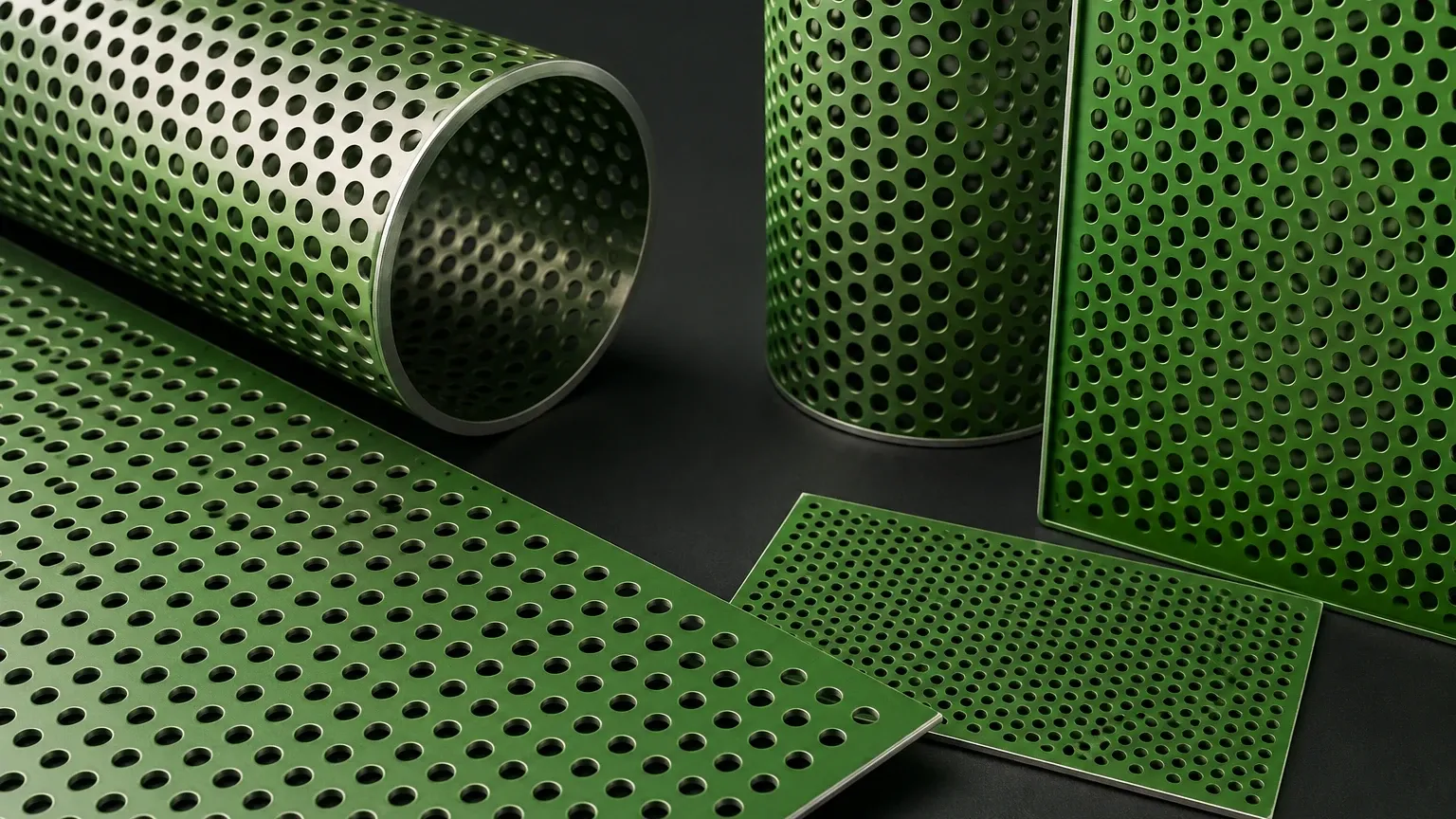
If "green" refers to the aesthetic color of the metal, the finishing process must be scrutinized. Traditional liquid paints often contain Volatile Organic Compounds (VOCs) that are harmful to the environment. For green perforated metal, powder coating is the preferred method. Powder coating is typically VOC-free, produces minimal waste, and provides a highly durable finish that protects the metal from oxidation, further extending its service life.
Evaluating Performance: Open Area and Flow Dynamics
To achieve true efficiency in filtration, the relationship between the perforated metal support and the primary filtration media (such as wire mesh) must be carefully engineered. The perforated metal acts as the structural skeleton, while the mesh provides the precision filtration.
Support for Fine Filtration
In high-pressure applications, such as hydraulic oil filtration or polymer melt processing, the perforated metal must withstand significant mechanical stress. If the perforated sheet is too thin or the open area is too high, the material may deform, leading to system failure. Conversely, if the open area is too low, the resulting pressure drop will increase energy costs. Achieving the "green" balance requires precise calculations of the flow velocity and the mechanical properties of the alloy.
Calculating Open Area (Round Holes, Staggered)
The formula for calculating the open area of a 60-degree staggered round hole pattern is:
Open Area % = (D² × 90.69) / R²
* *D = Hole Diameter*
* *R = Center-to-Center Pitch*
Engineers use this data to predict the behavior of the fluid as it passes through the perforated metal, ensuring that the system operates within its most efficient parameters.
Common Risks and Quality Assurance in Metal Perforation
Selecting a supplier for green perforated metal involves more than just comparing price points. Substandard manufacturing can lead to risks that undermine the sustainability and safety of a project.
1. Burrs and Sharp Edges: In filtration, burrs can break off and contaminate the downstream fluid, or they can damage the delicate wire mesh layers. High-quality perforation involves deburring processes to ensure a smooth, clean finish.
2. Inconsistent Hole Geometry: Variations in hole size or pitch can lead to uneven flow distribution, creating "hot spots" on the filter media where premature clogging or wear occurs.
3. Material Fatigue: If the perforation process introduces excessive internal stress into the metal, the sheet may crack under cyclic loading. Proper annealing and tension leveling are necessary to ensure long-term durability.
4. Environmental Compliance: It is crucial to confirm that the materials and processes used comply with international standards such as RoHS (Restriction of Hazardous Substances) and REACH (Registration, Evaluation, Authorisation and Restriction of Chemicals).
Pre-Purchase Checklist for Engineers and Procurement Teams
Before finalizing a specification for Perforated & Expanded Metal, technical professionals should confirm the following details to ensure the product aligns with their "green" and performance objectives:
* Application Environment: Will the metal be exposed to corrosive chemicals, high temperatures, or extreme weather? This dictates the material grade and necessary surface treatments.
* Flow Requirements: What is the required flow rate, and what is the maximum allowable pressure drop? This determines the necessary open area and hole pattern.
* Structural Load: Will the perforated metal be a load-bearing component? The thickness (gauge) and margins (unperforated edges) must be calculated to handle the mechanical stress.
* Customization Needs: Are there specific dimensions, bolt hole patterns, or forming requirements (such as rolling into cylinders) needed for the final assembly?
* Sustainability Documentation: Can the manufacturer provide material certifications (MTRs) and documentation regarding the recycled content or environmental compliance of the product?
By focusing on these technical and environmental factors, organizations can ensure that their use of green perforated metal contributes to more efficient, durable, and sustainable industrial operations. Kaifil remains committed to providing the engineering expertise and manufacturing precision required to meet these evolving B2B needs.
