


How to Paint Perforated Metal
Perforated metal is a versatile industrial material used extensively in filtration, architectural cladding, acoustic dampening, and structural support. While materials like stainless steel offer inherent corrosion resistance, many industrial applications require specialized coatings to enhance durability, provide chemical resistance, or meet specific aesthetic requirements. Understanding how to paint perforated metal is essential for engineers and procurement teams who need to ensure that the final component maintains its mechanical integrity and filtration performance after treatment.
When dealing with Perforated & Expanded Metal, the painting process is significantly more complex than coating a solid sheet. The presence of thousands of small apertures introduces risks such as hole clogging, uneven edge coverage, and "bridging." This guide provides a technical overview of the engineering considerations, surface preparation protocols, and application methods required to achieve a professional-grade finish on industrial metal components.
Engineering Considerations Before Coating
Before initiating any coating process, engineers must evaluate how the paint or powder layer will interact with the technical specifications of the perforated sheet. In industrial filtration, the precision of the hole size and the percentage of open area are critical to the system's flow rate and pressure drop.
Impact on Filtration Accuracy
Painting adds a measurable thickness to the surface of the metal. If a filter cartridge requires a specific micron rating, even a thin layer of liquid paint can reduce the effective diameter of the holes. For example, a 100-micron coating applied to both sides of a perforation can reduce the hole diameter by 200 microns. In high-precision applications, this can lead to premature clogging or insufficient flow. Designers must account for this "coating allowance" during the initial fabrication stage.
Open Area Maintenance
The "bridging" effect occurs when the surface tension of the paint causes it to span across the holes rather than coating the interior walls of the perforations. This is particularly common in expanded metal or perforated sheets with high hole density and small diameters. Maintaining the calculated open area is vital for hydraulic and pneumatic systems to prevent unwanted backpressure.
Surface Preparation for Industrial Metal
In a B2B manufacturing context, the longevity of a coating is almost entirely dependent on the quality of the surface preparation. Perforated metal often retains residual lubricants, oils, and metal fines from the punching or expanding process. If these contaminants are not removed, the paint will fail to adhere, leading to peeling and corrosion.
Degreasing and Cleaning
The first step in how to paint perforated metal is a thorough degreasing. Industrial-grade alkaline cleaners or solvent degreasers are used to remove paraffin-based lubricants used during the manufacturing of Perforated & Expanded Metal. For complex filter components, ultrasonic cleaning may be employed to ensure that the interior surfaces of the holes are free of debris.
Mechanical and Chemical Etching
For stainless steel and aluminum, the surface is often too smooth for optimal paint adhesion. Mechanical abrasion, such as sandblasting or bead blasting, creates a "profile" or "tooth" on the metal. Alternatively, chemical etching using phosphoric acid can prepare the surface. This is especially important for stainless steel filter cartridges that will be exposed to high-pressure washdowns or abrasive fluids.
Passivation and Priming
If the base material is carbon steel, a zinc-rich primer is often necessary to prevent oxidation beneath the paint layer. For stainless steel, ensuring the material has been properly passivated before painting ensures that the underlying metal remains resistant to localized pitting, even if the paint layer is eventually scratched or compromised.
Selecting the Right Coating Method
There are several methods used to apply color and protective layers to perforated components. The choice depends on the environment in which the filter or screen will operate.
Powder Coating
Powder coating is the industry standard for most industrial perforated metal applications. It involves applying a dry powder via electrostatic spray and then curing it in an oven.
* Advantages: Excellent edge coverage (the powder wraps around the sharp edges of the holes), high durability, and resistance to chemicals and UV.
* Disadvantages: Higher risk of bridging in very fine meshes; requires specialized equipment.
Liquid Spray Painting
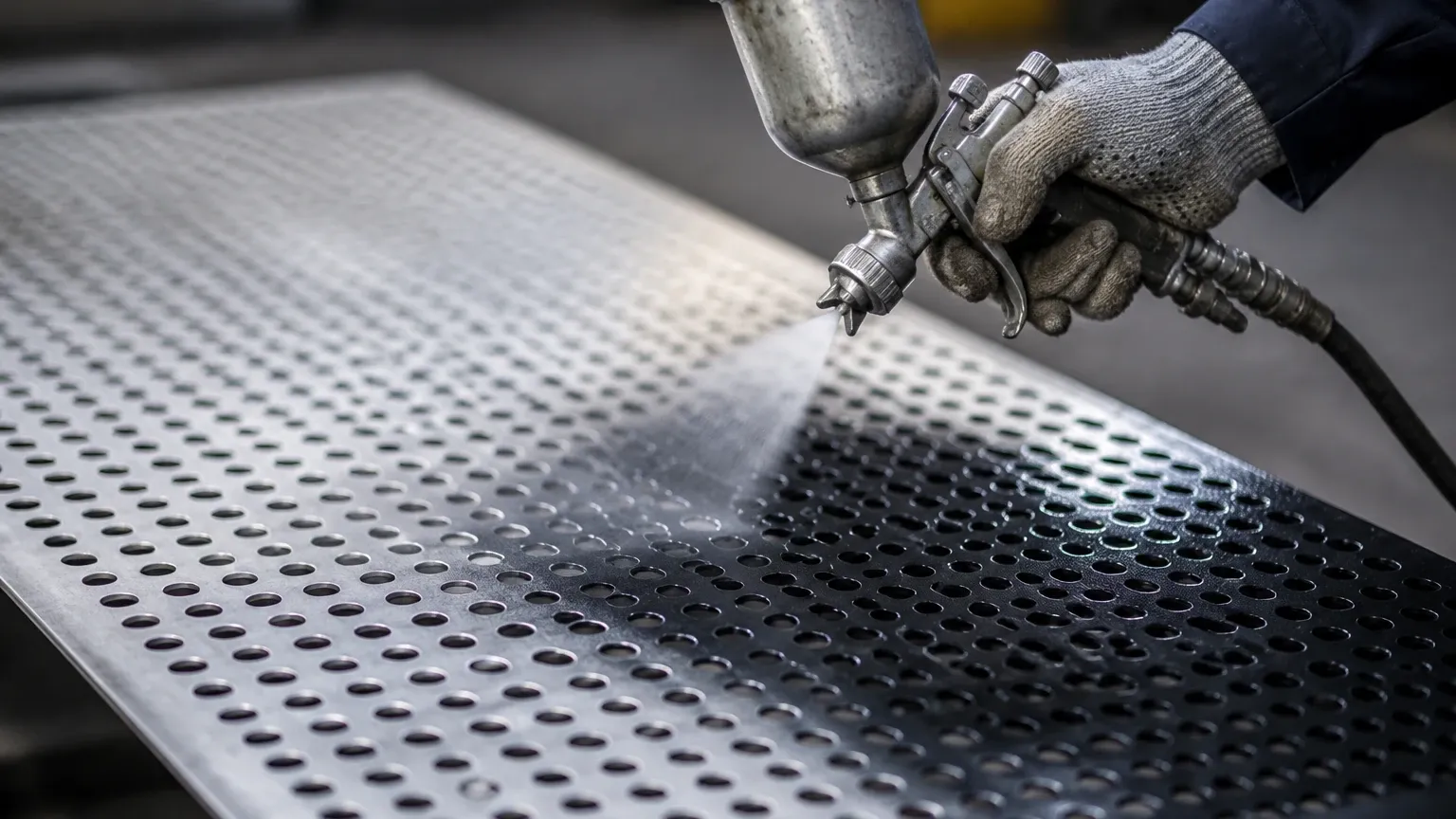
Traditional liquid spray is used when powder coating is not feasible, such as for extremely large components or when specific high-performance liquid resins (like epoxies or polyurethanes) are required for chemical compatibility.
* Advantages: Can be applied in thinner layers than powder, reducing the impact on hole diameter.
* Disadvantages: Poor edge coverage; the paint tends to pull away from the sharp edges of the perforations due to surface tension, leaving them vulnerable to corrosion.
E-Coating (Electrophoretic Deposition)
E-coating involves submerging the metal part in a bath of paint and applying an electric current. This is perhaps the most effective method for complex filtration components.
* Advantages: Guarantees 100% coverage of all interior hole surfaces and complex geometries without bridging.
* Disadvantages: Limited color options and generally thinner than powder coating.
Step-by-Step Guide: How to Paint Perforated Metal
To achieve a result that meets industrial quality standards, follow this technical workflow:
1. Inspection and Deburring: Ensure the Perforated & Expanded Metal is free of burrs. Sharp edges will cause the paint to thin out at the most critical points, leading to "edge rust."
2. Pre-Treatment: Clean the metal using a multi-stage process (Wash, Rinse, Phosphate/Chromate conversion, Rinse, Dry).
3. Hanging/Fixturing: Suspend the parts in a way that allows maximum airflow through the perforations. This helps prevent paint from pooling in the holes.
4. Application: Apply the coating. If using liquid spray, use multiple thin coats rather than one thick coat to minimize bridging.
5. Clearing the Perforations: Immediately after application (and before curing), use a high-pressure air blast if necessary to blow out any paint that has bridged across the holes.
6. Curing: Follow the manufacturer’s specifications for time and temperature. Under-cured paint will be soft and chemically sensitive, while over-cured paint may become brittle.
Common Risks and Quality Control
When purchasing or specifying painted perforated metal, engineers should be aware of common failure points and how to audit them.
Adhesion Testing
In industrial environments, the coating must withstand vibration and thermal expansion. Cross-hatch adhesion tests (ASTM D3359) should be performed on sample pieces to ensure the bond between the paint and the metal substrate is secure.
Dry Film Thickness (DFT) Measurement
Using an ultrasonic or magnetic thickness gauge, the DFT should be checked at various points on the sheet. For perforated metal, it is also important to check the "wrap-around" thickness on the edges of the holes, as this is where corrosion typically starts.
Clogging and Flow Testing
For components used in filtration or ventilation, a flow test may be required after painting. This confirms that the coating process has not reduced the air or liquid flow beyond the allowable tolerance. If the pressure drop is too high, the painting process must be adjusted to use a lower-viscosity coating or a different application method.
Customization and OEM Solutions
For many B2B applications, standard painting methods may not suffice. Custom filtration solutions often require specific coatings that can withstand extreme temperatures, cryogenic environments, or highly acidic processing fluids.
Kaifil specializes in manufacturing precision metal filter components that meet these demanding requirements. From selecting the appropriate grade of stainless steel to ensuring the final Perforated & Expanded Metal product meets exact filtration benchmarks, the focus remains on durability and performance. When customization is required, working with a manufacturer that understands the intersection of metallurgy and coating technology is essential.
Conclusion
Knowing how to paint perforated metal is a balance between protecting the substrate and preserving the functional characteristics of the perforations. Whether the goal is to improve the lifespan of a hydraulic filter or to integrate an expanded metal screen into an architectural design, the technical success of the project relies on rigorous surface preparation and the correct choice of application method. By considering the impact of coating thickness on open area and ensuring high-quality edge coverage, engineers can specify perforated metal solutions that deliver both aesthetic value and long-term industrial reliability.
