


Njr Expanded Metal
In industrial filtration and structural engineering, the selection of support materials is as critical as the selection of the primary filtration media. For procurement specialists and engineers searching for njr expanded metal, the focus typically lies on finding a balance between structural rigidity, open area for fluid flow, and material longevity. Expanded metal, particularly when manufactured from stainless steel, serves as a cornerstone in the production of durable filter cartridges, protective screens, and industrial partitions.
As a specialized manufacturer, Kaifil provides high-performance Perforated & Expanded Metal solutions designed to meet the rigorous demands of chemical processing, hydraulic systems, and water treatment. Understanding the technical nuances of how these materials are manufactured, specified, and integrated into filtration systems is essential for optimizing performance and reducing the total cost of ownership.
The Manufacturing Process of Expanded Metal
Expanded metal is produced through a unique process of simultaneous slitting and stretching. Unlike perforated metal, which is created by punching holes and removing material (creating waste known as "slugs"), expanded metal is formed from a single solid sheet or coil. A series of knives slits the metal while the machine stretches the material, creating a diamond-shaped pattern of openings.
This process offers several engineering advantages:
1. Material Efficiency: Since no metal is removed during production, there is zero waste. This makes expanded metal a highly cost-effective alternative to perforated metal, especially when using expensive alloys like 316L stainless steel.
2. Structural Integrity: Because the material is not cut and then joined, but rather stretched from a single piece, it maintains its structural continuity. The "bonds" (the intersections of the diamonds) are stronger than welds or mechanical joins.
3. Weight-to-Strength Ratio: Expanded metal is significantly lighter than a solid sheet of the same dimensions but retains a high percentage of the original sheet’s strength, making it ideal for support cores in high-pressure filter cartridges.
Technical Specifications: LWD, SWD, and Beyond
When specifying njr expanded metal for industrial applications, engineers must use standardized terminology to ensure the finished product meets the application's mechanical requirements. The geometry of the diamond opening is defined by two primary measurements:
* LWD (Long Way of Design): The distance from the center of one bond to the center of the next bond across the long axis of the diamond.
* SWD (Short Way of Design): The distance from the center of one bond to the center of the next bond across the short axis of the diamond.
* LWO (Long Way of Opening): The actual width of the opening in the long direction.
* SWO (Short Way of Opening): The actual width of the opening in the short direction.
In addition to the opening size, the Strand Width (the amount of metal between the openings) and Strand Thickness (the thickness of the original base material) dictate the overall weight and strength of the mesh. For filtration applications, the Open Area Percentage is the most critical metric, as it directly impacts the flow rate and pressure drop across the filter element.
Material Selection for Corrosive Environments
For most industrial B2B applications, stainless steel is the preferred material for expanded metal due to its resistance to oxidation and chemical degradation. Kaifil specializes in several grades to suit different operational environments:
304 Stainless Steel
The most common grade, offering excellent corrosion resistance in standard industrial environments. It is widely used in food and beverage processing and general water filtration.
316/316L Stainless Steel
Containing molybdenum, 316 stainless steel provides superior resistance to chlorides and marine environments. 316L (low carbon) is preferred for components requiring welding, as it prevents carbide precipitation and ensures the integrity of the filter assembly in chemical processing plants.
Specialized Alloys
In extreme cases involving high temperatures or highly acidic/alkaline fluids, exotic materials like Monel, Inconel, or Hastelloy may be used in the expansion process to ensure the support structure does not fail before the filter media.
Flattened vs. Raised Expanded Metal
A critical decision for engineers is whether to specify "Raised" (Standard) or "Flattened" expanded metal.
* Raised Expanded Metal: This is the material as it comes off the expansion machine. The strands and bonds are set at a sharp angle to the plane of the sheet. This provides maximum rigidity and a slip-resistant surface, often used for industrial walkways or heavy-duty guards. However, in filtration, the raised edges can sometimes cause turbulence or damage delicate inner filter layers.
* Flattened Expanded Metal: The raised material is passed through a cold-roll reducing mill. This process flattens the strands and bonds into the same plane as the sheet. Flattened expanded metal is smoother, thinner, and slightly elongated. In the context of filter cartridges, flattened metal is often preferred for the outer protective sleeve to prevent injury during handling and to ensure a uniform diameter for housing fitment.
The Role of Expanded Metal in Industrial Filtration
In a complex filtration system, expanded metal rarely acts as the primary filter medium. Instead, it serves several vital secondary roles that ensure the primary medium (such as fine wire mesh or sintered metal) can function under stress.
1. Internal Support Cores
High-pressure hydraulic and gas filtration systems subject filter elements to significant differential pressure. An internal core made of stainless steel expanded metal prevents the filter media from collapsing inward. The diamond pattern provides multi-directional support, which is often superior to the linear support provided by some perforated designs.
2. Outer Protective Sleeves
Filter elements are often exposed to mechanical impact during installation or high-velocity fluid flow during operation. An outer sleeve of expanded metal protects the pleated or wrapped filter media from abrasion and deformation. The high open area of expanded metal ensures that the protective layer does not restrict flow or contribute to unnecessary pressure drop.
3. Pre-Filtration and Trash Screens
In water intake systems or large-scale chemical reactors, expanded metal is used as a coarse pre-filter. It captures large debris—such as stones, plastic, or large scale—before the fluid reaches the precision filtration stages. This extends the life of the more expensive fine filters downstream.
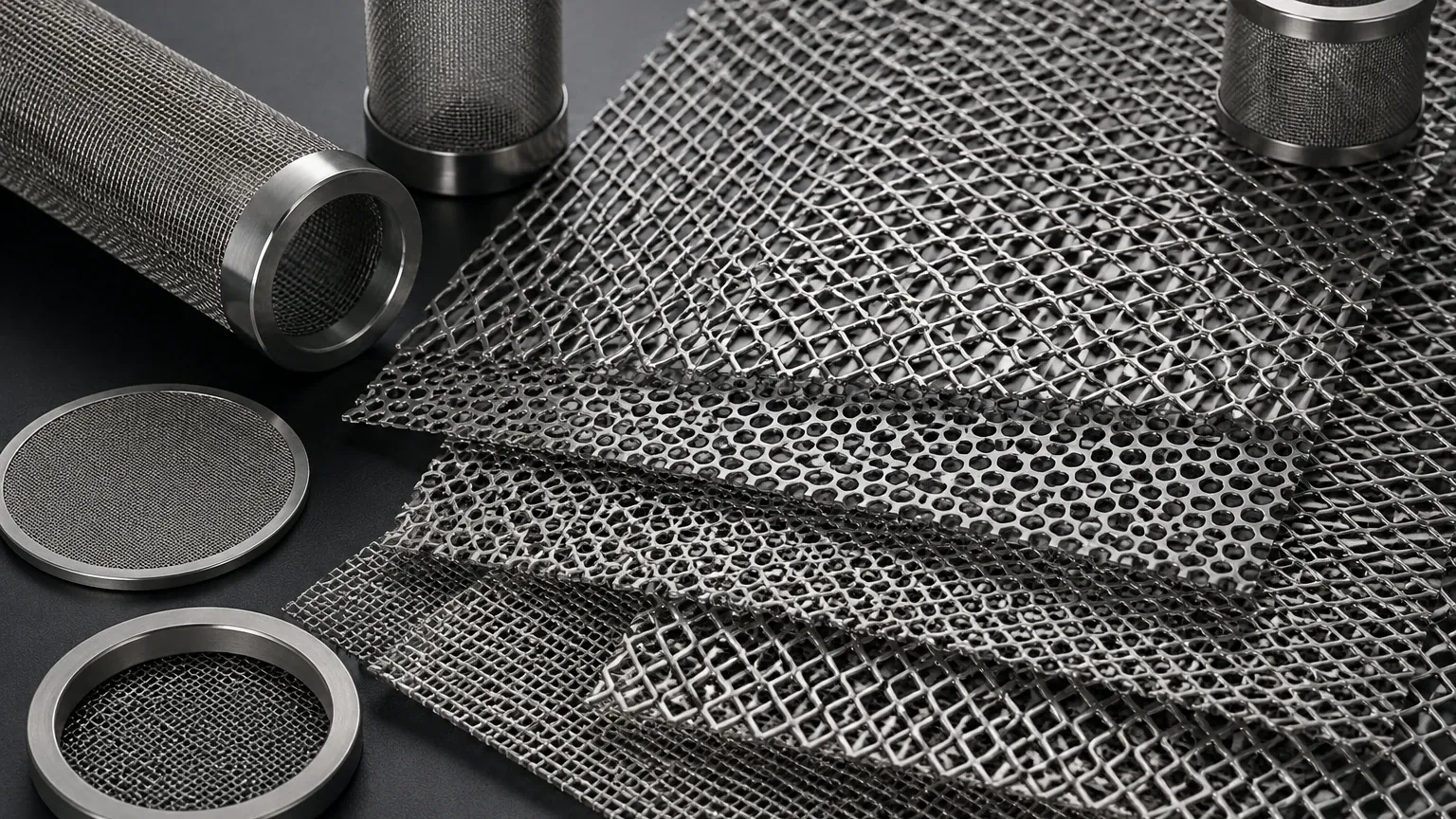
Comparing Perforated & Expanded Metal for Engineering Projects
Engineers often weigh the pros and cons of Perforated & Expanded Metal when designing a new filtration component. While both serve similar functions, the choice often comes down to specific project constraints.
| Feature | Expanded Metal | Perforated Metal |
| :— | :— | :— |
| Cost | Generally lower (no material waste) | Higher (material removed/wasted) |
| Strength | High strength-to-weight ratio | Extremely rigid but heavier |
| Open Area | Easily achieves >70% open area | Typically 30% to 50% for standard patterns |
| Surface | Can be raised or flattened | Always flat/smooth |
| Customization | Limited to diamond/hex shapes | Nearly any hole shape (round, square, slotted) |
| Flow Dynamics | Can create slight turbulence (Raised) | Predictable, laminar flow |
For applications where weight reduction and cost efficiency are paramount, expanded metal is the clear winner. For applications requiring precise hole diameters (e.g., exactly 2.0mm) to act as a primary sieve, perforated metal is usually specified.
Engineering Considerations for Customization
When partnering with a manufacturer like Kaifil for njr expanded metal solutions, providing detailed application data allows for better engineering outcomes. Key factors to confirm before production include:
* Direction of the Diamond: In some flow applications, the orientation of the LWD relative to the flow direction can affect the structural load. Engineers should specify if the diamond should run parallel or perpendicular to the length of the part.
* Tolerances: Standard industrial tolerances for expanded metal are broader than those for machined parts. If the metal is being used as a core for a precision-fit cartridge, tight tolerances on the SWD and LWD must be established.
* Surface Treatment: For pharmaceutical or food-grade applications, the expanded metal should undergo electropolishing or passivation to remove surface impurities and enhance the chromium oxide layer, ensuring maximum corrosion resistance.
* Edge Conditions: Expanded metal naturally has "random" edges where the diamonds are cut. If the part requires a solid border or a "bond sheared" edge (where the cut happens exactly at the intersection), this must be specified, as it affects both the cost and the assembly method (welding vs. mechanical clamping).
Quality Assurance and Compliance
In B2B procurement, ensuring that the material meets international standards is non-negotiable. Quality njr expanded metal should be manufactured in accordance with standards such as ASTM F1267, which covers the composition and physical properties of expanded metal. For filtration in the European market, compliance with PED (Pressure Equipment Directive) may also be relevant if the filter is part of a pressurized vessel.
Kaifil’s commitment to quality involves rigorous inspection of the base material (MTRs – Material Test Reports) and post-production checks on dimensions and mesh integrity. This ensures that every component delivered can withstand the burst pressures and chemical exposures inherent in industrial filtration.
Conclusion: Selecting the Right Partner
Choosing the right njr expanded metal involves more than just selecting a part number from a catalog. It requires a deep understanding of how the material’s geometry, grade, and finish will interact with the fluid and the primary filtration media. By focusing on technical accuracy and material performance, engineers can design systems that are both efficient and durable.
Whether you are designing a new hydraulic filter, a chemical strainer, or an industrial guard, the versatility of Perforated & Expanded Metal offers a range of solutions that balance cost and performance. Working with an experienced manufacturer like Kaifil ensures that you receive not only a high-quality product but also the engineering support necessary to navigate complex filtration challenges. From material selection to customized designs and production, the goal is to deliver dependable filtration components for the most demanding industrial environments.
