


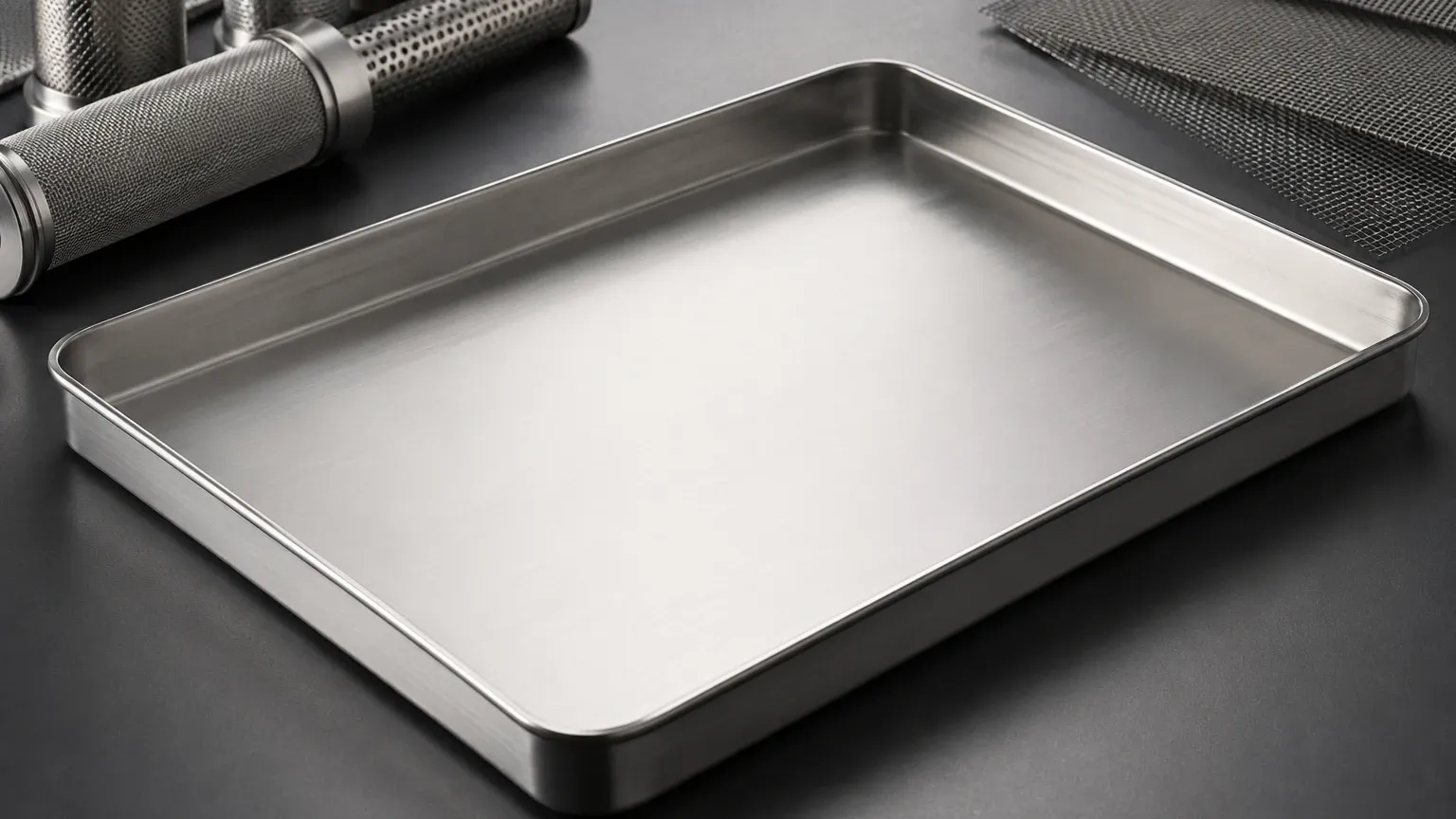
Non Perforated Metal Tray
In the landscape of industrial filtration and material handling, the selection of containment and transport components is as critical as the selection of the filtration media itself. While Perforated & Expanded Metal components are engineered specifically to allow the controlled passage of fluids or gases, the non perforated metal tray serves the opposite yet equally vital function: total containment, structural support, and protective shielding. For engineers and procurement specialists in the chemical, pharmaceutical, and food processing sectors, understanding the technical nuances of solid-surface trays is essential for maintaining system integrity and hygiene standards.
A non perforated metal tray is a solid-surface vessel, typically fabricated from high-grade alloys, designed to hold, transport, or contain materials without leakage or bypass. Unlike mesh-based or perforated alternatives, these trays provide a continuous barrier that is indispensable in applications ranging from secondary containment in hydraulic systems to sterile material handling in cleanrooms.
Engineering Fundamentals and Material Integrity
The performance of a non perforated metal tray is primarily dictated by its material composition and the precision of its fabrication. In industrial environments where corrosion, thermal stress, and mechanical impact are constant variables, the choice of substrate is the first point of engineering consideration.
Stainless Steel Grades
Stainless steel remains the industry standard for these components due to its inherent durability and resistance to oxidation.
* Type 304 Stainless Steel: This is the most common grade used for general industrial trays. It offers excellent formability and welding characteristics, making it suitable for standard drip trays and equipment housing. It provides reliable resistance to atmospheric corrosion and many organic and inorganic chemicals.
* Type 316/316L Stainless Steel: For more demanding environments, such as chemical processing or marine applications, Type 316 is preferred. The addition of molybdenum enhances resistance to pitting and crevice corrosion in chloride-rich environments. The "L" (low carbon) variant is often specified for trays requiring extensive welding to prevent carbide precipitation and ensure the longevity of the joints.
Structural Design and Load Bearing
Engineers must calculate the gauge (thickness) of the metal based on the intended load and the tray's dimensions. A tray used for light-duty component transport may utilize 18-gauge or 20-gauge sheet metal, whereas a heavy-duty industrial sump tray might require 10-gauge to 14-gauge material to prevent buckling or deformation under the weight of heavy machinery or bulk liquids.
Manufacturing Processes and Customization
Fabricating a high-quality non perforated metal tray involves more than simple bending. Professional manufacturing ensures that the tray meets specific dimensional tolerances and functional requirements.
Precision Bending and Forming
Using CNC press brakes, manufacturers can create precise angles and lip heights. The height of the tray walls is a critical safety factor in containment applications; for instance, a drip tray must be sized to hold at least 110% of the volume of the largest container it sits beneath. Custom lip designs, such as hemmed edges (where the metal is folded back on itself), provide additional structural rigidity and eliminate sharp edges, enhancing workplace safety.
Welding and Leak-Proofing
For trays intended to hold liquids, the corners must be fully welded rather than just folded. TIG (Tungsten Inert Gas) welding is frequently employed for stainless steel trays to produce clean, strong, and liquid-tight seams. In pharmaceutical and food-grade applications, these welds are often ground smooth and polished to eliminate crevices where bacteria could proliferate.
Surface Finishes
The surface finish of a non perforated metal tray affects both its corrosion resistance and its ease of cleaning.
* 2B Finish: A mill finish that is smooth and slightly reflective, suitable for most industrial applications.
* No. 4 Brushed Finish: Commonly used in food service and pharmaceutical environments for its aesthetic appeal and ability to hide minor scratches.
* Electropolishing: An electrochemical process that removes a fine layer of surface material, resulting in a mirror-like finish. This is the gold standard for high-hygiene environments as it minimizes surface roughness (Ra value), making it nearly impossible for contaminants to adhere to the metal.
The Relationship Between Solid Trays and Perforated Media
In many complex filtration systems, a non perforated metal tray works in tandem with Perforated & Expanded Metal components. This synergy is common in multi-stage processing equipment:
1. Support and Drainage: A perforated basket or insert may be placed inside a larger non-perforated tray. The perforated layer allows liquid to drain from a solid mass, while the solid tray captures and directs the filtrate toward a specific discharge point.
2. Drying Processes: In industrial drying ovens, solid trays are used for materials that might fall through even the finest mesh. Conversely, if airflow is required from beneath, the system might transition to a perforated design. Choosing between the two requires an analysis of particle size and the required rate of heat or mass transfer.
3. Secondary Containment: When using perforated filter housings, a solid tray is often installed underneath as a safety measure to catch any accidental bypass or leaks during filter element changes, protecting the facility floor and preventing environmental contamination.
Applications Across Key Industrial Sectors
Chemical and Petrochemical Processing
In these sectors, the non perforated metal tray is primarily used for hazardous material containment. Trays must be compatible with aggressive solvents and acids. The use of 316L stainless steel ensures that the containment system does not fail due to chemical attack, which could lead to costly downtime or safety violations.
Food and Beverage Production
Sanitary design is the priority here. Trays used for transporting ingredients or as part of a conveyor system must be free of "dead zones." Fully welded, radiused corners are often specified to ensure that high-pressure washdowns can reach every part of the tray surface, maintaining compliance with FDA and local health standards.
Pharmaceutical and Laboratory Environments
In cleanrooms, the non perforated metal tray is used for the sterilization of instruments and the transport of sensitive biological materials. These trays must withstand repeated autoclave cycles (high-pressure steam) without warping. The non-porous nature of stainless steel makes it the ideal substrate for maintaining a sterile environment.
Selection Criteria for Engineers and Purchasing Teams
When specifying a non perforated metal tray for an industrial project, several technical parameters must be confirmed to ensure the component is fit for purpose:
* Dimensional Accuracy: What are the exact length, width, and depth requirements? Does the tray need to fit into an existing rack or housing with tight tolerances?
* Material Compatibility: Does the liquid or solid being handled react with 304 stainless steel, or is 316 required? Are there trace elements in the process that could cause stress corrosion cracking?
* Load Requirements: What is the maximum weight the tray will support? Will the load be static or dynamic (moving)? This determines the required gauge and whether reinforcing ribs are necessary.
* Environmental Conditions: Will the tray be exposed to extreme temperatures? Stainless steel maintains its structural integrity at high temperatures, but thermal expansion must be accounted for in the design of the support structure.
* Regulatory Compliance: Does the application require specific certifications, such as food-grade material verification or pressure vessel standards for sealed trays?
Maintenance and Total Cost of Ownership
While the initial cost of a custom-fabricated stainless steel non perforated metal tray may be higher than plastic or galvanized steel alternatives, the total cost of ownership (TCO) is significantly lower. Stainless steel's longevity, resistance to damage, and 100% recyclability make it a sustainable and cost-effective choice for long-term industrial use.
Maintenance typically involves regular cleaning and inspection of welded seams. In highly corrosive environments, periodic passivation—a chemical treatment that restores the protective oxide layer on the surface of the stainless steel—can further extend the service life of the tray. Unlike plastic trays, which can crack, or galvanized trays, which can lose their protective coating, a well-maintained stainless steel tray can remain in service for decades.
Conclusion
The non perforated metal tray is a fundamental component in the industrial toolkit, providing the necessary containment and structural integrity to support complex processes. Whether acting as a standalone transport vessel or as a critical backup to Perforated & Expanded Metal filtration components, its design must be approached with technical rigor. By focusing on material grade, fabrication precision, and application-specific requirements, engineers can ensure that their containment solutions contribute to the overall efficiency, safety, and hygiene of their operations. For those managing demanding industrial environments, investing in high-quality, customized metal trays is a strategic decision that pays dividends in reliability and reduced maintenance overhead.
