


Perforated 7 8 Corrugated
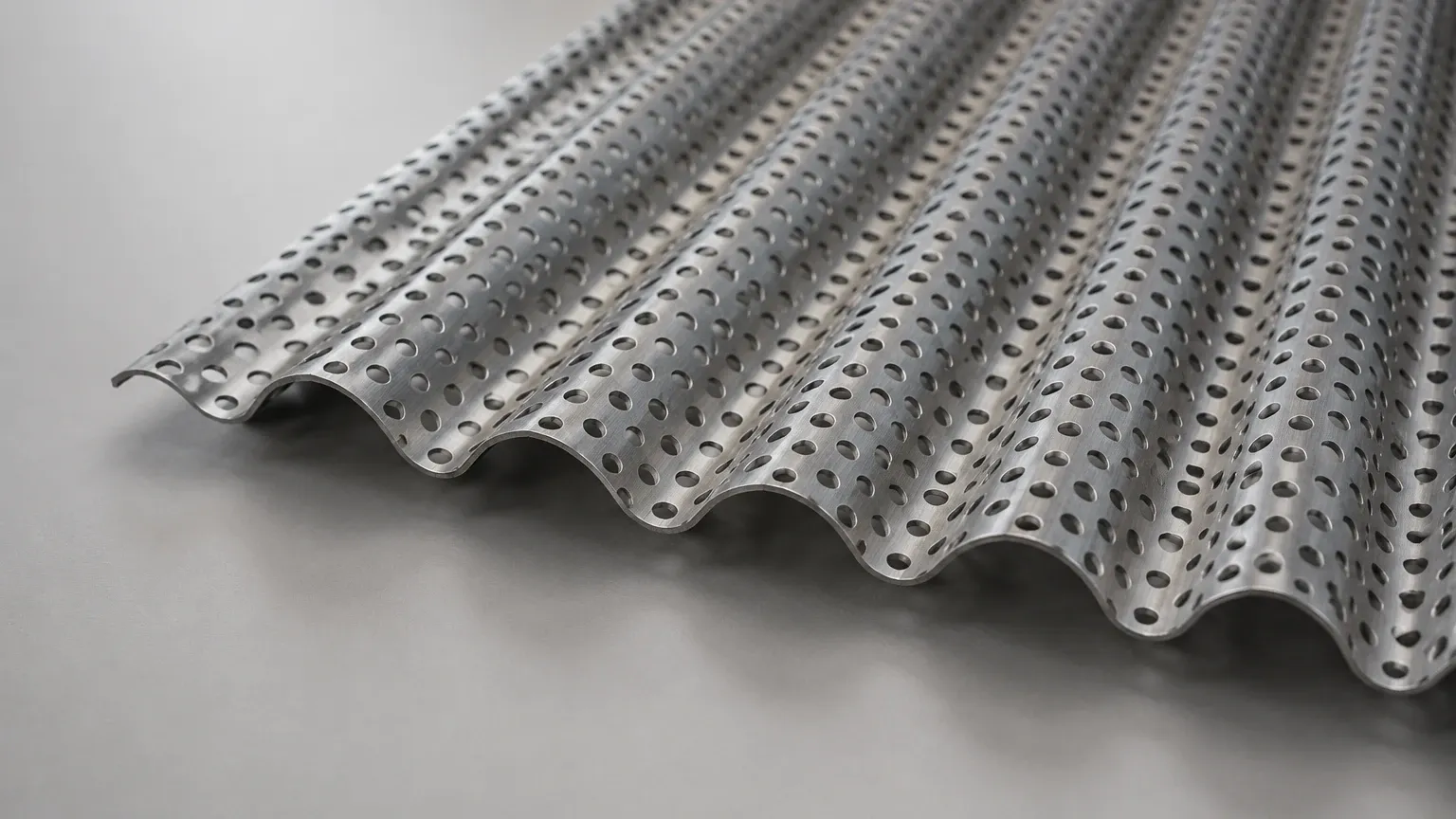
In the landscape of industrial filtration and structural engineering, the integration of geometric reinforcement with functional porosity represents a significant advancement in component design. The perforated 7 8 corrugated profile is a prime example of this synergy. By combining the inherent structural strength of a 7/8-inch deep rib profile with the precision of metal perforation, manufacturers provide a solution that addresses complex challenges in airflow management, structural support, and material separation.
For engineers and procurement specialists, understanding the technical nuances of these components is essential for optimizing system performance. Whether used as a high-strength support for filtration media or as a durable screen in chemical processing, the selection of material, gauge, and perforation pattern determines the long-term viability of the installation.
Understanding the 7/8 Corrugated Profile Geometry
The designation "7/8 corrugated" refers specifically to the height of the corrugation rib, which stands at 0.875 inches. This profile is distinct from shallower patterns, such as the 1/2-inch or 1/4-inch variations, because it offers a significantly higher moment of inertia. In engineering terms, this translates to greater resistance to bending and a higher load-bearing capacity over longer spans.
The pitch—the distance from the center of one crest to the next—is typically 2.67 inches. This specific geometry creates a repeating wave pattern that provides multi-directional rigidity. When a flat sheet of metal is transformed into this corrugated shape, its structural integrity increases exponentially, allowing for the use of thinner gauges without sacrificing the ability to withstand mechanical stress or high-pressure differentials.
When this profile is perforated, it retains much of its structural advantage while gaining the functionality of a screen or filter. The combination is particularly effective in environments where a flat perforated sheet would bow or fail under the weight of a filter cake or the force of high-velocity fluid streams.
The Role of Perforation in Industrial Applications
Perforation transforms a solid structural panel into a functional Perforated & Expanded Metal component. The primary objective of perforation in a 7/8 corrugated panel is to allow for the passage of air, light, or liquid while maintaining a physical barrier for solids.
Open Area Calculations
The "open area" is the percentage of the sheet that is comprised of holes. This is a critical metric for engineers calculating flow rates and pressure drops. For a perforated 7 8 corrugated panel, the open area is determined by the hole diameter and the spacing (pitch) between the holes.
Common patterns include:
* Staggered Round Holes: Usually arranged at a 60-degree angle, providing the highest strength-to-open-area ratio.
* Straight Row Round Holes: Used when specific alignment with internal components is required, though generally offering lower structural stability than staggered patterns.
* Square Holes: Often selected for applications requiring maximum open area, though they can introduce stress concentrators at the corners.
In industrial filtration, an open area of 40% to 60% is common, balancing the need for low resistance to flow with the requirement for mechanical support.
Material Selection and Corrosion Resistance
The environment in which the perforated 7 8 corrugated panel will operate dictates the material choice. While carbon steel and aluminum are available, stainless steel remains the standard for demanding industrial applications due to its superior mechanical properties and chemical resistance.
Stainless Steel 304 vs. 316
* Type 304: This is the most common grade, offering excellent durability and resistance to oxidation. It is suitable for most indoor industrial applications, food processing, and general filtration tasks.
* Type 316: For environments involving high salinity, chlorides, or acidic chemical processing, Type 316 is preferred. The addition of molybdenum enhances its resistance to pitting and crevice corrosion, making it the authoritative choice for marine or pharmaceutical environments.
Beyond the base alloy, the manufacturing process must ensure that the perforating and corrugating stages do not compromise the material's integrity. High-quality production involves precise tooling to prevent micro-cracking at the edges of the perforations, which could otherwise become focal points for stress corrosion cracking.
Engineering Performance: Airflow and Sound Control
One of the most frequent applications for perforated 7 8 corrugated panels is in ventilation and acoustic damping. The deep rib profile provides a natural plenum space when mounted against a flat surface, which can be utilized to manage airflow or house sound-absorbing insulation.
Fluid Dynamics and Pressure Drop
Engineers must account for the "tortuous path" created by the corrugation. As fluid or air passes through a corrugated perforated screen, the change in direction can induce turbulence. While this is often desirable in heat exchange applications to increase thermal transfer, it must be carefully modeled in filtration systems to ensure that the pressure drop does not exceed the capacity of the pumps or blowers.
Acoustic Attenuation
In power plants and heavy machinery enclosures, these panels serve as the facing for sound-absorption systems. The perforations allow sound waves to pass through the metal skin into an acoustic medium (like mineral wool), where the energy is dissipated. The 7/8-inch depth provides the necessary stiffness to prevent the panel itself from vibrating and contributing to the noise floor.
Selection Criteria for Industrial Procurement
When specifying perforated 7 8 corrugated components, purchasing teams and engineers should confirm several technical parameters to ensure the product meets the application requirements.
1. Gauge Thickness: Typically ranging from 22 gauge (0.030") to 18 gauge (0.048"). Thicker gauges are used for heavy-duty support, while thinner gauges are suitable for architectural screening or lightweight filtration covers.
2. Hole Size and Pattern: The diameter of the holes must be smaller than the particles being filtered but large enough to prevent premature blinding (clogging). Common diameters range from 1/16" to 1/4".
3. Margin Requirements: "Margins" refer to the unperforated areas along the edges of the sheet. Specifying clear margins is essential for secure welding or mechanical fastening without damaging the perforation pattern.
4. Finish: Depending on the application, panels may require de-burring, degreasing, or electropolishing. In food and pharmaceutical sectors, a smooth, burr-free finish is mandatory to prevent bacterial growth and ensure cleanability.
Installation and Structural Integration
The success of a perforated 7 8 corrugated installation depends largely on how the panels are secured. Because of the rib height, these panels are typically overlapped at the edges. A standard "lap" involves nesting the last rib of one panel over the first rib of the next, which creates a continuous, water-tight, or particle-tight seal.
Fastening Methods
* Mechanical Fasteners: Self-tapping screws with EPDM washers are common in exterior or large-scale industrial enclosures. The fasteners are typically placed in the "valleys" of the corrugation for maximum stability.
* Welding: In filtration housings, spot welding or TIG welding along the margins is used to integrate the panel into a frame. Care must be taken to manage heat input to avoid warping the corrugated profile.
Structural Spanning
Due to the 7/8-inch rib, these panels can often span 4 to 6 feet between supports, depending on the gauge and the load. This reduces the amount of internal framing required in large filtration vessels or ventilation ducts, leading to lower material costs and faster installation times.
Customization and Manufacturing Precision
Standard off-the-shelf perforated panels often fail to meet the exacting requirements of specialized industrial processes. Customization is frequently necessary to align the perforation pattern with internal baffles or to accommodate specific flow characteristics.
Manufacturing a perforated 7 8 corrugated panel involves a two-step process. First, the flat sheet is perforated using a high-speed CNC press or a wide-action perforating line. Second, the perforated sheet is fed through a roll-forming machine or a press brake to create the 7/8-inch corrugations.
Precision is paramount during the roll-forming stage. If the perforations are not aligned correctly with the corrugation dies, the holes can become distorted, affecting both the aesthetic appearance and the mechanical performance of the panel. Expert manufacturers ensure that the "stretch" of the metal during corrugation is accounted for in the initial perforation layout.
Maintenance and Total Cost of Ownership
While the initial cost of stainless steel perforated 7 8 corrugated panels may be higher than galvanized or aluminum alternatives, the total cost of ownership (TCO) is often lower due to reduced maintenance and longer replacement cycles.
In filtration applications, the panels must be monitored for blinding and corrosion. Stainless steel's ability to withstand aggressive CIP (Clean-in-Place) chemicals means the panels can be cleaned and returned to service multiple times. The structural rigidity of the 7/8 profile also prevents the "oil-canning" effect—the popping sound and metal fatigue caused by repeated pressure fluctuations—which is a common failure mode in flatter, less rigid screens.
By selecting a high-performance profile like the 7/8-inch corrugated perforated metal, industrial facilities can ensure a reliable, low-maintenance solution that supports efficient operations across a wide range of demanding environments.
