


Perforated Metal 50
In the landscape of industrial filtration and structural engineering, the specification of "50" in relation to perforated metal typically refers to one of the most critical performance metrics: the percentage of open area. Achieving a 50% open area represents a significant engineering balance, offering a high rate of throughput while maintaining the structural integrity of the metal substrate. For technical professionals and purchasing teams, understanding the nuances of Perforated & Expanded Metal with these specific parameters is essential for optimizing flow control, filtration efficiency, and component longevity.
At Kaifil, we recognize that perforated metal 50 is not a one-size-fits-all solution. Whether used as a support core for fine wire mesh filters or as a primary screening element in heavy-duty industrial processes, the precision of the perforation pattern and the quality of the material selection determine the success of the application. This guide explores the technical considerations, material science, and engineering factors involved in selecting and implementing perforated metal with a 50% open area.
The Technical Significance of 50% Open Area
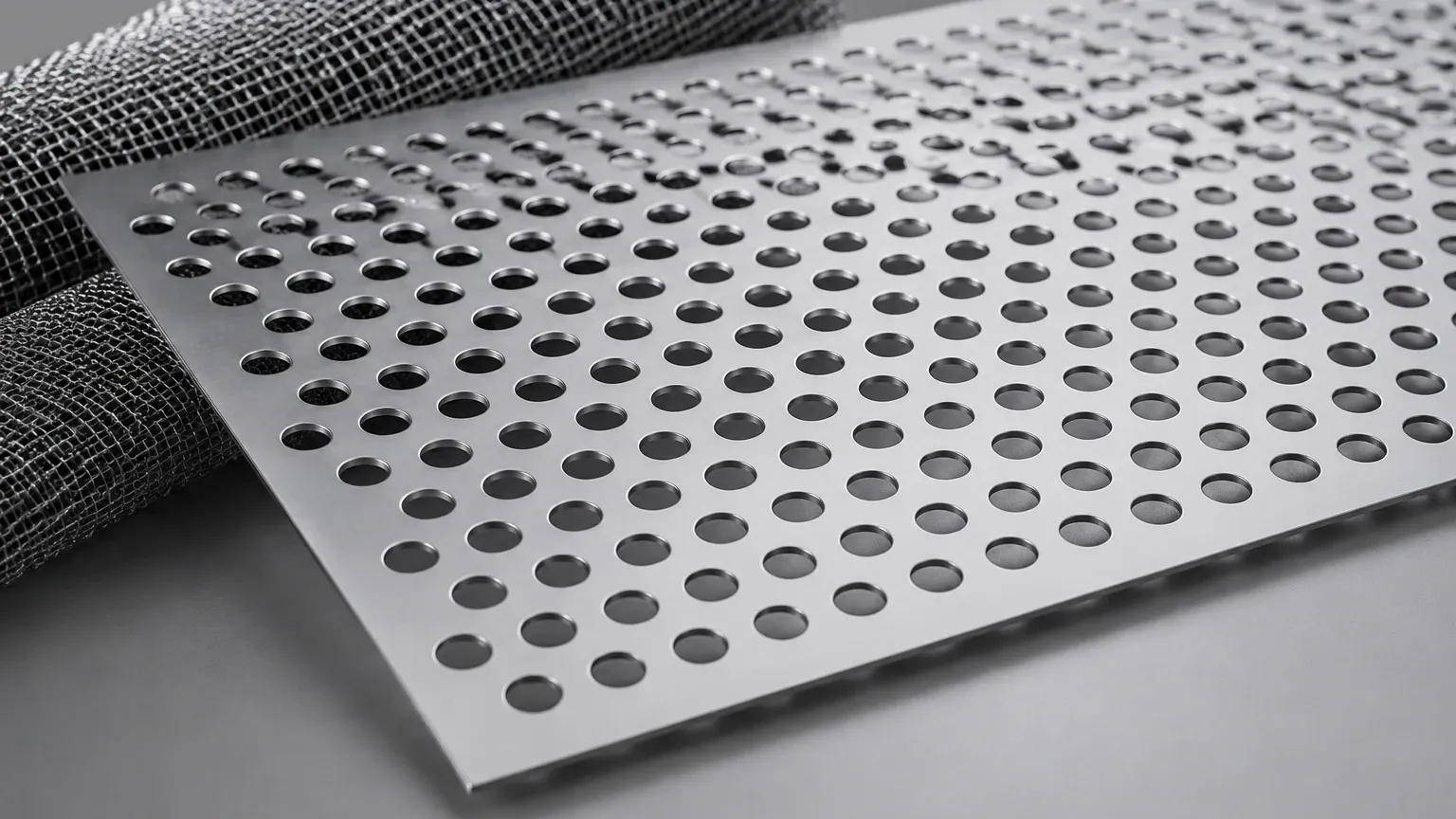
The open area of a perforated sheet is the ratio of the total area of the holes to the total area of the sheet, expressed as a percentage. In a perforated metal 50 configuration, half of the surface area is removed, which has profound implications for both fluid dynamics and mechanical strength.
Geometric Calculations
Calculating the open area depends heavily on the hole pattern. For the most common configuration—round holes in a 60-degree staggered pattern—the formula used by engineers is:
OA = (D² × 90.69) / C²
Where:
* D = Hole Diameter
* C = Center-to-Center Distance (Pitch)
To achieve a 50% open area, the relationship between the hole diameter and the pitch must be precisely managed. For example, if a design requires a specific hole size for particle retention, the pitch must be adjusted to hit the 50% target. A common pitfall in procurement is overlooking how small changes in pitch can drastically alter the open area, leading to unexpected pressure drops or structural failure under high-velocity flow.
Structural Trade-offs
While a 50% open area provides excellent flow characteristics, it also reduces the overall weight and stiffness of the material. In high-pressure hydraulic or chemical processing applications, the remaining metal "bridges" must be wide enough to withstand the mechanical stresses of the system. Engineers must evaluate the yield strength of the base material to ensure that the perforated metal 50 component does not deform or fatigue prematurely during operation.
Material Integrity: Choosing the Right Alloy
Selection of the base metal is as critical as the perforation pattern itself. In industrial environments where perforated metal 50 is utilized, the material must withstand chemical corrosion, thermal cycling, and mechanical wear.
Stainless Steel Grades
Kaifil specializes in high-performance stainless steel alloys, which are the industry standard for demanding filtration tasks:
* Type 304: Suitable for general-purpose applications, offering good corrosion resistance and excellent formability. It is frequently used in food and beverage processing where sanitary conditions are required.
* Type 316/316L: The preferred choice for pharmaceutical and marine environments. The addition of molybdenum provides superior resistance to chloride-induced pitting and crevice corrosion. The "L" (low carbon) variant is essential if the perforated metal 50 component requires welding, as it prevents carbide precipitation that can lead to intergranular corrosion.
* Duplex Stainless Steels: For extreme environments involving high pressure and highly corrosive media, Duplex alloys offer nearly twice the strength of austenitic stainless steels, allowing for thinner gauges without sacrificing structural reliability.
Surface Treatments and Passivation
Beyond the alloy itself, surface finishing plays a vital role in performance. For perforated metal 50 used in the pharmaceutical or food industries, electropolishing or chemical passivation is often required. These processes remove free iron from the surface and enhance the protective chromium oxide layer, ensuring that the filter components do not contaminate the process stream.
Engineering for Flow Dynamics and Pressure Management
One of the primary reasons engineers specify perforated metal 50 is to manage the pressure drop (ΔP) across a system. In filtration, the open area directly correlates to the resistance the fluid encounters as it passes through the media.
Interstitial Velocity and Turbulence
As fluid moves through the holes of a perforated plate, its velocity increases. This is known as interstitial velocity. With a 50% open area, the velocity of the fluid within the holes is effectively doubled compared to the approach velocity. If this velocity is too high, it can lead to turbulence, which may cause vibration in the filter housing or premature wear on secondary filter layers (such as fine wire mesh).
Support for Multi-Stage Filtration
In many high-precision applications, perforated metal 50 serves as the "drainage layer" or structural support for finer filtration media. In a pleated filter cartridge, for instance, the perforated metal provides the rigid skeleton that prevents the pleats from collapsing under high differential pressure. The 50% open area ensures that the support structure itself does not become a bottleneck for the flow, allowing the fine mesh to operate at its maximum efficiency.
Manufacturing Precision: From Perforation to Finishing
The quality of perforated metal 50 is determined by the precision of the manufacturing process. Inconsistent hole sizes or irregular spacing can lead to uneven flow distribution and localized stress points.
Punching and Tooling
Most industrial perforated metal is produced using high-speed CNC punching presses. For a 50% open area, the proximity of the holes means that the tooling must be maintained to extremely tight tolerances. Dull punches can create "burrs"—small, sharp fragments of metal at the edge of the holes. In filtration, burrs are unacceptable as they can trap contaminants, hinder cleaning, or even break off and enter the process stream.
Secondary Processing
At Kaifil, we provide comprehensive secondary processing to ensure the perforated metal 50 meets exact application requirements:
* Deburring: Mechanical or chemical removal of sharp edges to ensure a smooth, cleanable surface.
* Degreasing: Essential for oxygen service or high-purity chemical applications to remove residual lubricants from the punching process.
* Forming and Welding: Perforated sheets are often rolled into cylinders or formed into cones. Precision welding (TIG or Plasma) is required to ensure the seam does not create a "blind spot" in the filtration area.
Application-Specific Selection Criteria
When specifying perforated metal 50, the intended industry dictates the necessary certifications and design standards.
Chemical and Petrochemical Processing
In these sectors, the primary concern is chemical compatibility and the ability to withstand high temperatures. Perforated metal 50 is often used in strainer baskets and catalyst support grids. The large open area allows for high-volume throughput, which is critical for maintaining plant productivity.
Food and Beverage Industry
Sanitary design is paramount. Perforated metal 50 components must be free of crevices where bacteria can grow. The hole patterns must be designed to be compatible with Clean-in-Place (CIP) systems, ensuring that high-pressure washdown fluids can reach all surfaces of the metal.
Hydraulic and Water Treatment
In water treatment, perforated metal 50 acts as a pre-filter to remove large debris before the water reaches more sensitive membranes or fine filters. In hydraulic systems, it serves as a diffuser to reduce the velocity of returning oil, preventing aeration and foaming in the reservoir.
Long-Term Performance and Maintenance Protocols
The total cost of ownership (TCO) for perforated metal 50 is influenced more by its durability and cleanability than by its initial purchase price. Engineers should consider the following when evaluating long-term performance:
Cleaning and Regeneration
Unlike disposable synthetic filters, stainless steel perforated metal is designed for long-term reuse. However, the 50% open area can become blinded if the particle size of the contaminant is close to the hole diameter (a phenomenon known as "near-size plugging"). Specifying a staggered hole pattern can help mitigate this, as it creates more complex flow paths that are easier to clear via backpulsing or ultrasonic cleaning.
Inspection and Replacement Cycles
While robust, perforated metal is subject to fatigue, especially in systems with frequent pressure pulsations. Regular inspection should look for:
* Ligament Cracking: Small cracks forming in the metal bridges between holes.
* Erosion: Thinning of the metal edges due to high-velocity abrasive particles.
* Corrosion: Any signs of pitting or discoloration that could indicate the protective oxide layer has been compromised.
Conclusion
Specifying perforated metal 50 requires a deep understanding of the intersection between geometry, material science, and fluid dynamics. By selecting a 50% open area, engineers can achieve high flow rates and low pressure drops, provided they account for the resulting changes in structural strength and interstitial velocity.
As a specialist in custom filtration solutions, Kaifil provides the technical expertise and manufacturing precision necessary to produce high-quality Perforated & Expanded Metal components. From selecting the appropriate stainless steel grade to ensuring a burr-free finish, our focus is on delivering filtration media that meets the rigorous demands of modern industrial processes. When your application requires the specific balance of performance offered by perforated metal 50, consulting with an experienced manufacturer ensures that your filtration system operates with maximum reliability and efficiency.
