


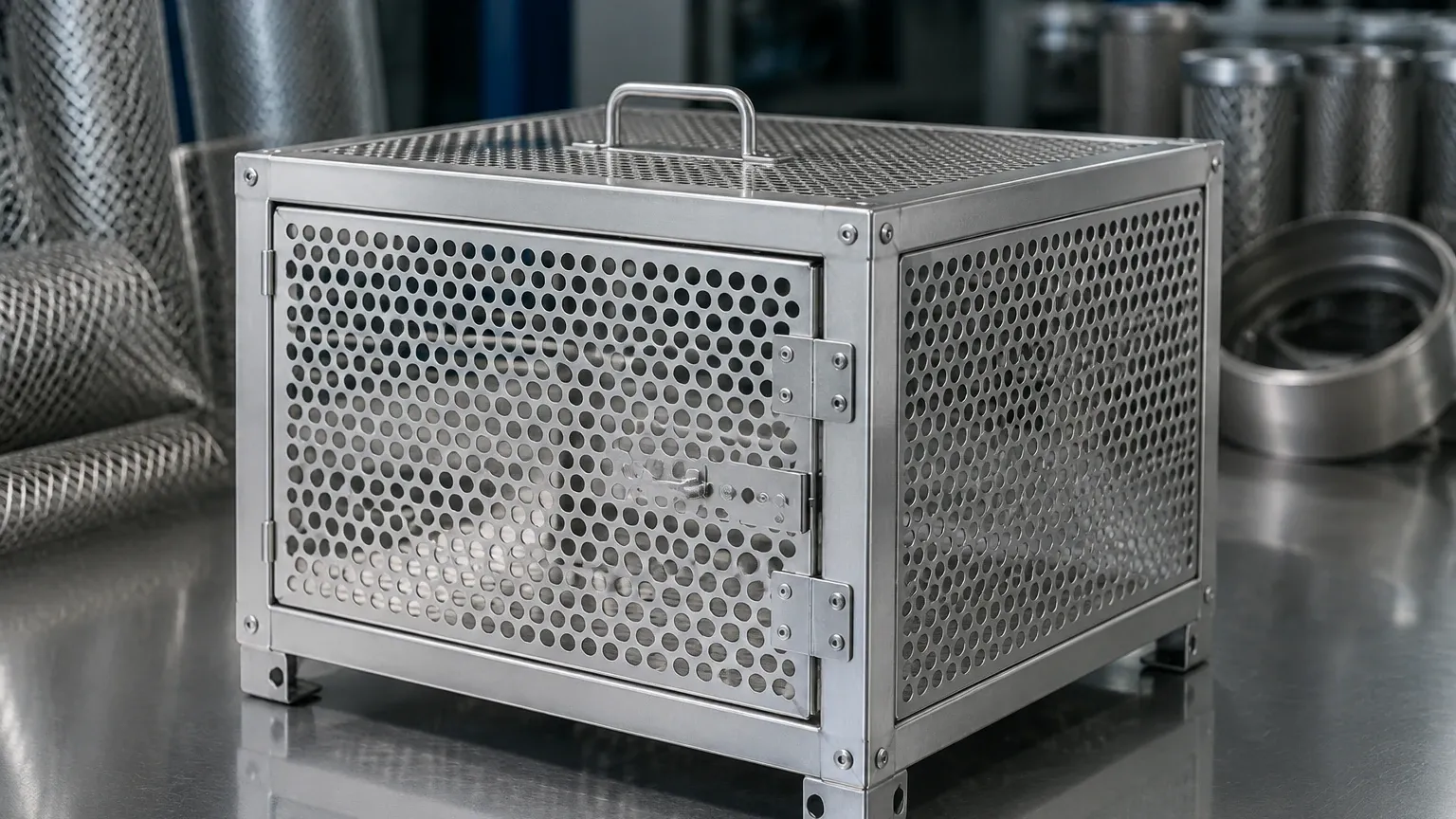
Perforated Metal Cage
In industrial filtration and fluid processing, the structural integrity of a filter element is as critical as its filtration accuracy. A perforated metal cage serves as the primary structural skeleton for many filtration systems, providing the necessary mechanical strength to withstand high-pressure differentials while protecting delicate filter media. For engineers and procurement specialists, selecting the correct cage design is a balance of material science, fluid dynamics, and manufacturing precision.
At Kaifil, we specialize in the engineering and production of Perforated & Expanded Metal components designed for demanding industrial environments. Understanding the technical nuances of these components is essential for ensuring the longevity and efficiency of filtration equipment.
Engineering Fundamentals of Perforated Metal Cages
A perforated metal cage is typically a cylindrical or conical structure fabricated from metal sheets that have been punched or stamped with a specific pattern of holes. Unlike woven wire mesh, which provides the primary filtration barrier, the perforated cage is designed to provide rigidity.
Material Selection and Chemical Compatibility
The choice of material is the first and most critical decision in the engineering process. Because these cages are often submerged in corrosive chemicals or high-temperature fluids, stainless steel is the industry standard.
* SS304/SS304L: Suitable for general industrial applications, food and beverage processing, and water treatment where moderate corrosion resistance is required.
* SS316/SS316L: The preferred choice for chemical processing and pharmaceutical applications. The addition of molybdenum provides superior resistance to chlorides and pitting.
* Specialty Alloys: In extreme environments involving highly acidic or alkaline solutions, alloys like Duplex stainless steel or Monel may be required to prevent premature structural failure.
Hole Patterns and Open Area Calculations
The performance of a perforated metal cage is largely determined by its "open area percentage." This is the ratio of the total area of the holes to the total area of the sheet. For a filtration cage, the goal is to maximize the open area to minimize pressure drop while maintaining enough metal "bridge" to ensure structural rigidity.
* Round Holes (Staggered): The most common pattern due to its balanced strength-to-weight ratio and uniform flow distribution.
* Square Holes: Provide a high open area but may have lower structural integrity under high-pressure radial loads.
* Slotted Holes: Often used in applications involving fibrous materials where directional flow is beneficial.
Engineers must calculate the required open area based on the flow rate of the medium. A cage with insufficient open area will cause a high initial pressure drop ($ΔP$), leading to increased energy consumption and potential pump cavitation.
The Role of the Cage in Multi-Layer Filtration
In most high-performance filter cartridges, the perforated metal cage does not act alone. It is part of a multi-layer assembly.
Internal vs. External Support
Depending on the flow direction (inside-to-out or outside-to-in), the cage may be positioned differently:
1. Inner Core: When the fluid flows from the outside in, the inner perforated metal cage prevents the filter media from collapsing inward under the pressure of the fluid.
2. Outer Guard: When the fluid flows from the inside out, or when the filter is subject to backwashing, an outer cage prevents the media from expanding or bursting outward.
Supporting Fine Wire Mesh
Fine stainless steel wire mesh lacks the inherent stiffness to maintain its shape under industrial flow rates. The perforated cage provides a flat, stable surface for the mesh to be pleated or wrapped against. This prevents the mesh from vibrating or flexing, which can lead to fatigue failure and "media migration"—where bits of the filter material break off and contaminate the downstream fluid.
Manufacturing and Fabrication Standards
The reliability of a perforated metal cage depends heavily on the quality of its fabrication. At Kaifil, we focus on several key manufacturing processes to ensure industrial-grade performance.
Welding Techniques
The longitudinal seam of the cage is a potential point of weakness. We utilize advanced welding techniques to ensure the seam is as strong as the base metal:
* TIG (Tungsten Inert Gas) Welding: Provides a clean, high-strength weld with minimal heat-affected zones, crucial for maintaining corrosion resistance.
* Plasma Welding: Used for precision applications requiring very thin walls or high-speed production with consistent penetration.
* Spot Welding: Often used for attaching end caps or reinforcement rings to the main cage body.
Finishing and Passivation
After punching and welding, the metal surface may have burrs or microscopic contaminants. For pharmaceutical and food-grade applications, the cage must undergo secondary finishing:
* Deburring: Mechanical or chemical removal of sharp edges that could tear the filter mesh.
* Passivation: A chemical treatment that removes free iron from the surface and enhances the protective chromium oxide layer of the stainless steel.
* Electropolishing: Provides a mirror-like finish that reduces surface roughness, making the cage easier to clean and reducing the likelihood of bacterial growth.
Key Evaluation Criteria for Engineers
When specifying a perforated metal cage for a new project or as a replacement part, engineers should evaluate the following criteria to ensure the component is fit for purpose.
Structural Integrity and Pressure Ratings
The cage must be rated for the maximum expected differential pressure of the system. This includes not only the operating pressure but also potential pressure spikes during start-up or valve closures. Factors influencing strength include wall thickness, hole diameter, and the width of the metal bridges between holes.
Dimensional Tolerances
In high-precision housings, even a 1mm deviation in diameter or length can lead to bypass. If the cage does not seat perfectly against the gaskets or end caps, unfiltered fluid will take the path of least resistance, bypassing the filter media entirely. It is essential to confirm that the manufacturer can meet tight tolerances for roundness and straightness.
Compatibility with Filter Media
The hole size of the perforated cage should be significantly larger than the pore size of the mesh it supports, but small enough to provide adequate support. If the holes are too large, the mesh may "bridge" over the holes and eventually rupture under pressure.
Common Risks and Failure Modes
Understanding why cages fail can help in designing more robust filtration systems. Most failures in perforated metal cages can be traced back to three issues:
1. Corrosion Fatigue: In systems with fluctuating pressures, the combination of chemical attack and mechanical stress can lead to cracks forming at the edges of the perforations.
2. Buckling: This occurs when the radial pressure exceeds the mechanical strength of the cage, usually due to an underspecified wall thickness or an over-clogged filter element that was not replaced in time.
3. Erosion: In high-velocity systems carrying abrasive particles, the edges of the perforations can wear down over time, eventually weakening the structure and changing the flow characteristics.
To mitigate these risks, Kaifil recommends regular inspection cycles and the use of high-grade materials that exceed the minimum requirements of the application.
Customization and Total Cost of Ownership
While standard sizes are available, many industrial applications require a customized perforated metal cage to fit unique housing geometries or specific flow requirements. Customization options include:
* Variable Hole Densities: Increasing hole frequency in high-flow areas while maintaining solid sections for structural mounting.
* Integrated End Fittings: Welding flanges, threaded connectors, or handles directly to the cage to simplify installation and removal.
* Reinforcement Rings: Adding solid metal bands to the circumference of the cage to provide extra resistance against collapse in ultra-high-pressure applications.
Total Cost Considerations
When evaluating the cost of a perforated cage, engineers should look beyond the initial purchase price. A cheaper, lower-quality cage may lead to:
* Frequent filter media failures.
* Increased downtime for maintenance.
* Higher energy costs due to inefficient flow patterns.
Investing in a precision-engineered cage made from high-quality stainless steel ensures a longer service life and more predictable filtration performance, ultimately lowering the total cost of ownership.
Conclusion
The perforated metal cage is the backbone of industrial filtration. Whether it is supporting a fine wire mesh in a chemical reactor or acting as a coarse strainer in a water intake system, its design and construction dictate the reliability of the entire process. By focusing on material grade, open area optimization, and precision fabrication, engineers can ensure their systems operate at peak efficiency with minimal risk of structural failure.
For technical assistance in selecting or designing the right Perforated & Expanded Metal solutions for your application, Kaifil provides comprehensive OEM support and engineering expertise. Confirming your specific pressure requirements, chemical environment, and flow rates with our technical team is the first step toward an optimized filtration solution.
