


Perforated Metal Decor
In modern industrial and architectural design, the integration of functional components with aesthetic requirements has led to the widespread adoption of perforated metal decor. While the term "decor" often implies a purely visual application, in a B2B and engineering context, it refers to the use of precision-engineered metal sheets that provide structural integrity, ventilation, and light control while maintaining a specific visual profile. For engineers and procurement professionals, selecting the right Perforated & Expanded Metal involves balancing material science, manufacturing tolerances, and environmental resistance.
Perforated metal is manufactured through a cold-stamping process where various hole shapes and patterns are punched into metal sheets. Expanded metal, conversely, is produced by simultaneously slitting and stretching the material, creating a diamond-shaped mesh without any material waste. Both processes result in versatile materials used for facades, interior partitions, equipment enclosures, and acoustic panels.
Technical Fundamentals of Perforated Metal
To specify perforated metal decor effectively, one must understand the geometric and mechanical variables that define the product's performance. The primary factors include the hole pattern, the open area percentage, and the material gauge.
Hole Patterns and Arrangements
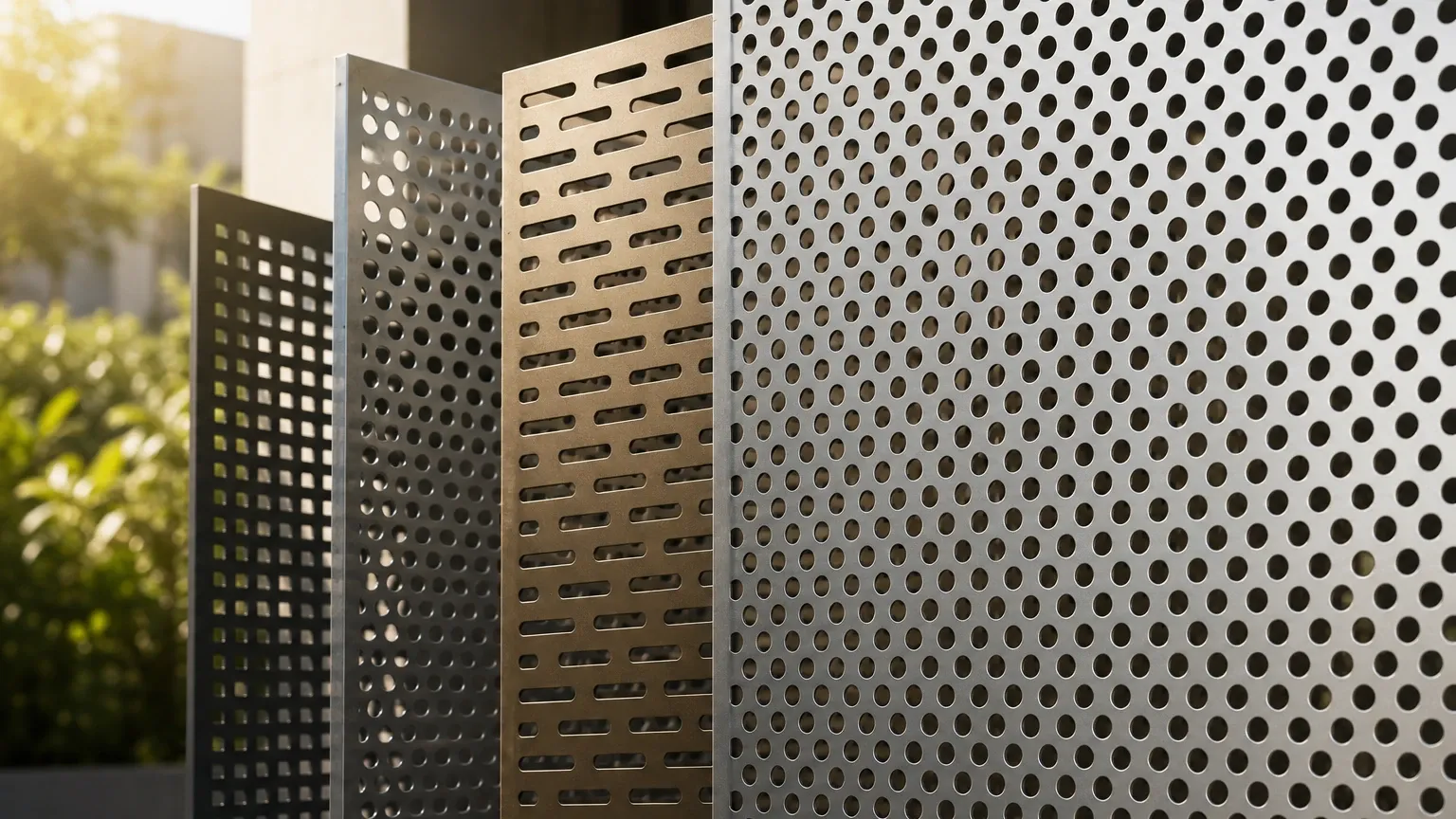
Hole patterns are generally categorized into round, square, slotted, and hexagonal shapes. Round holes are the most common due to their structural stability and ease of manufacturing.
* Staggered Pattern: Typically set at 60 degrees, this arrangement provides the highest structural strength and a uniform appearance. It is often the preferred choice for industrial filtration and high-pressure environments.
* Straight Line Pattern: Holes are aligned in both horizontal and vertical rows. While visually symmetrical, this pattern offers lower mechanical strength compared to staggered arrangements.
* Decorative/Custom Patterns: Advanced CNC punching and laser cutting allow for complex geometric shapes, logos, or varying hole sizes across a single sheet, often used in architectural branding.
Calculating the Open Area
The "open area" is the ratio of the total area of the holes to the total area of the sheet, expressed as a percentage. This is a critical metric for applications involving airflow, light transmission, or sound absorption. For instance, an open area of 40% means that 40% of the sheet is comprised of holes, while 60% is solid material. Engineers must ensure the open area is sufficient for the application (e.g., HVAC ventilation) without compromising the sheet's rigidity.
Material Selection for Industrial and Architectural Use
The environment in which the perforated metal decor will be installed dictates the material choice. Selecting an inappropriate alloy can lead to premature failure due to corrosion or mechanical stress.
Stainless Steel (304 and 316 Grades)
Stainless steel is the industry standard for high-durability applications. Grade 304 offers excellent corrosion resistance for most indoor and mild outdoor environments. Grade 316, containing molybdenum, is essential for marine environments or chemical processing plants where exposure to chlorides and acids is common. Stainless steel maintains its structural integrity at high temperatures and provides a clean, professional finish.
Aluminum
Aluminum is favored for its high strength-to-weight ratio and natural resistance to atmospheric corrosion. It is significantly lighter than steel, making it ideal for large-scale architectural facades where reducing the dead load on the building structure is a priority. Aluminum can also be easily anodized or powder-coated in various colors to meet specific design requirements.
Carbon Steel and Galvanized Steel
For interior applications where cost-efficiency is paramount, carbon steel is a viable option, provided it is finished with a protective coating. Galvanized steel, which features a zinc coating, offers better rust protection and is frequently used in industrial partitions and safety guards.
Engineering Considerations for Perforated Metal Decor
When transitioning from a conceptual design to a technical specification, several engineering factors must be addressed to ensure the final product meets the intended performance standards.
Structural Integrity and Load Bearing
Perforating a metal sheet inherently reduces its mechanical strength. Engineers must calculate the "equivalent solid thickness" to determine how the perforated sheet will behave under load. Factors such as the margin (the unperforated area around the edges) play a significant role in maintaining the sheet's flatness and preventing warping during the manufacturing process or installation.
Acoustic Performance
Perforated metal decor is an excellent medium for sound control. When used in conjunction with acoustic absorbing materials, perforated panels act as a transparent facing that allows sound waves to pass through the holes into the insulation, where the energy is dissipated. The hole size and spacing are tuned to target specific sound frequencies.
Thermal Management and Airflow
In equipment enclosures and server rooms, perforated metal provides essential ventilation. The challenge lies in selecting an open area that allows for maximum heat dissipation while still providing enough physical protection for the internal components. Precision in hole placement ensures that airflow is laminar rather than turbulent, which can improve cooling efficiency.
Manufacturing Processes and Customization
At Kaifil, the production of Perforated & Expanded Metal involves high-precision machinery capable of handling various gauges and materials. Understanding the manufacturing limits helps in designing feasible components.
1. Punching: High-speed CNC presses punch thousands of holes per minute. This process is highly cost-effective for large production runs with standard hole patterns.
2. Laser Cutting: For complex decorative patterns or thicker materials where punching might cause distortion, laser cutting offers extreme precision and the ability to create intricate shapes without the need for custom tooling.
3. Secondary Operations: Once perforated, the metal often requires further processing. This includes leveling (to ensure the sheet is perfectly flat), shearing to size, notched corners, and forming or bending into 3D shapes like cassettes or U-profiles.
4. Finishing: To enhance durability and appearance, finishes such as powder coating, PVDF coating, or electropolishing (for stainless steel) are applied. These coatings provide UV resistance and prevent oxidation.
Common Risks in Specification and Procurement
Failure to account for specific technical details can lead to project delays or sub-optimal performance. Procurement teams should be aware of the following risks:
* Burrs and Sharp Edges: The punching process can leave small metal fragments or sharp edges. In applications where the metal is accessible to personnel, specifies should require deburring or edge rolling.
* Tolerance Accumulation: Standard manufacturing tolerances for hole diameter and pitch can accumulate over large panels. It is vital to define acceptable tolerance levels early in the design phase.
* Material Memory and Warping: High open-area percentages can cause the metal to "curl" due to the internal stresses released during punching. Leveling is a necessary step to ensure the panels remain flat for installation.
* Corrosion at the Cut Edges: In galvanized or coated materials, the edges of the punched holes may expose the base metal. In highly corrosive environments, post-perforation coating is recommended over pre-coated sheets.
Application Profiles for Perforated Metal Decor
While the versatility of the material is vast, certain industrial and commercial applications highlight the functional benefits of perforated metal decor:
Architectural Facades and Sunshades
Large-scale perforated panels are used as building envelopes to provide solar shading. By calculating the sun's angle, engineers can design hole patterns that block direct heat gain while allowing natural light and views. This significantly reduces the building's HVAC load.
Interior Partitions and Ceiling Panels
In commercial office spaces or industrial facilities, perforated metal offers a way to define spaces without blocking light or airflow. When used as ceiling panels, they hide mechanical services (pipes, ducts) while remaining acoustically transparent.
Equipment and Machinery Guards
In manufacturing environments, perforated metal decor serves as a safety barrier. It allows operators to monitor machinery visually while protecting them from moving parts. The durability of stainless steel or heavy-gauge carbon steel ensures these guards can withstand impact.
Confirmation Checklist Before Ordering
Before finalizing a purchase order for perforated metal decor, technical teams should confirm the following details with the manufacturer:
* Material Grade: Is the specific alloy suitable for the installation environment (e.g., 316 vs. 304 stainless)?
* Hole Specifications: Diameter, center-to-center distance (pitch), and the resulting open area percentage.
* Margins: Are there specific unperforated borders required for welding or bolting?
* Flatness Requirements: Does the application require precision leveling to prevent oil-canning or warping?
* Surface Finish: Is the finish purely aesthetic, or does it provide necessary chemical or UV resistance?
* Quantity and Lead Time: For custom patterns, what is the lead time for tooling and production?
By addressing these technical parameters, engineers can ensure that perforated metal decor serves its dual purpose of enhancing the visual environment while performing reliably under industrial conditions. Kaifil provides the engineering support and manufacturing precision necessary to transform these specifications into high-performance filtration and architectural components.
