


Perforated Metal Hatch
In industrial engineering and facility management, a perforated metal hatch serves as a critical component for balancing access, security, and environmental control. These specialized access points are integrated into flooring, ductwork, machinery enclosures, and storage tanks to allow for ventilation, drainage, or visibility while maintaining a structural barrier. Unlike solid plate hatches, a hatch constructed from Perforated & Expanded Metal provides functional transparency, making it indispensable in sectors ranging from chemical processing to food and beverage manufacturing.
Selecting the correct perforated metal hatch requires a deep understanding of material properties, mechanical loads, and the specific filtration or airflow requirements of the application. For engineers, the challenge lies in specifying a design that offers the necessary open area without compromising the structural integrity of the hatch or the safety of the personnel interacting with it.
Understanding the Role of Perforated Metal Hatches in Industrial Systems
A perforated metal hatch is more than just a cover; it is a functional interface. In industrial environments, these hatches are typically used to provide access to internal components of a system while ensuring that the system remains ventilated. For example, in large-scale HVAC systems or industrial drying equipment, a hatch must allow air to pass through at specific velocities to prevent pressure buildup while keeping debris or unauthorized personnel out.
The versatility of perforated metal allows for precise control over the environment. By adjusting the hole size, shape, and pitch, engineers can dictate the level of light transmission, sound attenuation, and fluid flow. In filtration systems, a perforated metal hatch may also serve as a primary or secondary screen, preventing large particulates from entering sensitive areas during maintenance or operation.
Engineering Considerations: Open Area and Airflow Dynamics
The most critical technical specification for any perforated metal hatch is the percentage of open area. This figure determines how much of the metal sheet has been removed by the perforation process and directly influences both the airflow and the strength of the hatch.
Calculating Open Area
For a standard round-hole pattern with a 60-degree staggered layout—the most common configuration for industrial hatches—the open area is calculated using the hole diameter (D) and the center-to-center distance or pitch (P). The formula is:
Open Area % = (D² × 90.69) / P²
Engineers must balance this percentage against the required structural rigidity. A hatch with a 60% open area provides excellent ventilation but may require additional reinforcement or thicker gauge material if it is intended for use in a floor where foot traffic or equipment loads are expected.
Airflow and Pressure Drop
In applications involving fans or blowers, the hatch must not create an excessive pressure drop. A perforated metal hatch with insufficient open area can cause turbulence and reduce the efficiency of the entire system. Conversely, too much open area might allow contaminants to pass through. Precision manufacturing ensures that the hole patterns are consistent across the entire surface of the hatch, providing predictable performance across all operating conditions.
Material Selection for Durability and Chemical Resistance
Industrial hatches are often exposed to harsh environments, including corrosive chemicals, high temperatures, and high humidity. Therefore, material selection is paramount. While carbon steel and aluminum are options for light-duty or dry environments, stainless steel remains the industry standard for high-performance applications.
Stainless Steel 304 vs. 316
* Grade 304: This is the most common stainless steel used for industrial hatches. It offers excellent corrosion resistance and is suitable for most indoor and outdoor applications where chemical exposure is moderate.
* Grade 316: For hatches used in marine environments, chemical processing plants, or pharmaceutical facilities, Grade 316 is preferred. The addition of molybdenum enhances resistance to chlorides and acidic solutions, preventing pitting and stress corrosion cracking.
Surface Finishes
Beyond the base material, the finish of a perforated metal hatch affects its longevity and ease of maintenance. For the food and beverage industry, an electropolished finish is often required to ensure a smooth, burr-free surface that resists bacterial growth and is easy to sanitize. In heavy industrial settings, a mill finish or a powder-coated finish may be sufficient to provide additional protection against the elements.
Structural Integrity and Load-Bearing Capacity
When a perforated metal hatch is integrated into a walkway or a platform, it must be rated for specific load-bearing capacities. The perforation process inherently reduces the strength of the metal sheet compared to a solid plate of the same thickness. To compensate, engineers must consider the "equivalent solid thickness" and the orientation of the perforations.
Load Calculations
Determining the allowable load for a perforated hatch involves analyzing the yield strength of the material and the geometry of the hole pattern. Staggered patterns generally offer better structural integrity than straight-row patterns because they distribute stress more evenly across the metal bridges (the areas between the holes).
Reinforcement Techniques
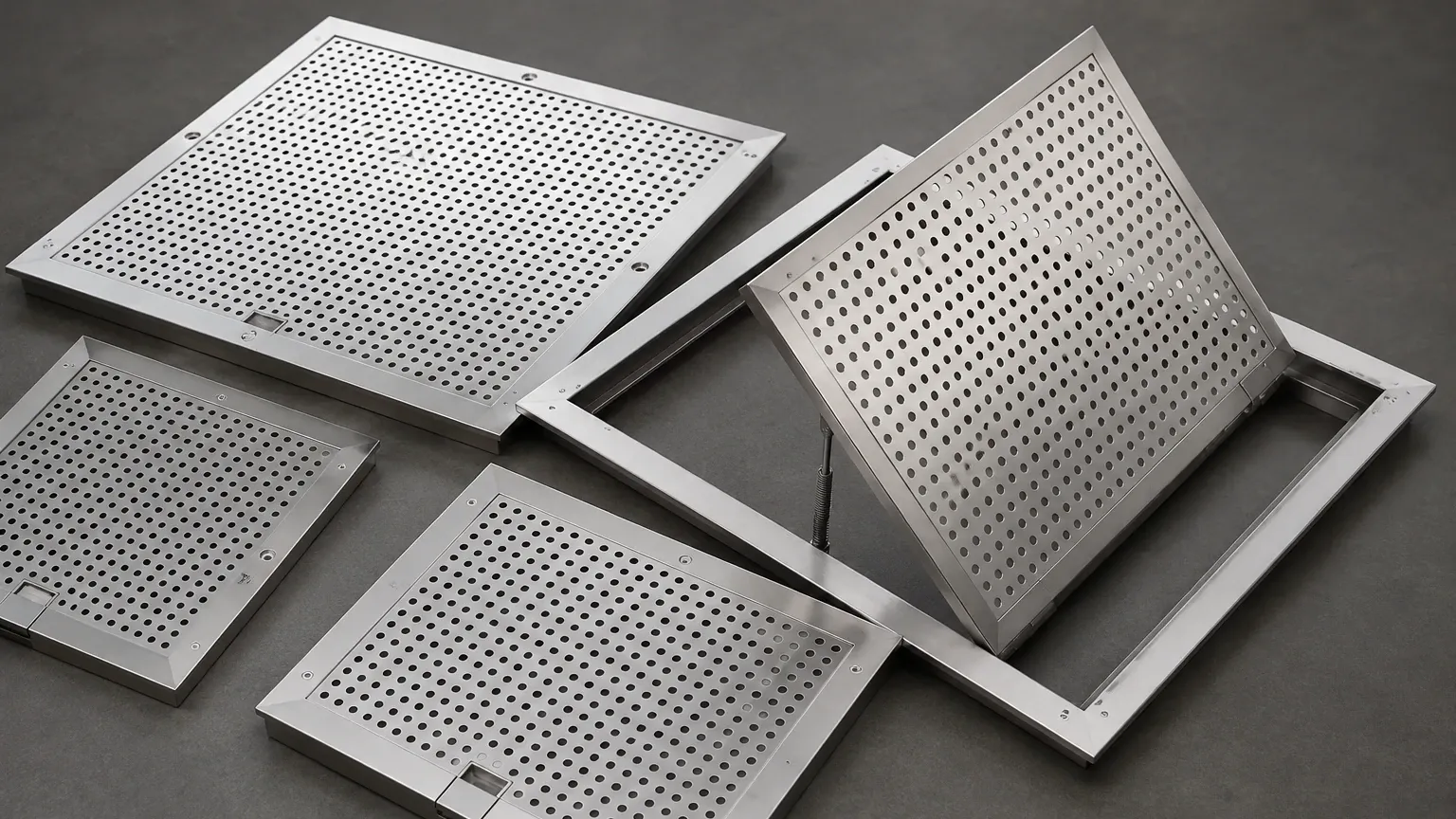
For large-span hatches, internal bracing or a perimeter frame made of angle iron or U-edging is often necessary. This prevents the perforated sheet from sagging or deforming under load. In custom OEM solutions, the frame is often welded directly to the perforated panel, creating a unified component that can be easily bolted or hinged into place.
Customization Options for Industrial Applications
One of the primary advantages of working with a professional manufacturer is the ability to customize every aspect of the perforated metal hatch. Standard off-the-shelf solutions rarely meet the precise requirements of complex industrial machinery.
Hole Patterns and Shapes
While round holes are the most common due to their ease of manufacture and structural stability, other shapes are available for specific functions:
* Square Holes: Provide a higher open area for maximum visibility and airflow but are slightly less rigid than round holes.
* Slotted Holes: Ideal for drainage or for screening elongated materials.
* Hexagonal Holes: Offer the highest possible open area (up to 80%) and are often used in high-performance cooling applications.
Hardware and Integration
Custom hatches can be designed with integrated hinges, recessed handles, and locking mechanisms. For safety, many industrial hatches include gas struts to assist with opening or "hold-open" arms to prevent accidental closure during maintenance. The edges of the hatch can also be customized with gaskets to provide a liquid-tight or dust-tight seal when the hatch is closed, even if the center panel is perforated.
Maintenance and Operational Longevity
A perforated metal hatch is designed for long-term service, but its performance depends on regular maintenance, especially in filtration and ventilation roles. Over time, the perforations can become clogged with dust, grease, or process byproducts, which reduces the effective open area and increases pressure drop.
Cleaning Protocols
Because stainless steel is resistant to most cleaning agents, these hatches can usually be cleaned using high-pressure water or steam. In food-grade applications, the hatch may need to be removed for ultrasonic cleaning to ensure that all particles are cleared from the hole interiors. The design of the hatch should allow for easy removal if frequent cleaning is anticipated.
Inspection Cycles
Regular inspections should focus on the integrity of the welds, the condition of the hinges, and any signs of wear on the perforated surface. In high-vibration environments, the edges of the perforations should be checked for stress fractures. Identifying these issues early prevents catastrophic failure and ensures the safety of the facility.
Selection Criteria for Engineering and Procurement Teams
Before purchasing or specifying a perforated metal hatch, engineers and procurement teams should confirm several key factors to ensure the product is fit for purpose. Relying on a manufacturer with expertise in Perforated & Expanded Metal ensures that these technical nuances are addressed during the design phase.
1. Environment: Will the hatch be exposed to saltwater, caustic chemicals, or extreme temperatures? This dictates the material grade and finish.
2. Airflow Requirements: What is the minimum required open area to maintain system efficiency?
3. Load Requirements: Will the hatch be subject to foot traffic, heavy equipment, or static loads? This determines the gauge thickness and reinforcement needs.
4. Safety Compliance: Does the hatch need to meet specific safety standards, such as slip resistance or OSHA-compliant guarding requirements?
5. Dimensional Tolerances: Industrial systems often have tight tolerances. Precision-cut hatches ensure a perfect fit, reducing installation time and preventing leaks or gaps.
By addressing these factors, organizations can invest in filtration and access solutions that improve operational efficiency, enhance safety, and reduce the total cost of ownership through durability and ease of maintenance. Whether for a new installation or a retrofit project, the perforated metal hatch remains a vital component in modern industrial design.
