


Perforated Metal Material
In industrial engineering and filtration design, selecting the correct perforated metal material is a critical decision that influences the structural integrity, flow dynamics, and longevity of the final product. Perforated metal is essentially a sheet or coil of metal that has been mechanically or laser-stamped to create a pattern of holes, slots, or decorative shapes. While the concept is straightforward, the engineering nuances—ranging from metallurgical properties to geometric precision—require careful evaluation to ensure performance in demanding industrial environments.
At Kaifil, we recognize that perforated metal serves as more than just a screen; it is often the structural backbone of complex filtration systems, providing the necessary reinforcement for finer wire mesh layers while maintaining specific flow characteristics. This guide explores the technical considerations essential for engineers and purchasing teams when specifying perforated and expanded metal for industrial applications.
Understanding Perforated Metal Material in Industrial Filtration
Perforated metal material is a staple in the filtration industry because it combines high mechanical strength with customizable permeability. In a typical multi-layer filter cartridge, the perforated metal acts as the internal support core or the external protective shroud. Its primary role is to withstand the differential pressure across the filter media without deforming, which could lead to bypass or mechanical failure of the finer mesh layers.
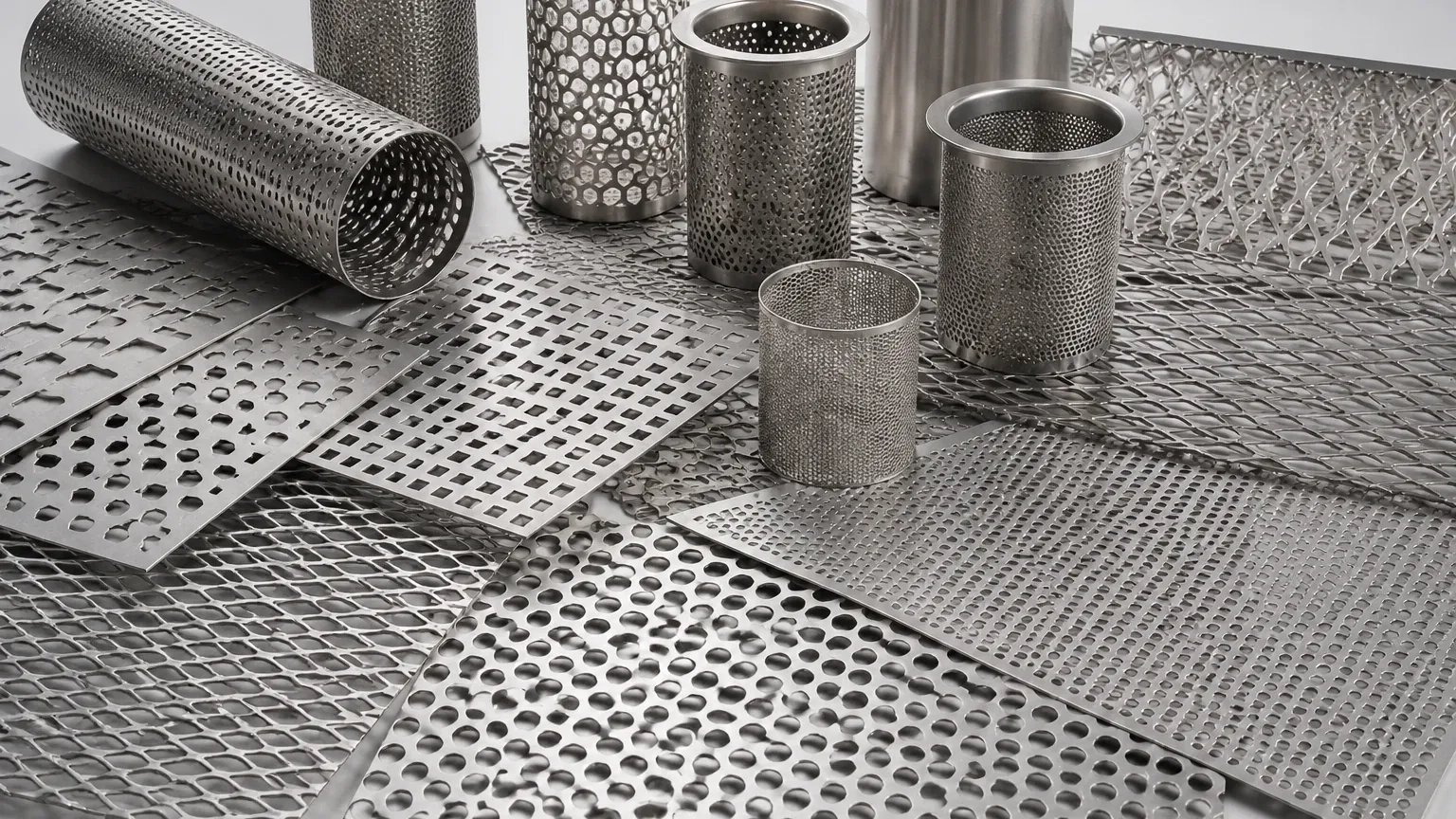
When comparing Perforated & Expanded Metal, it is important to distinguish their manufacturing processes and resulting properties. Perforated metal is created by punching holes out of a solid sheet, which allows for extremely precise hole diameters and spacing. Expanded metal, conversely, is produced by simultaneously slitting and stretching the sheet, creating a diamond-shaped mesh without any material waste. While expanded metal offers an excellent strength-to-weight ratio and cost-efficiency, perforated metal is generally preferred for applications requiring specific open area percentages and high-precision flow control.
Material Selection Criteria for Demanding Environments
The choice of perforated metal material is dictated by the chemical, thermal, and mechanical stresses of the application. Since Kaifil specializes in stainless steel filtration solutions, we focus on grades that offer the best balance of durability and corrosion resistance.
Stainless Steel 304 and 304L
Grade 304 is the most common perforated metal material used in general industrial applications. It provides excellent forming and welding characteristics and is resistant to atmospheric corrosion and many organic and inorganic chemicals. For components that require extensive welding, 304L (low carbon) is often specified to prevent carbide precipitation and ensure the integrity of the heat-affected zone.
Stainless Steel 316 and 316L
In environments involving chlorides, such as marine applications or chemical processing, Grade 316 is the standard. The addition of molybdenum enhances its resistance to pitting and crevice corrosion. 316L is typically the material of choice for pharmaceutical and food-grade filtration components, where preventing contamination and ensuring easy sterilization are paramount.
Specialized Alloys
For extreme conditions involving high temperatures or highly aggressive acids, materials like Hastelloy, Monel, or Inconel may be used. These alloys are selected based on their specific resistance to oxidation and stress-corrosion cracking, though they require specialized manufacturing expertise to perforate and form accurately.
Technical Specifications: Patterns, Pitch, and Open Area
The performance of a perforated metal component is defined by its geometry. Engineers must specify the hole shape, the arrangement (pattern), and the distance between holes (pitch).
Hole Patterns
* Round Holes: The most common and efficient pattern for filtration. Round holes offer the best structural stability and are the easiest to manufacture with high precision.
* Square Holes: Often used when a higher open area is required, though they may have slightly lower structural rigidity than round holes of the same open area.
* Slotted Holes: Ideal for sorting or straining elongated particles and are frequently used in vibrating screens or specialized liquid-solid separation equipment.
Staggered vs. Straight Centers
A 60-degree staggered pattern is the industry standard for round holes because it provides the highest degree of structural uniformity and the most efficient use of the surface area. Straight-row patterns are available but are generally less robust under pressure and may lead to "tracking" or uneven wear in certain flow conditions.
Calculating Open Area
The open area percentage determines the flow rate and pressure drop across the material. For a 60-degree staggered round hole pattern, the formula is:
Open Area % = (D² × 90.69) / P²
*(Where D = Hole Diameter and P = Pitch)*
Accurately calculating this value is essential for sizing pumps and ensuring that the filtration system does not suffer from excessive parasitic energy loss due to flow restriction.
Manufacturing Precision and Quality Standards
High-quality perforated metal material is defined by more than just the holes. In industrial B2B procurement, the "secondary" characteristics often determine the success of the assembly process.
Flatness and Stress Relief
The perforating process introduces significant internal stresses into the metal sheet. If not properly leveled, the material may exhibit "oil canning" or bowing, which makes it difficult to roll into cylinders or weld into filter housings. Professional manufacturers utilize precision leveling equipment to ensure the material remains flat within tight tolerances.
Margins and Edges
Margins refer to the unperforated areas along the edges of the sheet. For filter cores, having specific margins is crucial for seam welding. If the perforation pattern runs to the very edge, the resulting weld may be weak or aesthetically poor. Specifying "safe sides" or finished margins ensures a clean, weldable surface for downstream fabrication.
Deburring and Surface Finish
Punching metal naturally creates burrs on the exit side of the hole. In filtration, these burrs can trap contaminants, damage delicate wire mesh layers, or even break off and contaminate the downstream fluid. Kaifil employs rigorous deburring processes and surface treatments, such as electropolishing or pickling, to ensure that every component is smooth and chemically passive.
Applications Across Industrial Sectors
Perforated metal material is utilized across a vast spectrum of industries, each with unique requirements for material purity and mechanical performance.
* Chemical Processing: Used in catalyst baskets and reactor internals where resistance to aggressive solvents and high pressures is mandatory.
* Food and Beverage: Perforated stainless steel is used for straining juices, dairy processing, and brewing. Here, the material must meet strict hygienic standards, such as those set by the FDA or 3-A, requiring smooth surfaces free of pits or crevices.
* Pharmaceuticals: Precision-perforated components are used in centrifuges and fluid bed dryers. The focus here is on 316L stainless steel and ultra-smooth finishes to prevent cross-contamination between batches.
* Hydraulic Systems: Perforated metal serves as the inner core for high-pressure hydraulic filters, protecting the system from large debris while supporting the pleated glass fiber media.
Evaluating Suppliers for Custom Filtration Components
When sourcing perforated metal material, engineers should look beyond the per-unit price and consider the total cost of ownership and the supplier's technical capabilities. A reliable partner should be able to provide:
1. Material Certification: Full traceability of the metal heat numbers to ensure the alloy composition matches the specification.
2. Dimensional Reports: Verification that hole diameters, pitch, and margins are within the agreed-upon tolerances.
3. Customization Support: The ability to provide custom hole patterns or non-standard sheet sizes to reduce waste and simplify assembly.
4. Engineering Consultation: Guidance on the optimal balance between open area and structural strength for a specific application.
Common risks in procurement include inconsistent hole patterns, poor edge quality, and residual oils from the punching process. These issues can lead to increased assembly time, higher reject rates, and potential field failures. Working with a specialist like Kaifil ensures that these factors are managed through controlled manufacturing processes and rigorous quality inspections.
Conclusion
Selecting the right perforated metal material is a foundational step in designing efficient and durable industrial filtration systems. By understanding the interplay between material grades, hole geometries, and manufacturing tolerances, engineers can optimize performance while controlling costs. Whether you require a standard support core or a highly customized perforated component for a specialized chemical process, technical precision and material integrity remain the benchmarks of quality.
For more detailed technical specifications or to discuss custom requirements for your next project, Review product options and application support to see how professional manufacturing can enhance your filtration performance.
