


Perforated Metal Open Area
In industrial engineering and filtration design, the concept of "open area" is a critical parameter that dictates the performance, efficiency, and structural integrity of a component. For engineers and procurement specialists sourcing Perforated & Expanded Metal, understanding how to calculate and optimize the open area is essential for ensuring that the final product meets the specific demands of the application, whether it involves fluid filtration, acoustic dampening, or structural ventilation.
At its core, the open area of a perforated sheet is the ratio of the total area of the holes to the total area of the sheet, usually expressed as a percentage. This figure directly influences the flow rate of liquids or gases, the pressure drop across the medium, and the weight-to-strength ratio of the material. As a specialized manufacturer of stainless steel filtration solutions, Kaifil provides precision-engineered perforated components tailored to rigorous industrial standards.
The Technical Significance of Perforated Metal Open Area
The open area is more than just a geometric measurement; it is a functional specification. In filtration systems, the open area determines the "throughput" capacity. A higher percentage of open area typically results in a lower pressure drop, which reduces the energy requirements for pumps and blowers. However, increasing the open area often comes at the cost of structural rigidity.
For engineers, the selection process involves a delicate balance between three primary factors:
1. Flow Requirements: The volume of media (liquid or gas) that must pass through the screen per unit of time.
2. Structural Load: The mechanical stress the sheet must withstand, including internal pressure, vibrations, and physical impacts.
3. Filtration Accuracy: The size of the particles that must be retained, which dictates the hole diameter and, consequently, the possible open area configurations.
Understanding these trade-offs is the first step in specifying the correct perforated metal for an industrial project.
Calculating Open Area for Different Hole Patterns
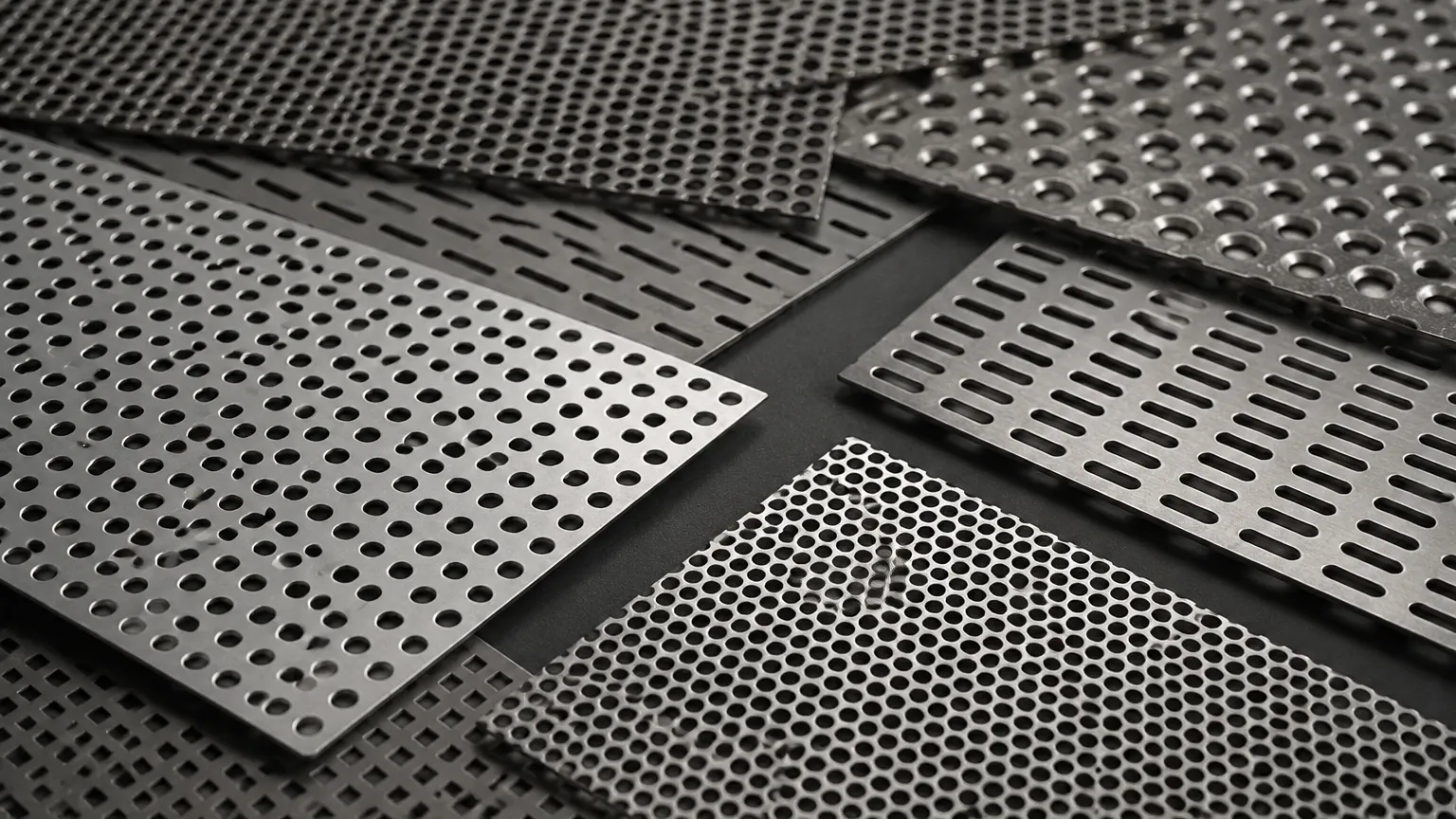
The geometry of the perforations significantly impacts the calculation of the open area. While many patterns exist, the most common in industrial filtration are round holes and square holes, arranged in either staggered or straight-row configurations.
Round Holes, 60-Degree Staggered
This is the most popular pattern due to its inherent structural strength and uniform flow characteristics. In a 60-degree staggered layout, each hole is equidistant from its six neighbors.
* Formula: $OA = (D^2 \times 90.69) / C^2$
* *Where D is the hole diameter and C is the center-to-center distance (pitch).*
This configuration provides the highest degree of structural integrity because the "bridges" (the metal between the holes) are oriented in a way that resists deformation under load.
Round Holes, Straight Row
In this pattern, holes are aligned vertically and horizontally. While simpler to manufacture for some applications, it offers lower structural strength than the staggered version.
* Formula: $OA = (D^2 \times 78.54) / C^2$
Square Holes, Straight Row
Square holes offer a high open area and are often used in applications requiring maximum visibility or airflow where particle shape is less of a concern.
* Formula: $OA = (S^2 \times 100) / C^2$
* *Where S is the side length of the square hole.*
The Impact of Margins
It is important to note that the theoretical open area calculation often assumes a continuous pattern. In practice, perforated sheets usually have "margins"—unperforated areas along the edges of the sheet to facilitate welding or mounting. Engineers must account for these margins when calculating the *effective* open area of a finished component, as large margins can significantly reduce the total flow capacity of the part.
Engineering Considerations: Strength vs. Transparency
A common challenge in specifying Perforated & Expanded Metal is the relationship between the hole size and the material thickness. As a rule of industrial manufacturing, the hole diameter should generally not be less than the thickness of the material. For example, perforating 1.0mm holes in a 2.0mm thick stainless steel plate is technically difficult and can lead to tool breakage or excessive burring.
Pressure Drop and Velocity
When fluid passes through a perforated screen, it experiences a restriction. This restriction causes a pressure differential ($ΔP$). If the perforated metal open area is too small for the required flow velocity, the pressure drop will increase exponentially, potentially leading to system failure or cavitation in hydraulic applications. Conversely, an excessively high open area may cause the metal to flex or fatigue under the force of the fluid flow.
Material Selection
In the chemical processing and food industries, the choice of material is as critical as the open area. Stainless steel (304, 316L) is the standard due to its corrosion resistance and ability to maintain structural integrity at high temperatures. Kaifil specializes in these high-grade alloys to ensure that the filtration components do not contaminate the process media and can withstand aggressive cleaning cycles.
Perforated vs. Expanded Metal: A Comparison of Open Area
While both materials provide openings for flow and filtration, they are manufactured differently, which affects how the open area is evaluated.
* Perforated Metal: Created by punching holes out of a solid sheet. The open area is precisely controlled by the die geometry. It offers a flat surface and highly predictable flow characteristics.
* Expanded Metal: Created by slitting and stretching the metal simultaneously. This process creates diamond-shaped openings. The open area in expanded metal depends on the "strand width" and the "bond." Expanded metal is often more cost-effective as there is no material waste (no "slugs" are punched out), but it can be more difficult to calculate a precise open area for fine filtration compared to perforated sheets.
For high-precision industrial filtration, perforated metal is usually preferred because the hole geometry is consistent across the entire surface, ensuring a uniform micron rating.
Customization and OEM Solutions
Every industrial environment has unique requirements. A standard off-the-shelf perforated sheet may not provide the optimal balance of flow and durability. This is where customization becomes vital. Engineering teams should confirm several factors before finalizing a design:
1. End-Pattern Requirements: Do you need finished ends (no partial holes) or unfinished ends? Finished ends are safer to handle and easier to weld but may require custom tooling.
2. Surface Finish: For food and pharmaceutical applications, the perforated metal must be free of burrs and may require electropolishing to ensure a smooth, easy-to-clean surface.
3. Hole Profile: While round holes are standard, tapered or countersunk holes can be engineered to prevent "blinding" (clogging) in specific filtration processes.
Kaifil’s manufacturing capabilities allow for the production of custom filter cartridges and precision metal components that integrate these specific perforated patterns into complex assemblies. By working closely with global customers, we ensure that the perforated metal open area is optimized for the specific viscosity, pressure, and particle load of the application.
Maintenance, Clogging, and Replacement Cycles
The longevity of a perforated filter component is directly tied to its open area and the nature of the media being filtered. Over time, particles may become lodged in the openings—a phenomenon known as blinding or pegging.
Factors Influencing Replacement:
* Clog Rate: If the open area is too low, the filter will clog faster, requiring more frequent maintenance shutdowns.
* Cleaning Compatibility: Stainless steel perforated metal is conducive to backwashing, ultrasonic cleaning, and chemical sterilization. The robustness of the bridges between the holes determines how many cleaning cycles the component can survive before the metal work-hardens and cracks.
* Total Cost of Ownership: While a sheet with a very high open area might seem efficient, if it requires replacement every three months due to structural fatigue, the total cost of ownership (TCO) will be higher than a slightly more restrictive but more durable screen.
Engineers should monitor the pressure differential across the perforated plate. A sustained increase in $ΔP$ that cannot be resolved through standard cleaning protocols indicates that the component has reached the end of its service life.
Conclusion
Selecting the right perforated metal open area is a foundational step in designing efficient industrial systems. By understanding the mathematical formulas for different patterns and the physical constraints of material thickness and strength, engineers can specify components that deliver reliable performance and long-term durability.
Whether you are designing a high-pressure hydraulic filter, a food-grade centrifugal screen, or an industrial strainer, the precision of the perforation pattern is paramount. For more detailed technical specifications or to discuss a custom filtration project, you can Review product options and application support to find the ideal solution for your specific industrial requirements. Kaifil remains committed to providing the engineering expertise and manufacturing quality necessary to support the most demanding filtration challenges across the globe.
