


Perforated Metal Strapping
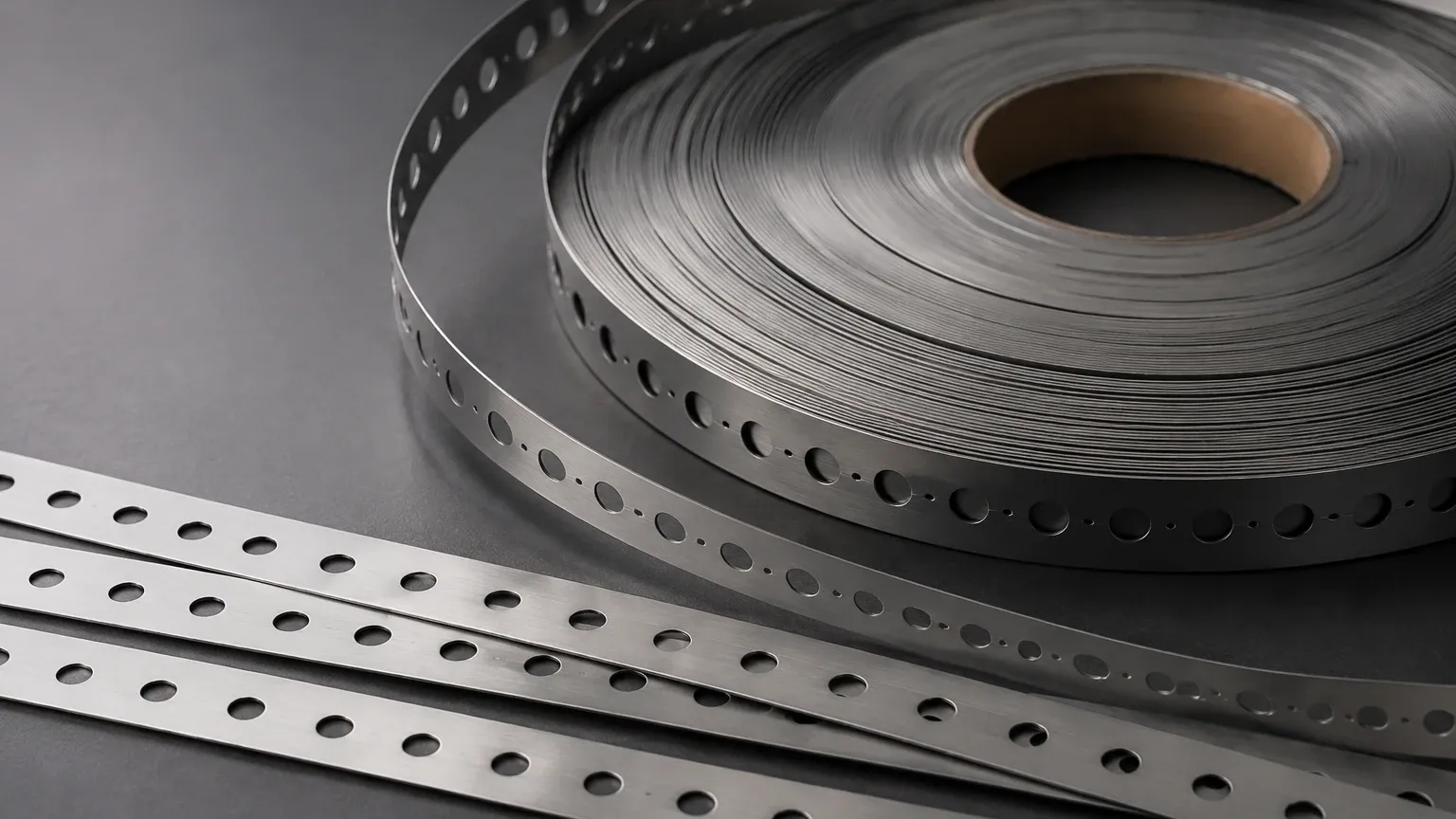
In industrial engineering and filtration system design, the integrity of a component often depends on the reliability of its support and fastening mechanisms. Perforated metal strapping is a versatile engineering solution used to secure, reinforce, and stabilize components in demanding environments. As a specialized application of Perforated & Expanded Metal, this material provides a unique balance of high tensile strength, adjustable fastening points, and corrosion resistance, particularly when fabricated from high-grade stainless steel alloys.
For engineers and procurement teams, selecting the correct perforated metal strapping involves more than choosing a width and thickness. It requires a technical understanding of material properties, load-bearing capacities, and the specific environmental stressors of the application, such as chemical exposure or extreme thermal cycling.
Technical Specifications and Material Selection
The performance of perforated metal strapping is fundamentally tied to the alloy from which it is manufactured. In industrial filtration and chemical processing, stainless steel is the standard due to its mechanical durability and resistance to oxidation.
Grade 304 Stainless Steel
Grade 304 is the most common choice for general industrial strapping. It offers excellent formability and welding characteristics. It is suitable for applications where moisture is present but where the strap will not be exposed to highly concentrated chlorides or acids. In food and beverage filtration systems, 304 provides the necessary hygiene standards and structural support for filter mesh assemblies.
Grade 316 and 316L Stainless Steel
For more aggressive environments, such as marine applications, pharmaceutical manufacturing, or chemical processing, Grade 316 is preferred. The addition of molybdenum enhances resistance to pitting and crevice corrosion in chloride-rich environments. Grade 316L (low carbon) is often specified when the strapping must be welded to other components, as it minimizes carbide precipitation that can lead to intergranular corrosion.
Mechanical Properties
When evaluating strapping, engineers must consider the "net section" of the material. Because the perforations remove a portion of the metal, the effective tensile strength is lower than that of a solid band of the same dimensions. Calculating the open area percentage is critical for determining the safe working load (SWL). Typically, perforated strapping for industrial use features a staggered hole pattern to maximize the number of fastening points while maintaining the highest possible ligament strength between the holes.
Engineering Considerations for Load and Tension
Perforated metal strapping is frequently used to apply tension or to provide a rigid boundary for cylindrical components. In these scenarios, the geometry of the perforations plays a significant role in the strap's behavior under load.
Ligament Width and Stress Distribution
The "ligament" is the solid metal remaining between the perforations. If the holes are too large or the pitch (distance between hole centers) is too tight, the ligament width may be insufficient to handle the required tension, leading to elongation or catastrophic failure. Engineers must specify a pitch that aligns with the fastening hardware (bolts, rivets, or tensioning tools) while ensuring the cross-sectional area of the ligaments can withstand the calculated stress.
Edge Finish and Safety
In high-vibration environments, such as hydraulic systems or industrial machinery, the edge finish of the strapping is a critical safety and performance factor. Standard slit edges can be sharp and may cause stress risers or damage to adjacent soft components, such as rubber gaskets or synthetic filter media. Specifying deburred or round-edged strapping reduces the risk of fatigue cracking and simplifies handling during installation.
Applications in Industrial Filtration and Support
Within the scope of Kaifil’s expertise, perforated metal strapping serves as a vital structural element in the assembly of complex filtration units. It is rarely a standalone product but rather a component that ensures the longevity of the primary filtration media.
Reinforcing Filter Cartridges
In large-scale industrial filter cartridges, perforated strapping is often used to wrap around the exterior of pleated or wrapped wire mesh. This prevents the mesh from expanding or deforming under high differential pressure. By providing a rigid external cage, the strapping ensures that the filtration surface remains uniform, preventing "blind spots" or bypasses that could compromise fluid purity.
Securing Internal Components
In chemical reactors and water treatment vessels, internal components such as distributors or support grids must be held firmly in place. Perforated metal strapping allows for adjustable fastening around varying diameters, making it an ideal solution for securing these internals without the need for custom-machined brackets. The perforations also allow for fluid flow, ensuring that the strapping itself does not create stagnant zones where debris could accumulate.
Heat Exchanger and Pipe Support
Beyond filtration, this material is used to secure insulation and cladding on high-temperature piping. The perforations allow for thermal expansion and contraction of the pipe without the strap snapping, provided the material grade is matched to the operating temperature of the system.
Customization and Manufacturing Precision
Standard off-the-shelf strapping often fails to meet the precise tolerances required for high-performance industrial equipment. Custom manufacturing allows for the optimization of the strap for a specific application.
Hole Pattern Customization
While round holes are standard, slotted or square perforations may be required to accommodate specific mounting hardware or to provide a higher degree of adjustability. The orientation of the holes—whether straight or staggered—can be engineered to provide directional strength where it is most needed.
Dimensional Accuracy
For OEM applications, consistent width and thickness are paramount. Variations in material thickness can lead to uneven tensioning, which is particularly problematic in automated assembly lines. Precision manufacturing ensures that every roll or strip of strapping meets the exact specifications required for the project’s engineering drawings.
Surface Treatments
Depending on the application, perforated metal strapping may undergo additional surface treatments. Electropolishing is common for pharmaceutical and food-grade applications to remove surface impurities and create a microscopically smooth finish that resists bacterial growth. Passivation is also standard for stainless steel strapping to restore the protective oxide layer after the perforation and slitting processes.
Installation and Maintenance Best Practices
To ensure the long-term performance of perforated metal strapping, proper installation and a structured maintenance schedule are necessary.
1. Avoid Galvanic Corrosion: When installing stainless steel strapping, it is vital to ensure that the fasteners and the components being secured are compatible. Using carbon steel bolts with stainless strapping in a moist environment will lead to rapid galvanic corrosion of the carbon steel.
2. Tension Management: Over-tensioning can lead to "necking" at the ligaments, where the metal thins and eventually fails. Using calibrated tensioning tools ensures that the strap is tight enough to secure the load without exceeding the yield strength of the material.
3. Inspection Cycles: In filtration systems, strapping should be inspected during every filter element change. Look for signs of stress whitening, ligament elongation, or localized pitting. If the strapping shows signs of permanent deformation, it should be replaced to prevent failure during the next operational cycle.
4. Vibration Dampening: In applications with high mechanical vibration, using a thin polymer liner between the strap and the component can prevent fretting corrosion and mechanical wear.
Total Cost of Ownership and Selection Criteria
When specifying Perforated & Expanded Metal products like strapping, the initial purchase price is only one part of the total cost of ownership (TCO). High-quality stainless steel strapping may have a higher upfront cost than galvanized or plastic alternatives, but its durability in harsh environments significantly reduces the frequency of replacements and the risk of unplanned downtime.
Engineers should confirm the following data points before finalizing a procurement order:
* Material Grade: Is 304 sufficient, or does the chemical environment require 316L?
* Open Area Ratio: Does the perforation pattern leave enough solid metal to support the intended load?
* Hole Diameter and Pitch: Does the pattern match the intended fastening system?
* Edge Condition: Does the application require deburred edges to protect other components?
* Compliance: Does the material meet industry-specific standards (e.g., FDA for food contact or ASTM for structural integrity)?
By addressing these technical variables, purchasing teams can ensure they receive a component that enhances the reliability and efficiency of their industrial systems. Perforated metal strapping is a critical, albeit often overlooked, element in the success of industrial filtration and structural support projects.
