


Perforated Metal Strip
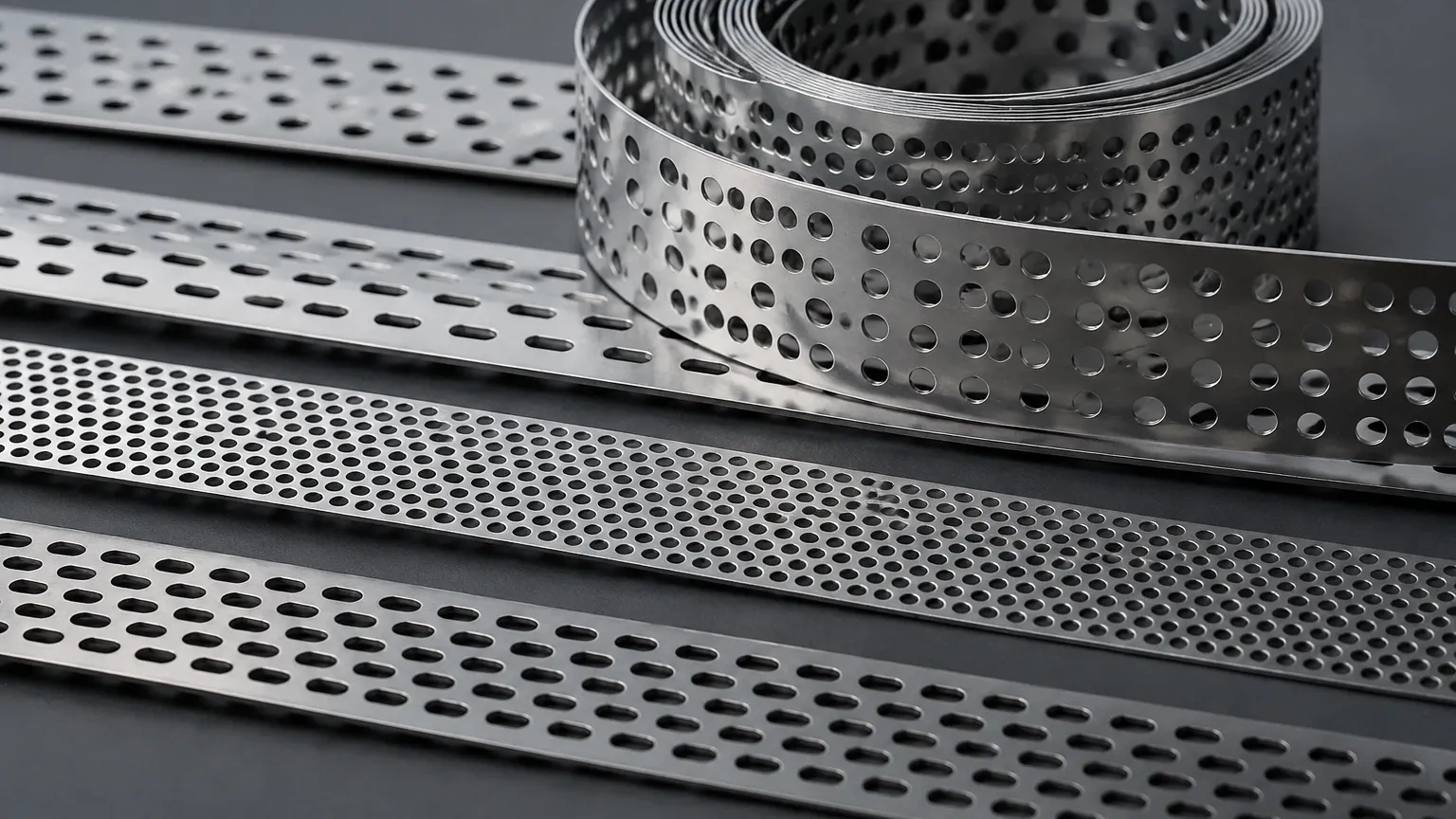
In the landscape of industrial filtration and structural engineering, the perforated metal strip serves as a foundational component for a wide array of high-performance systems. Unlike standard perforated sheets, which are typically produced in large dimensions, a perforated metal strip is engineered with specific widths, thicknesses, and margins to meet the precise requirements of automated manufacturing lines, spiral-welded tube production, and specialized filtration assemblies.
At Kaifil, the production of Perforated & Expanded Metal focuses on providing technical solutions where dimensional accuracy and material integrity are paramount. For engineers and procurement specialists, selecting the correct perforated metal strip involves more than simply choosing a hole size; it requires a deep understanding of metallurgy, mechanical stresses, and the fluid dynamics associated with industrial filtration.
Understanding the Role of Perforated Metal Strips in Filtration
A perforated metal strip is frequently utilized as the primary structural support for finer filter media, such as stainless steel wire mesh or synthetic membranes. In high-pressure environments—such as hydraulic systems or chemical processing plants—the fine mesh lacks the inherent strength to withstand the differential pressure (ΔP) generated during the filtration cycle.
By incorporating a precision-engineered perforated metal strip, manufacturers can create a rigid cage or core. This core prevents the collapse of the filter media while maintaining a high open-area ratio to ensure minimal resistance to flow. The choice of the strip is critical because any irregularity in the perforation pattern or a lack of flatness can lead to uneven stress distribution, potentially causing premature failure of the entire filter element.
Material Selection and Metallurgical Properties
The performance of a perforated metal strip is largely dictated by its material composition. Since these components are often exposed to corrosive fluids, high temperatures, or abrasive particles, selecting the appropriate alloy is the first step in the engineering process.
Stainless Steel 304 and 304L
As the most common material for industrial perforation, Grade 304 offers excellent formability and general corrosion resistance. It is suitable for food and beverage applications, basic water treatment, and general industrial use. The "L" (low carbon) variant is preferred when the strip will be welded into tubes, as it minimizes carbide precipitation during the welding process.
Stainless Steel 316 and 316L
For more demanding environments, such as pharmaceutical processing or marine applications, Grade 316 is the standard. The addition of molybdenum enhances resistance to pitting and crevice corrosion, particularly in chloride-rich environments. For perforated metal strips used in chemical filtration, 316L is often the authoritative choice to ensure long-term durability.
Specialty Alloys
In extreme cases involving high-temperature oxidation or highly acidic media, alloys such as Monel, Inconel, or Duplex stainless steel may be required. These materials maintain their structural integrity and perforation geometry under conditions that would cause standard stainless steel to degrade.
Engineering Parameters: Hole Patterns and Open Area
The functionality of a perforated metal strip is defined by its geometric configuration. Engineers must balance the need for structural strength with the requirement for high flow rates.
1. Hole Shape: Round holes are the most common due to their ease of manufacture and uniform stress distribution. However, square or slotted holes may be used when specific flow characteristics or aesthetic requirements are involved.
2. Staggered vs. Straight Centers: A 60-degree staggered pattern is the industry standard for maximum open area and strength. It provides a uniform flow profile across the strip. Straight patterns are generally reserved for decorative applications or specific alignment needs.
3. Open Area Calculation: The open area is the percentage of the strip that is removed by perforation. For a 60-degree staggered round hole pattern, the formula is:
`% Open Area = (D² × 90.69) / P²`
*Where D = Hole Diameter and P = Pitch (center-to-center distance).*
4. The "Bridge" Width: The bridge is the amount of metal remaining between the holes. If the bridge is too narrow, the strip loses its structural integrity and may deform during the slitting or winding process. A general rule of thumb is that the bridge should not be less than the material thickness.
Manufacturing Precision: Slitting and Margin Control
One of the most critical aspects of producing a high-quality perforated metal strip is the management of "margins"—the unperforated areas along the edges of the strip. In B2B applications, margins are not merely aesthetic; they are functional.
Margin Consistency
When a perforated metal strip is used in automated welding or assembly, the margins must be perfectly consistent. Uneven margins can cause the strip to "camber" (curve sideways), making it impossible to feed through CNC machinery or spiral-welding heads. Precision slitting after the perforation process ensures that the strip remains straight and the edges are burr-free.
Edge Treatments
Depending on the application, strips can be supplied with "safe edges" (unperforated margins) or "full-width perforation" (where the pattern goes all the way to the edge). For filter cores, a specific margin is usually required to allow for a clean longitudinal weld without interfering with the hole pattern.
Technical Considerations for Customization
Kaifil specializes in providing customized filtration solutions that move beyond off-the-shelf specifications. When requesting a custom perforated metal strip, engineers should confirm several technical variables to ensure the final product meets the application's demands:
* Flatness Requirements: Perforation introduces internal stresses into the metal. High-speed punching can cause the strip to bow or twist. Leveling processes are often necessary to restore the strip to the required flatness for downstream processing.
* Burr Direction: In filtration, the direction of the burr (the small ridge of metal left by the punch) can be important. For example, if the strip is used as an outer guard, the burrs should face inward to avoid damaging the filter media or injuring personnel during handling.
* Surface Finish: Options range from mill finish and 2B to electropolished or passivated finishes. Passivation is particularly important for stainless steel strips used in medical or food-grade applications to ensure the removal of free iron and the restoration of the protective oxide layer.
Common Risks and Quality Evaluation
Procuring a perforated metal strip from an unreliable source can lead to significant operational risks. Understanding these risks allows purchasing teams to implement better quality control measures.
* Pitch Inaccuracy: If the distance between holes varies, the cumulative error over a long strip can lead to misalignment in the final assembly. This is often a result of worn tooling or improper tensioning during the perforation process.
* Material Fatigue: Low-quality alloys or excessive cold-working during perforation can lead to stress corrosion cracking. It is essential to verify material certifications (MTRs) to ensure the chemical composition matches the specification.
* Inconsistent Slitting: If the slitting blades are not sharp or properly aligned, the edges of the strip may exhibit excessive burrs or deformation, which interferes with welding and can create leak paths in filtration systems.
Total Cost of Ownership and Maintenance
While the initial cost of a perforated metal strip is a factor, the total cost of ownership (TCO) is determined by its durability and the protection it provides to more expensive components. A well-engineered strip reduces the frequency of filter replacements by protecting the delicate mesh from mechanical damage and pressure surges.
In most industrial applications, perforated metal strips are considered permanent or semi-permanent components of a filter assembly. Maintenance typically involves cleaning via backwashing or ultrasonic baths. Because stainless steel is highly resistant to these cleaning methods, a high-quality strip can last for years, provided it was correctly specified for the chemical environment at the outset.
Conclusion for Engineering and Purchasing Teams
Selecting a perforated metal strip is a technical decision that impacts the efficiency, safety, and longevity of industrial systems. By focusing on material grade, precise hole geometries, and rigorous manufacturing tolerances, engineers can ensure that their filtration solutions perform reliably under pressure.
As a professional manufacturer, Kaifil provides the expertise needed to navigate these technical choices. Whether your project requires a specific margin for spiral welding or a high-open-area pattern for low-pressure gas filtration, our capabilities in Perforated & Expanded Metal production ensure that every strip meets the authoritative standards of modern industry. Before proceeding with a high-volume order, it is recommended to confirm the specific tolerances, material certifications, and edge requirements to guarantee a seamless integration into your production workflow.
