


Perforated Metal Tape
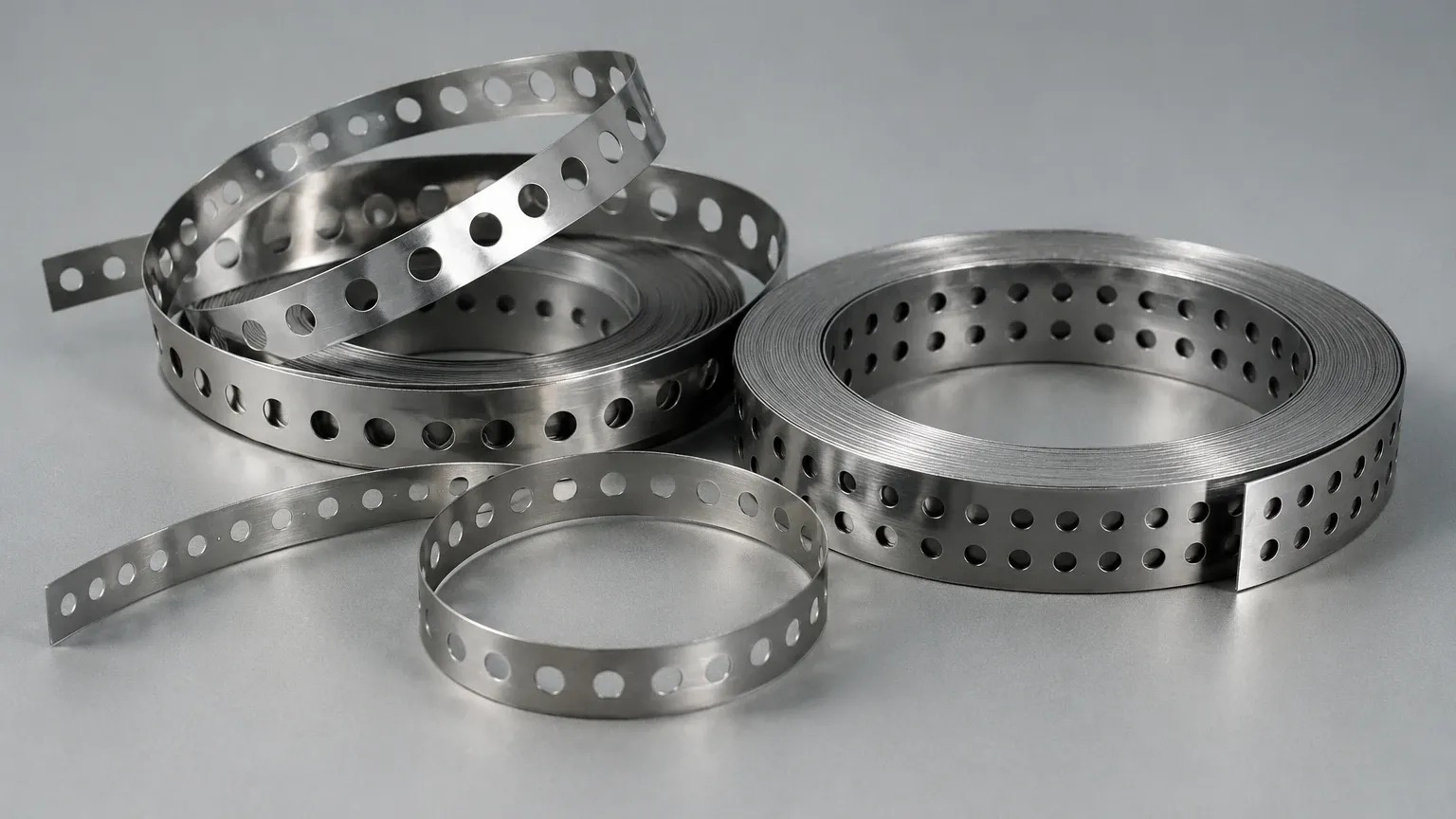
In industrial manufacturing and filtration engineering, the structural integrity of a component often depends on the precision of its internal support structures. Perforated metal tape, a specialized form of perforated metal processed into narrow strips or continuous coils, serves as a critical material for these applications. Unlike standard sheets, these tapes are engineered for high-speed automated production lines, spiral tube winding, and reinforcement in complex assemblies.
Understanding the technical nuances of perforated metal tape is essential for engineers and procurement teams who must balance mechanical strength with specific flow characteristics. This guide examines the engineering parameters, material selection, and application-specific considerations for integrating these components into industrial systems.
The Role of Perforated Metal Tape in Industrial Design
Perforated metal tape is essentially a high-precision strip of metal—typically stainless steel—that has been subjected to a punching or drilling process to create a pattern of holes. While it shares the fundamental characteristics of Perforated & Expanded Metal products, its format as a continuous tape allows for unique manufacturing efficiencies.
In many B2B sectors, particularly in the production of filter cartridges and hydraulic components, the tape is used as a "support skeleton." It provides the necessary rigidity to withstand high differential pressures while maintaining the open area required for fluid or gas passage. The choice of tape over sheet material is usually driven by the need for continuous feeding into CNC machines, spiral welders, or stamping presses, which reduces material waste and minimizes downtime associated with sheet handling.
Technical Specifications and Material Selection
Selecting the correct material for perforated metal tape is the first step in ensuring long-term performance in demanding environments. Since these tapes are often exposed to corrosive fluids, extreme temperatures, or high mechanical stress, the metallurgical properties are paramount.
Stainless Steel Grades
Most industrial applications utilize stainless steel due to its inherent resistance to oxidation and chemical attack.
* AISI 304/304L: The standard choice for general industrial use. It offers excellent formability and weldability, making it ideal for perforated metal tape used in non-corrosive or mildly corrosive environments like food processing or general water treatment.
* AISI 316/316L: Contains molybdenum, which provides superior resistance to chlorides and pitting. This grade is the industry standard for pharmaceutical, chemical processing, and marine applications where the tape must maintain integrity in the presence of aggressive solvents or saline conditions.
* Specialty Alloys: For high-temperature applications (exceeding 800°C) or highly acidic environments, alloys like Inconel or Monel may be used, though these are typically reserved for specialized aerospace or petrochemical filtration systems.
Dimensional Parameters
The utility of the tape is defined by its dimensions and tolerances. Standard thicknesses for industrial tapes typically range from 0.3mm to 2.0mm, with widths varying from 10mm to several hundred millimeters. Precision in width is critical; even a 0.5mm deviation can cause misalignment in spiral winding machines, leading to structural failure in the finished product.
Engineering the Hole Pattern and Open Area
The performance of perforated metal tape is largely determined by its hole geometry. Engineers must calculate the "Open Area Percentage" to ensure the tape does not become a bottleneck in the system while still providing enough metal mass to support the required load.
Common Hole Patterns
1. Round Holes (Staggered): The most common configuration. A 60-degree staggered pattern provides the highest strength-to-weight ratio and uniform stress distribution. It is the preferred choice for filter cores.
2. Round Holes (Straight): Used when specific alignment with other components is required, though it offers less structural rigidity than staggered patterns.
3. Square or Slotted Holes: These are often used for specialized screening or when the tape serves as a decorative or protective guard that requires a specific aesthetic or high open area.
Calculating Open Area
The open area is the ratio of the total area of the holes to the total area of the tape. For a 60-degree staggered round hole pattern, the formula is:
Open Area % = (D² × 90.69) / P²
*Where D is the hole diameter and P is the pitch (the distance between the centers of two adjacent holes).*
A higher open area reduces the pressure drop across the tape but decreases the tensile strength. In filtration support, an open area between 40% and 60% is often the "sweet spot" for balancing flow and structural support.
Applications in Filtration and OEM Manufacturing
Perforated metal tape is a staple in the production of filtration components. Its ability to be formed into cylinders and welded makes it the primary material for filter cartridge cores and outer guards.
Filter Core Construction
In a typical stainless steel filter cartridge, the perforated metal tape is spiral-wound or longitudinally welded to form a rigid center tube. This tube supports the filter media (such as wire mesh or pleated fabric) against the force of the fluid flow. If the tape fails, the media will collapse, leading to a total system failure. Therefore, the tape must be free of burrs and sharp edges that could puncture the delicate filtration layers.
Spiral Welded Tubes
For larger industrial filters or exhaust components, perforated metal tape is fed into a spiral welding machine. The tape is angled and wrapped around a mandrel, with the edges welded together. This process creates a tube that is significantly stronger than a standard longitudinal weld, as the seam acts as a reinforcing rib around the circumference of the cylinder.
Acoustic and Thermal Shielding
Beyond filtration, perforated metal tape is utilized in the automotive and aerospace industries for heat shields and silencers. The perforations help dissipate heat and break up sound waves, while the tape format allows for easy wrapping around curved exhaust pipes or engine components.
Quality Evaluation and Risk Mitigation
When sourcing perforated metal tape for B2B applications, several technical risks must be managed to avoid production delays or field failures.
Burr Management and Surface Finish
The punching process naturally creates a "die side" (smooth) and a "break side" (with a slight burr). In filtration, burrs are unacceptable as they can tear the filter media or release metal particles into the downstream flow. High-quality tapes undergo de-burring processes, such as vibratory finishing or chemical polishing, to ensure all surfaces are smooth. Furthermore, for pharmaceutical and food-grade applications, the tape must be ultrasonically cleaned to remove all traces of lubricants used during the punching process.
Flatness and Camber
"Camber" refers to the curvature of the tape along its length. If a tape has excessive camber, it will not track straight through automated machinery, leading to jams or uneven welds. Engineers should specify maximum allowable camber (e.g., less than 1mm per 2 meters of length) to ensure compatibility with high-speed production lines.
Edge Treatment
Tapes can be supplied with "sheared edges" or "safe edges" (margins). A sheared edge means the perforation pattern continues to the very edge of the strip, which may result in half-holes. A safe edge includes a solid metal margin along the sides, which increases the tape's tensile strength and makes it safer for manual handling during assembly.
Procurement Checklist for Engineers
Before finalizing a specification for perforated metal tape, the following factors should be confirmed with the manufacturer:
1. Material Certification: Ensure the supplier provides Mill Test Reports (MTRs) to verify the chemical composition of the stainless steel.
2. Tolerances: Define acceptable limits for width, thickness, and hole pitch. For spiral winding, width tolerance is often the most critical factor.
3. Coil Length and ID/OD: Confirm that the coil size is compatible with your de-coiling equipment. Larger coils reduce the frequency of changeovers but require more robust handling equipment.
4. Cleaning Standards: Specify if the tape requires degreasing, passivation (to enhance corrosion resistance), or specialized clean-room packaging.
5. Application Environment: Disclose the operating temperature and chemical exposure to the manufacturer so they can recommend the most cost-effective alloy that meets the longevity requirements.
Conclusion
Perforated metal tape is a versatile and indispensable component in modern industrial engineering. Whether it is providing the backbone for a high-pressure hydraulic filter or acting as a heat shield in an engine assembly, its performance is dictated by precise geometry and material integrity. By focusing on technical parameters such as open area calculations, burr control, and material grading, engineers can ensure that their use of Perforated & Expanded Metal in tape form contributes to a reliable and efficient end product.
For organizations looking to optimize their filtration or structural components, partnering with a manufacturer that understands the intersection of metallurgy and precision punching is vital. Detailed communication regarding the end-use environment and mechanical requirements will result in a perforated metal tape that not only fits the design but enhances the total lifecycle value of the industrial system.
