


Perforated Metal Uses
Perforated metal is a fundamental component in modern industrial engineering, serving as a versatile medium for filtration, separation, and structural support. Unlike standard sheets, perforated metal is precision-engineered with a pattern of holes, slots, or decorative shapes designed to meet specific mechanical and fluid dynamic requirements. For engineers and procurement specialists, understanding the breadth of perforated metal uses is essential for optimizing system performance, particularly in demanding sectors like chemical processing, water treatment, and food production.
At its core, the selection of Perforated & Expanded Metal involves balancing open area, structural integrity, and corrosion resistance. While often viewed as a simple commodity, the technical nuances of hole geometry and material properties dictate the efficiency of the entire filtration or processing assembly.
Core Industrial Applications of Perforated Metal
The diversity of perforated metal uses stems from its ability to provide a controlled passage for gases, liquids, and light while maintaining the physical strength of the base metal. In industrial environments, these components are rarely standalone; they are often integrated into complex machinery or filtration systems.
Industrial Filtration and Separation
In filtration, perforated metal serves two primary roles: as a primary filter medium for coarse particles and as a structural support core for finer wire mesh or membrane filters. In high-pressure hydraulic systems, a perforated stainless steel tube provides the necessary rigidity to prevent the collapse of delicate mesh layers under differential pressure. In water treatment, large-scale perforated screens act as intake filters, removing debris and protecting downstream pumps and sensitive components.
Chemical and Petrochemical Processing
The chemical industry utilizes perforated metal for catalyst support grids, centrifuge baskets, and distillation tray components. Because these environments involve exposure to corrosive agents and extreme temperatures, materials like 316L stainless steel are typically specified. The precision of the perforation ensures uniform flow distribution, which is critical for maintaining consistent chemical reactions and heat exchange efficiency.
Food and Beverage Processing
Sanitary requirements drive perforated metal uses in the food industry. It is used in grain drying, fruit juice straining, and as sorting screens for bulk solids. The smooth, burr-free finish of high-quality perforated sheets prevents bacterial growth and allows for effective Clean-in-Place (CIP) procedures. Stainless steel is the standard here, ensuring no metallic contamination enters the food supply chain.
Engineering Considerations for Material Selection
When evaluating perforated metal for a specific application, engineers must look beyond the hole pattern. The performance of the component is heavily influenced by the physical properties of the alloy and the mechanical stresses it will encounter.
1. Material Grade: Stainless steel (304, 316, 316L) is the most common choice for industrial filtration due to its corrosion resistance. However, for specialized environments, exotic alloys or carbon steel with protective coatings may be used. 316L is particularly favored in pharmaceutical and marine applications due to its superior resistance to pitting and crevice corrosion.
2. Open Area Percentage: This is the ratio of the area of the holes to the total area of the sheet. A higher open area increases flow rates and reduces pressure drop but decreases the structural strength of the sheet. Calculating the optimal open area is a critical step in ensuring the filter does not become a bottleneck in the system.
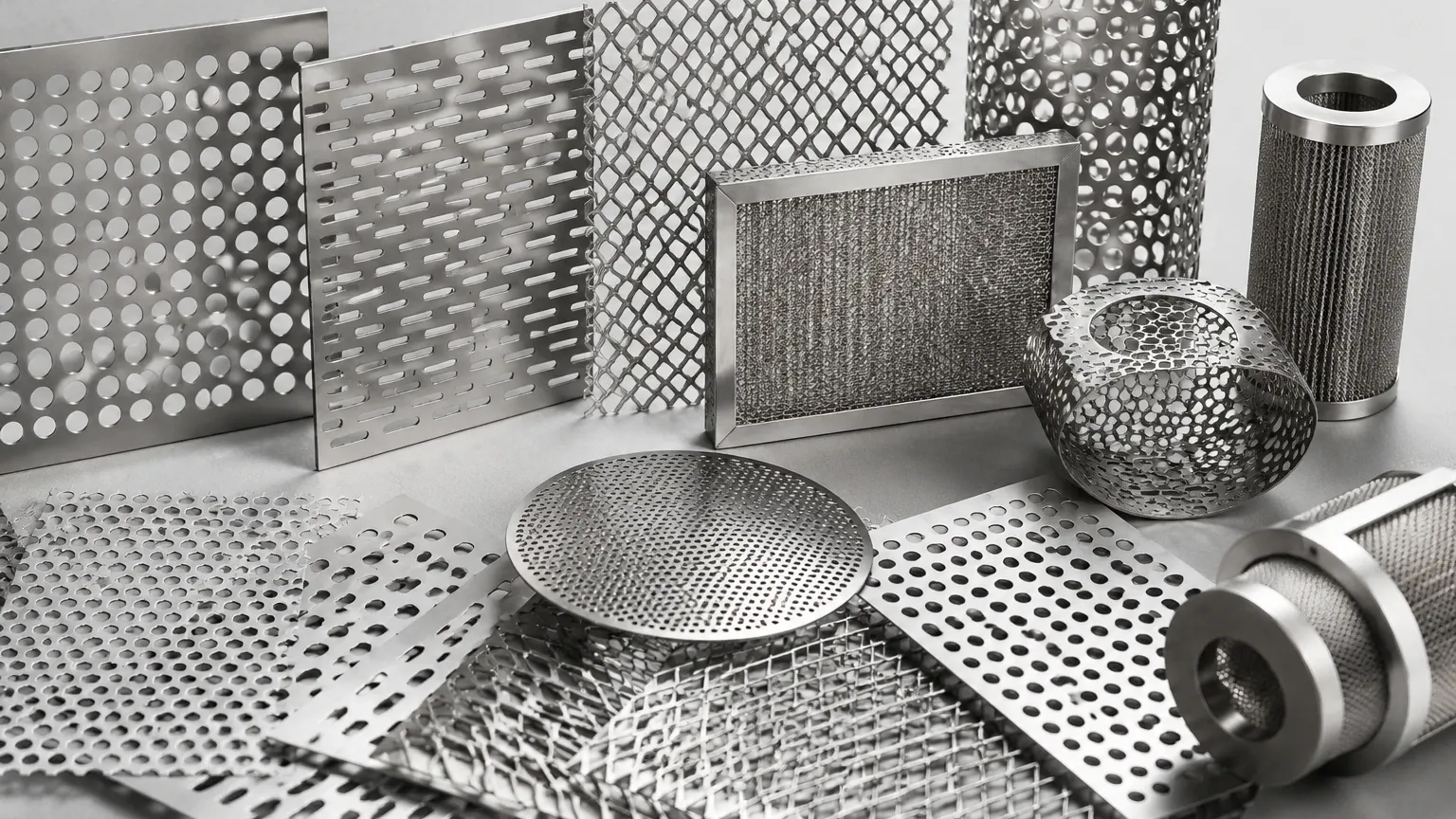
3. Hole Geometry and Pitch: Round holes are the most common due to their structural stability and ease of manufacturing. Square holes provide a larger open area, while slotted holes are ideal for vibrating screens and sorting applications. The "pitch" (the distance between the centers of adjacent holes) determines the density of the pattern and influences the "bridge" width—the solid metal between holes that provides strength.
Comparison: Perforated vs. Expanded Metal in Filtration
While both materials provide openings for flow, their manufacturing processes and physical characteristics lead to different perforated metal uses and expanded metal applications.
Perforated Metal is produced by punching holes into a solid sheet. This process allows for extremely high precision in hole size and placement. It results in a flat, smooth surface that is easy to clean and weld. It is the preferred choice for high-precision filtration where exact particle retention is required.
Expanded Metal is created by simultaneously slitting and stretching the metal sheet. This process creates diamond-shaped openings and results in no material waste. Expanded metal has a three-dimensional texture that provides excellent grip and structural rigidity. In filtration, it is often used as a pre-filter or a protective outer wrap for filter cartridges, where its ruggedness can deflect larger debris before it reaches the primary filter media.
Optimizing Perforated Metal for High-Performance Filtration
In the context of custom filtration solutions, perforated metal is often the "backbone" of the filter element. For manufacturers like Kaifil, the engineering focus is on how the perforated component interacts with other layers, such as multi-layer sintered wire mesh.
Structural Support for Cartridges
In high-viscosity fluid filtration or high-pressure gas applications, the filter media itself lacks the strength to withstand the force of the flow. A perforated metal inner core provides the necessary hoop strength to prevent deformation. The hole pattern on this core must be carefully aligned to ensure that it does not block the effective filtration area of the mesh, which would lead to localized high-velocity zones and premature wear.
Flow Distribution and Turbulence Control
Perforated sheets can be used as diffusers to break up high-velocity streams. By strategically placing a perforated plate before a delicate filter or heat exchanger, engineers can ensure that the fluid enters the component at a uniform velocity. This prevents "channeling," where the fluid takes the path of least resistance, leading to uneven filter loading and reduced service life.
Customization and Technical Specifications for Procurement
To ensure the success of a project, the procurement process for perforated components should be driven by detailed technical specifications. Standard off-the-shelf sheets rarely meet the specific needs of specialized industrial equipment.
* Margins and Blank Areas: Custom perforated metal allows for "plain" or unperforated margins along the edges of the sheet. This is essential for welding the sheet into a cylinder or mounting it into a frame without compromising the integrity of the holes.
* Flatness and Tolerances: For high-speed rotating machinery or precision assemblies, the flatness of the perforated sheet is critical. Manufacturing processes like leveling are often required after the punching process to remove internal stresses caused by the perforating hits.
* Surface Finishing: Depending on the application, perforated metal may require electropolishing, degreasing, or passivating. In pharmaceutical and food applications, electropolishing is used to create a mirror-like finish that minimizes particle adhesion and maximizes cleanability.
Maintenance and Longevity in Demanding Environments
The service life of a perforated metal component depends largely on the operating conditions and the maintenance regime. While stainless steel is durable, it is not indestructible. Factors such as erosion-corrosion (where high-velocity particles wear away the protective oxide layer) can lead to premature failure.
Cleaning Protocols
One of the primary perforated metal uses in filtration is as a cleanable media. Unlike disposable synthetic filters, stainless steel perforated elements can often be cleaned and reused. Ultrasonic cleaning is highly effective for removing fine particulates lodged in the holes. For chemical processing, backpulsing or backwashing with compatible solvents can restore the flow rate without dismantling the system.
Monitoring for Blinding and Wear
Regular inspection should look for "blinding" (the permanent clogging of holes) and signs of mechanical fatigue. In vibrating screens, the constant stress can lead to cracks in the bridges between holes. If the open area begins to decrease due to buildup that cannot be cleaned, the resulting increase in pressure drop can damage other system components, such as seals and pumps.
Conclusion: Selecting the Right Solution
Understanding the various perforated metal uses allows engineers to select the most efficient and cost-effective material for their specific industrial challenges. Whether it is providing the structural integrity for a high-pressure filter cartridge or acting as a precise sorting screen in a food processing line, the performance of perforated metal is a product of deliberate engineering.
When specifying these components, it is vital to work with a manufacturer that understands the intersection of material science and fluid dynamics. By confirming the required open area, material grade, and mechanical tolerances early in the design phase, technical teams can ensure that their filtration systems deliver reliable, long-term performance in even the most demanding environments.
