


Perforated Metal Veil
In industrial engineering and filtration design, a perforated metal veil serves as a critical interface between raw fluid streams and precision separation components. While the term "veil" may suggest a purely aesthetic or lightweight application, in the context of heavy-duty industrial processing, it refers to a precisely engineered perforated sheet that provides structural protection, flow stabilization, and primary debris exclusion. For engineers and procurement specialists, selecting the correct Perforated & Expanded Metal solution requires a deep understanding of material science, fluid dynamics, and mechanical tolerances.
As a specialized manufacturer, Kaifil focuses on the production of high-performance stainless steel filtration components. The perforated metal veil is often the first line of defense in a multi-stage filtration system or the external support structure for delicate wire mesh elements. This guide explores the technical specifications, application logic, and selection criteria necessary for integrating these components into demanding industrial environments.
Engineering Fundamentals of Perforated Metal Veils
The performance of a perforated metal veil is dictated by its geometric configuration and material properties. Unlike standard hardware-grade sheets, industrial veils must adhere to strict tolerances to ensure compatibility with filter housings and downstream components.
Hole Patterns and Pitch
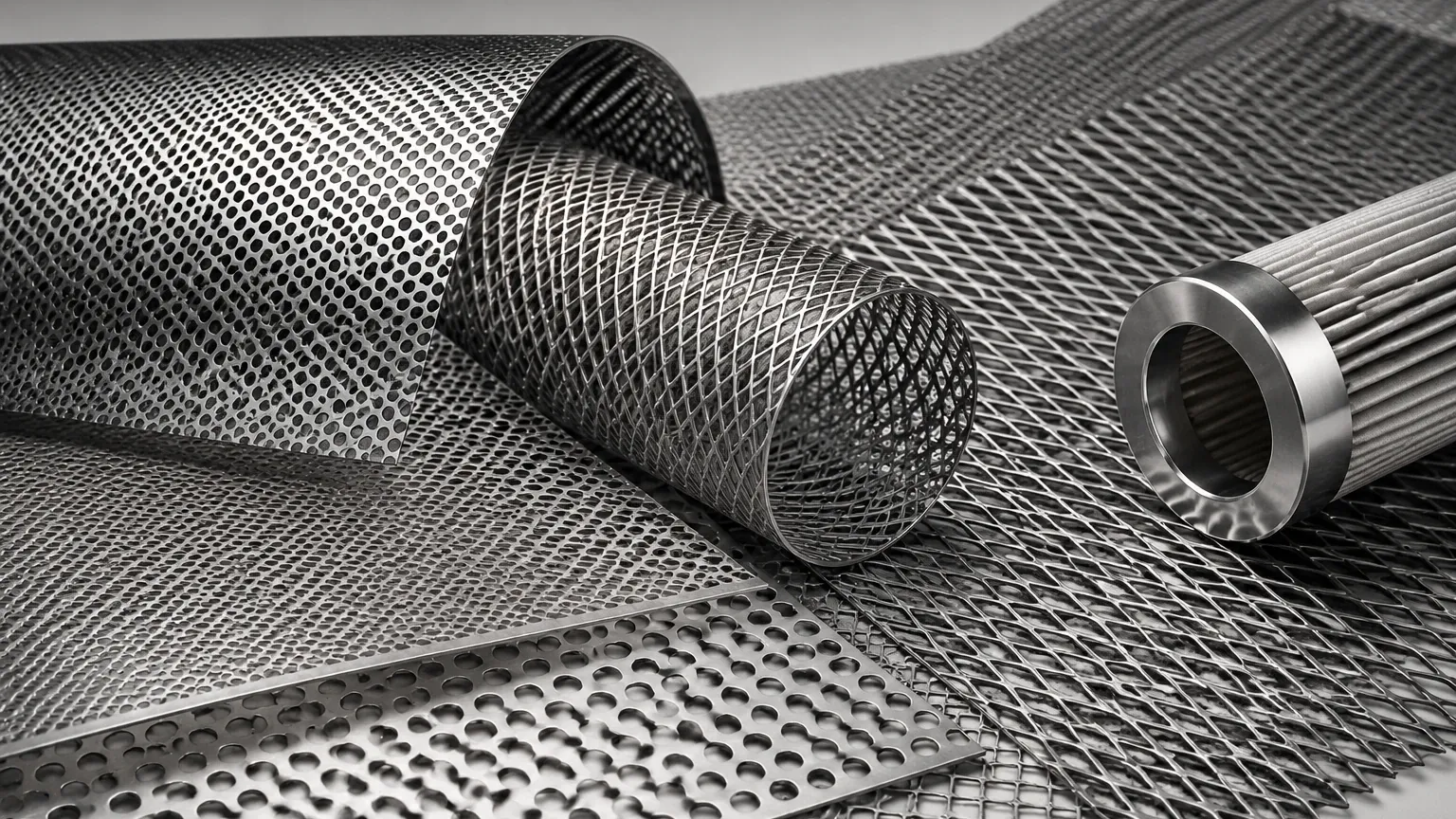
Most industrial applications utilize a 60-degree staggered round hole pattern. This configuration is preferred because it offers the highest degree of structural integrity and a uniform open area. The "pitch"—the distance from the center of one hole to the center of the adjacent hole—determines the strength of the "bridge" (the metal remaining between holes). For a perforated metal veil acting as a support for a filter cartridge, the bridge must be wide enough to withstand differential pressure without deforming, yet narrow enough to maximize the open area for flow efficiency.
Open Area Calculations
The open area percentage is a vital metric for engineers calculating flow rates and pressure drops. For a standard staggered round hole pattern, the formula is:
Open Area % = (D² × 90.69) / P²
*(Where D is the hole diameter and P is the pitch)*
In filtration, a perforated metal veil typically targets an open area between 30% and 60%. A higher open area reduces resistance to flow but can compromise the mechanical strength of the veil, especially in high-pressure hydraulic or chemical processing systems.
Functional Roles in Industrial Filtration and Separation
Within a filtration assembly, the perforated metal veil is rarely a standalone component. Instead, it functions as part of a complex system designed to remove contaminants while maintaining structural stability.
Structural Support for Fine Mesh
Fine stainless steel wire mesh, while excellent for high-precision filtration, lacks the inherent stiffness to resist high-pressure surges. A perforated metal veil is often used as an inner core or an outer shroud. By sandwiching the fine mesh against a perforated veil, the assembly can handle significantly higher differential pressures (ΔP) without the mesh tearing or collapsing. This is particularly critical in backwashing filters where the flow direction alternates.
Flow Distribution and Turbulence Control
In large-scale chemical reactors or water treatment vessels, the entry of high-velocity fluids can create localized turbulence that damages internal components. A perforated metal veil acts as a diffuser, breaking up the concentrated kinetic energy of the incoming fluid and distributing it evenly across the entire surface of the primary filter element. This ensures uniform loading of contaminants and extends the service life of the filter.
Primary Debris Exclusion
In many raw water or oil-and-gas applications, the veil serves as a "trash screen." It is designed to capture large particulates, scale, and debris that would otherwise instantly clog or damage finer downstream filtration media. Because the veil is typically made from thicker gauge stainless steel, it can be mechanically cleaned or scraped without risk of deformation.
Material Selection for Demanding Environments
The longevity of a perforated metal veil is heavily dependent on its resistance to the operating environment. Kaifil utilizes various grades of stainless steel to meet these demands.
* Stainless Steel 304: The standard choice for general industrial applications, providing good corrosion resistance and excellent formability. It is widely used in food and beverage processing where hygiene is paramount but chemical aggression is moderate.
* Stainless Steel 316L: Containing molybdenum, 316L offers superior resistance to chlorides and acids. This is the preferred material for marine environments, pharmaceutical manufacturing, and chemical processing plants where the veil is exposed to corrosive cleaning agents or harsh process fluids.
* Duplex and Super Duplex Steels: For extreme high-pressure or highly corrosive environments (such as offshore oil platforms), duplex steels provide higher yield strength and localized corrosion resistance compared to standard austenitic steels.
Technical Specifications and Customization Options
When specifying a perforated metal veil for an OEM project, several technical variables must be confirmed to ensure the component performs as intended within the larger system.
Gauge and Thickness
The thickness of the veil usually ranges from 0.5mm to 3.0mm, depending on the diameter of the filter and the expected pressure load. Thicker gauges provide more rigidity but increase the overall weight and cost of the component. Engineers must balance the need for a "lightweight" veil with the mechanical requirements of the application.
Margins and Blank Areas
Margins are the unperforated areas along the edges of the sheet. In the manufacturing of filter cartridges, margins are essential for providing a clean surface for longitudinal welding or end-cap attachment. Specifying "no margins" or "finished margins" is a critical step in the procurement process to ensure the veil can be integrated into the final assembly without secondary trimming.
Surface Finishes and Deburring
In industrial filtration, the presence of burrs (small metal protrusions left by the punching process) can be catastrophic. Burrs can break off and enter the clean fluid stream or cause premature wear on the fine wire mesh layers. High-quality perforated metal veils undergo rigorous deburring processes, such as electropolishing or mechanical tumbling, to ensure a smooth, clean surface that meets pharmaceutical or food-grade standards.
Evaluating Total Cost and Replacement Cycles
While the initial purchase price of a perforated metal veil is a factor, technical professionals should focus on the total cost of ownership (TCO). A cheaply manufactured veil with inconsistent hole sizing or poor-grade material will lead to higher costs over time due to:
1. Premature Filter Failure: If the veil deforms under pressure, it can cause the internal mesh to fail, leading to unscheduled downtime.
2. Increased Cleaning Costs: Poorly finished veils with rough hole edges tend to trap contaminants more aggressively, making backwashing less effective and requiring more frequent manual cleaning.
3. System Contamination: Low-quality alloys may leach trace metals into sensitive pharmaceutical or food products, resulting in rejected batches.
Investing in precision-engineered Perforated & Expanded Metal components ensures that the filtration system operates at peak efficiency with predictable maintenance intervals. Stainless steel veils are typically designed to last through multiple filter media replacement cycles, provided they are specified correctly for the chemical and mechanical loads of the environment.
Procurement Checklist for Engineers
Before finalizing a custom order for perforated metal veils, engineers should confirm the following data points with their manufacturer:
* Material Grade: Does the alloy meet the specific corrosion resistance requirements of the process fluid?
* Hole Diameter and Pitch: Are these optimized for the required open area and structural strength?
* Dimensional Tolerances: Does the diameter and length of the veil fit within the housing tolerances (typically +/- 0.5mm or tighter)?
* End Treatment: Are the margins clearly defined for welding or mechanical fastening?
* Compliance Standards: Does the material and manufacturing process comply with industry-specific standards such as FDA, 3-A (for dairy), or ASME?
Conclusion
The perforated metal veil is a foundational component in industrial filtration, providing the necessary balance of flow permeability and mechanical robustness. Whether used as a protective shroud for a stainless steel filter cartridge or as a flow diffuser in a large-scale chemical reactor, its design must be rooted in factual engineering data. By selecting the appropriate material grade, hole pattern, and finishing process, purchasing teams can ensure their systems achieve high-performance filtration with minimal operational risk. Kaifil remains committed to delivering these precision components, supporting global industries with durable and customized filtration solutions.
