


Perforated Metal Wall Art
In the realm of industrial design and architectural engineering, the distinction between functional components and aesthetic installations often blurs. Perforated metal wall art represents a sophisticated intersection where precision engineering meets architectural vision. While primarily recognized for its visual impact, the production of these panels relies on the same rigorous standards applied to high-performance industrial filtration systems. For engineers and procurement specialists, understanding the technical nuances of Perforated & Expanded Metal is essential for ensuring that decorative installations meet structural, environmental, and longevity requirements.
As a manufacturer specializing in stainless steel filtration and precision metal components, Kaifil approaches the production of perforated panels with an emphasis on material integrity and dimensional accuracy. Whether the application is a decorative facade, an acoustic partition, or a custom wall installation, the engineering principles remains consistent: selecting the right alloy, determining the optimal open area, and ensuring the structural stability of the finished product.
Engineering Fundamentals of Perforated & Expanded Metal
The creation of perforated metal wall art begins with a fundamental choice between two distinct manufacturing methods: perforation and expansion. Each process yields different physical properties and visual characteristics, which must be aligned with the project's technical specifications.
Perforated Metal
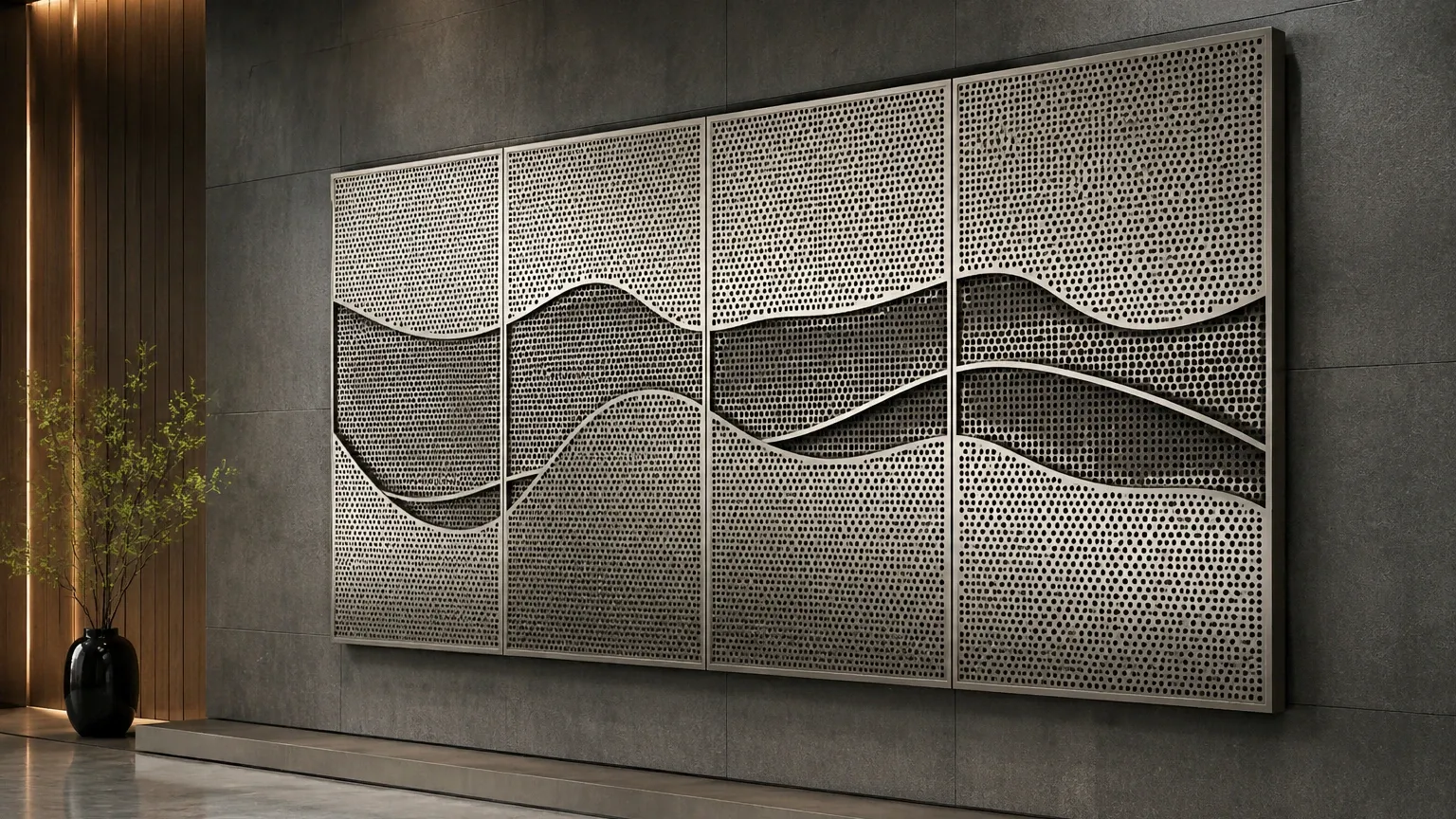
Perforation involves a mechanical punching process where CNC-controlled presses remove material to create specific patterns. This method allows for extreme precision in hole size, shape, and spacing. In architectural wall art, this precision is critical for maintaining pattern consistency across large surface areas. Common hole shapes include round, square, slotted, and hexagonal, often arranged in staggered or straight-line configurations. The choice of pattern directly influences the "open area"—the percentage of the panel that consists of holes—which affects both the visual transparency and the weight of the panel.
Expanded Metal
Expanded metal is produced by simultaneously slitting and stretching a solid metal sheet. This process creates a diamond-shaped mesh without any material waste, making it a highly efficient choice for large-scale installations. The resulting 3D structure provides inherent rigidity and can be used to control light and visibility depending on the angle of the strands. For wall art, expanded metal offers a more industrial, textured aesthetic compared to the flat surface of perforated sheets.
Material Selection and Environmental Resistance
When specifying perforated metal wall art, material selection is the most critical factor in determining the installation's lifecycle. Industrial environments or outdoor architectural applications require alloys that can withstand oxidation, moisture, and chemical exposure.
1. Stainless Steel 304: The most common grade for interior and standard outdoor applications. It offers excellent corrosion resistance and can be finished to various levels of brightness. However, it may be susceptible to pitting in high-salinity environments.
2. Stainless Steel 316: For installations in coastal areas or chemical processing facilities, SS316 is the preferred choice. The addition of molybdenum provides superior resistance to chlorides and industrial solvents, ensuring the "art" does not degrade into a maintenance liability.
3. Aluminum: Often selected for its high strength-to-weight ratio and natural corrosion resistance. Aluminum is ideal for large-scale wall art where structural load is a concern, though it lacks the extreme durability of stainless steel in high-impact environments.
4. Specialty Alloys: In specific industrial filtration contexts where wall art might also serve as a protective screen or vent, materials like Monel or Inconel may be considered for their high-temperature stability.
Technical Specifications for Architectural and Industrial Applications
To move from a conceptual design to a manufacturable product, engineers must define several key technical parameters. These specifications ensure that the perforated metal wall art functions as intended within its structural context.
Open Area Calculations
The open area percentage is vital for applications where the wall art also functions as a ventilation screen or acoustic baffle. For example, a 60-degree staggered round hole pattern is calculated using the formula:
*Open Area % = (D² × 90.69) / R²*
(Where D is the hole diameter and R is the center-to-center distance).
In architectural art, the open area determines how much light passes through the panel and how much of the underlying structure is visible. Engineers must balance the desired visual density with the need for airflow or sound transmission.
Gauge and Thickness
The thickness of the metal sheet (gauge) dictates the panel's rigidity. Thinner gauges are easier to form and punch but may require additional framing to prevent "oil canning" (visible buckling) over large spans. Conversely, thicker plates offer superior durability but increase the overall weight and cost of the installation. For most perforated metal wall art, thicknesses ranging from 1.0mm to 3.0mm are standard, though heavy-duty industrial screens may exceed these dimensions.
Margins and Edges
Margins are the unperforated areas at the edges of the sheet. Specifying "safe edges" or specific margin widths is crucial for mounting and framing. In precision manufacturing, consistent margins ensure that when multiple panels are installed side-by-side, the pattern remains continuous and the mounting hardware is concealed or integrated seamlessly.
Manufacturing Precision and Customization
As an OEM manufacturer, Kaifil emphasizes the importance of customization in the production of Perforated & Expanded Metal. Modern manufacturing techniques allow for the creation of "image perforation," where varying hole sizes are used to recreate complex graphics or logos on metal sheets. This level of detail requires advanced CAD/CAM software and high-speed CNC punching equipment.
Beyond the perforation itself, the finishing process is what elevates industrial metal into art. Common finishing techniques include:
* Electropolishing: Often used for stainless steel components to remove surface impurities and create a high-luster, mirror-like finish. This also enhances the corrosion resistance of the material by thickening the passive chromium oxide layer.
* Powder Coating: Provides a wide range of color options while adding a protective layer of polymer resin. This is ideal for branding or matching specific architectural color palettes.
* Anodizing: Specifically for aluminum, this electrochemical process increases the thickness of the natural oxide layer, providing a durable, weather-resistant finish in various metallic tones.
* Deburring: A critical step in industrial manufacturing. Ensuring that all punched holes are free of sharp edges is essential for safety, especially in public-facing wall art installations.
Functional Integration: More Than Just Aesthetics
In many B2B and industrial projects, perforated metal wall art is rarely just decorative. It often serves secondary and tertiary functional roles that contribute to the building's performance.
Acoustic Management
Perforated panels are frequently used in conjunction with acoustic backing materials to manage sound reflections in large industrial halls, lobbies, or transit hubs. The holes allow sound waves to pass through the metal surface and be absorbed by the insulation behind it, reducing reverberation and noise levels.
Light Control and Shading
When used as an exterior wall art installation or a facade, perforated metal acts as a solar screen. By carefully calculating the hole size and spacing, engineers can design panels that block a significant percentage of solar heat gain while still allowing natural light and visibility for occupants. This contributes to the energy efficiency of the facility.
Airflow and Thermal Regulation
In data centers or mechanical rooms, perforated wall art can double as ventilation grilles. The precision of the perforation ensures that the required CFM (cubic feet per minute) of airflow is maintained to prevent equipment overheating, while the "artistic" pattern conceals the industrial machinery behind it.
Selection Criteria for Engineers and Purchasing Teams
Before finalizing an order for perforated metal wall art, purchasing teams and engineers should confirm several factors to avoid common pitfalls in metal fabrication.
* Flatness Requirements: The punching process can introduce internal stresses into the metal sheet, causing it to curl or bow. Specifying "leveling" after perforation is necessary for panels that must remain perfectly flat for wall mounting.
* Tolerances: Standard industrial tolerances may not be sufficient for high-end architectural art. Define the acceptable variance in hole diameter and center-to-center spacing to ensure visual uniformity.
* Load-Bearing Capacity: If the wall art is part of a structural assembly or subject to wind loads (in outdoor applications), a structural analysis is required to ensure the remaining metal "bridges" between holes can support the necessary forces.
* Total Cost of Ownership: While aluminum or galvanized steel may have a lower upfront cost, the longevity and low maintenance requirements of stainless steel often result in a lower total cost over the life of the installation, especially in demanding environments.
Conclusion
Perforated metal wall art is a testament to the versatility of modern metal fabrication. By applying the same precision, material science, and engineering rigor used in industrial filtration, manufacturers like Kaifil provide solutions that are both visually striking and technically sound. Whether the goal is to enhance the branding of a corporate headquarters or to provide functional acoustic dampening in an industrial facility, the success of the project relies on a deep understanding of the properties and possibilities of Perforated & Expanded Metal.
For technical professionals, the key to a successful installation lies in the details: the choice of SS316 for durability, the precise calculation of open area for airflow, and the insistence on high-quality finishes and deburring. By treating wall art as a precision-engineered component, organizations can ensure their installations remain durable, functional, and aesthetically pleasing for decades.
