


Perforated vs Expanded Metal
In the realm of industrial filtration and structural engineering, selecting the correct medium is a critical decision that influences flow dynamics, structural integrity, and long-term operational costs. Two of the most common materials used for these purposes are perforated metal and expanded metal. While they may appear similar to the untrained eye, their manufacturing processes, mechanical properties, and performance characteristics differ significantly.
For engineers and procurement professionals, understanding the nuances of perforated vs expanded metal is essential for optimizing filtration systems and industrial components. This guide provides a technical deep dive into these materials, helping you determine which is best suited for your specific application requirements.
Understanding the Fundamental Differences
At its core, the choice between these two materials involves a trade-off between precision and material efficiency. Both serve as versatile solutions in the Perforated & Expanded Metal category, but they are produced through entirely different mechanical methods.
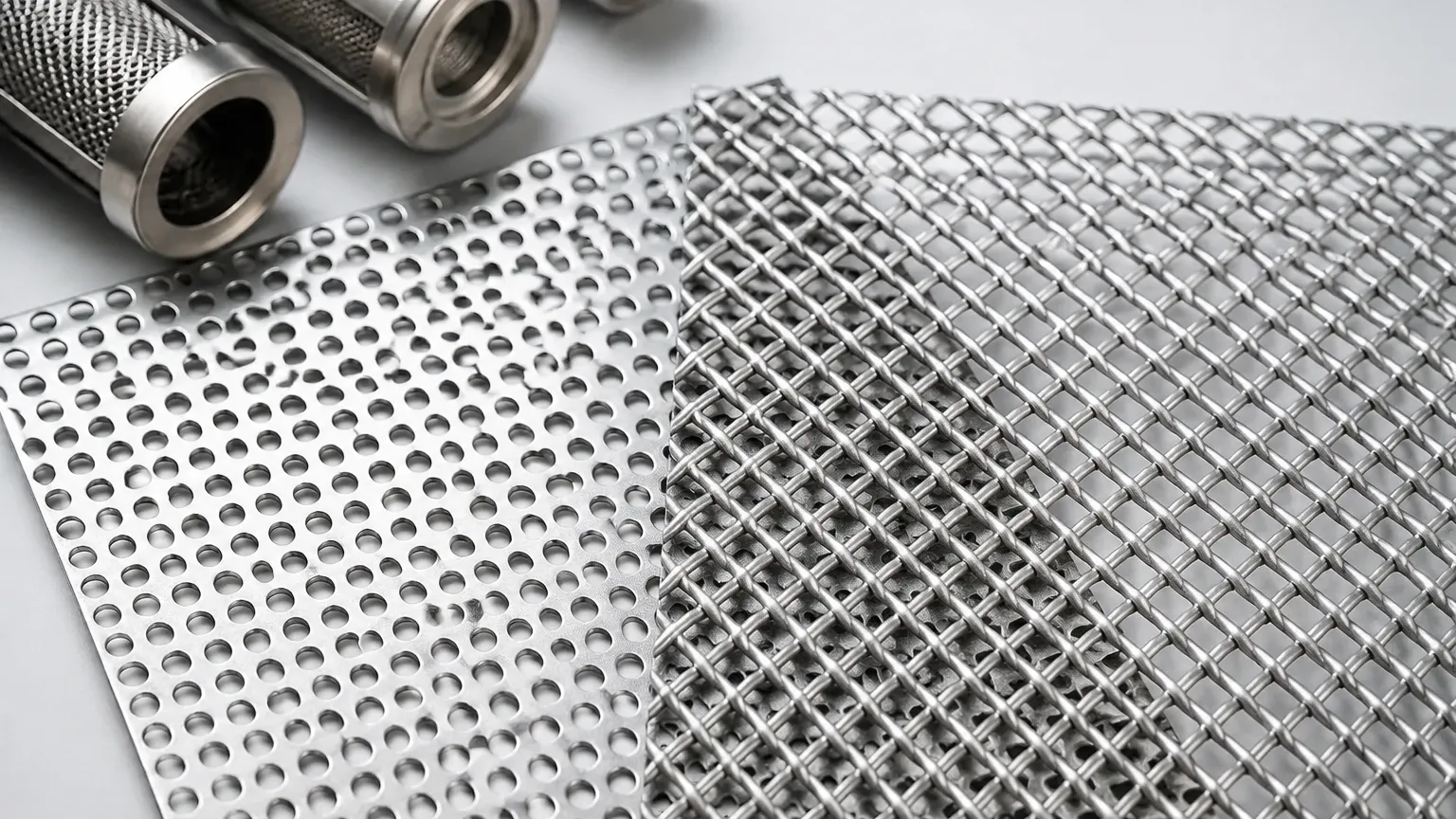
Perforated metal is created by punching a series of holes into a solid metal sheet. This process allows for extreme precision in hole size, shape, and spacing. However, it also results in "slugs"—the small pieces of metal removed from the holes—which are typically recycled but represent a loss of original material volume during the initial fabrication.
Expanded metal is produced by simultaneously slitting and stretching a metal sheet. This process creates a diamond-shaped pattern of openings. Because the metal is stretched rather than punched, there is no material waste. The resulting mesh is a single, continuous piece of metal that has been expanded to several times its original area.
Manufacturing Processes: Punching vs. Stretching
The Perforation Process
Perforated metal is manufactured using high-speed CNC punching presses or wide-action perforation lines. The process involves a set of dies and punches that strike the metal sheet.
* Precision: Allows for hole diameters as small as the material thickness.
* Versatility: Can produce round, square, slotted, hexagonal, or even decorative patterns.
* Margins: Engineers can specify unperforated "dead zones" or margins around the edges of the sheet to facilitate easier welding or mounting into filter frames.
The Expansion Process
Expanded metal is made on an expansion machine where a reciprocating knife slits the metal while it is being pulled forward.
* Standard Expanded Metal: The metal is slit and stretched, leaving the strands and bonds at a sharp angle to the plane of the sheet. This creates a 3D texture that provides excellent grip and strength but can affect flow turbulence.
* Flattened Expanded Metal: The standard expanded sheet is passed through a cold-rolling mill, which flattens the strands and bonds back into the same plane. This results in a smoother surface, similar to perforated metal, but with the characteristic diamond openings.
Structural Integrity and Mechanical Properties
When comparing perforated vs expanded metal, structural strength is often a primary concern. The two materials handle mechanical stress in different ways.
Strength-to-Weight Ratio
Expanded metal generally offers a superior strength-to-weight ratio. Because it is a single piece of material without joins or welds, the structural integrity of the original sheet is maintained and redirected. The "truss-like" characteristic of the diamond pattern allows it to distribute loads effectively across the surface.
Perforated metal’s strength depends heavily on the "bridge" (the distance between holes). While a perforated sheet is robust, the removal of material inherently reduces its overall structural rigidity compared to a solid sheet of the same thickness. However, for filtration cartridges, perforated metal often provides a more rigid, cylindrical form that can withstand high differential pressures without collapsing.
Rigidity and Formability
Perforated metal is generally easier to form into precise cylindrical shapes for filter cartridges. Its uniform thickness and predictable bending points make it ideal for high-precision OEM components. Expanded metal, particularly in its standard (raised) form, can be more challenging to roll into tight diameters due to the orientation of the strands.
Filtration Performance and Flow Dynamics
In industrial filtration, the primary goal is to achieve the desired filtration accuracy while minimizing pressure drop. The geometry of the openings plays a vital role here.
Open Area Calculations
The "open area" percentage determines the flow rate and the velocity of the fluid passing through the medium.
* Perforated Metal: Calculating open area is straightforward. For a 60-degree staggered round hole pattern, the formula is: `(Hole Diameter² × 90.69) / Center-to-Center Distance²`. This allows engineers to predict flow rates with high accuracy.
* Expanded Metal: Open area is determined by the LWD (Long Way of Diamond) and SWD (Short Way of Diamond) dimensions, along with the strand width. While expanded metal can achieve very high open area percentages (up to 80% or more), the 3D nature of the strands can create more turbulence in the fluid stream compared to the flat surface of perforated metal.
Particle Retention
Perforated metal is the preferred choice for precise particle retention. Because the holes are punched to exact specifications, there is very little variance in the size of the particles that can pass through. This makes it ideal for primary filtration stages where a specific "cut point" is required.
Expanded metal is often used as a support layer for finer filter media (like wire mesh) or as a coarse strainer for larger debris. The angled strands can actually help in depth filtration by trapping elongated particles that might otherwise pass through a flat perforated hole.
Material Efficiency and Cost Considerations
From a procurement perspective, the total cost of ownership involves both the initial purchase price and the material's longevity.
1. Material Utilization: Expanded metal is almost always more cost-effective when using expensive alloys like 316L stainless steel or Titanium. Since the process expands the metal without waste, you get more surface area per kilogram of raw material.
2. Tooling Costs: Perforated metal may require custom die sets if a non-standard pattern is requested, which can increase the cost for small production runs. Expanded metal patterns are generally more standardized across the industry.
3. Secondary Processing: Perforated metal often requires degreasing to remove lubricants used during the punching process. Expanded metal may require leveling or flattening, depending on the application.
Application-Specific Selection Criteria
Choosing between perforated vs expanded metal requires a thorough analysis of the operating environment.
Chemical Processing and Pharmaceuticals
In these industries, cleanliness and corrosion resistance are paramount. Perforated stainless steel is often preferred because its smooth, flat surface is easier to clean and sterilize (CIP/SIP processes). There are no "nooks and crannies" where bacteria or cross-contaminants can hide, which can be an issue with the bonds and strands of expanded metal.
Food and Beverage
Similar to pharmaceuticals, the food industry favors perforated metal for its hygienic properties. However, expanded metal is frequently used in drying trays or safety guards where high airflow is required and the material does not come into direct contact with the product.
Hydraulic and Industrial Equipment
For high-pressure hydraulic filters, perforated metal is the standard for the inner support core. It provides the necessary hoop strength to prevent the filter element from collapsing under pressure. Expanded metal is often used as an outer protective wrap to shield the delicate inner filter media from mechanical damage during handling or installation.
Maintenance, Cleaning, and Longevity
The lifespan of a filtration component is dictated by its resistance to fouling and its ability to be cleaned.
* Backwashing: Perforated metal responds well to backwashing and ultrasonic cleaning. The uniform holes allow for an even distribution of cleaning pressure.
* Mechanical Wear: In abrasive environments, the thicker strands of expanded metal can sometimes offer better wear resistance. However, if the strands are thin, they may erode faster than the solid bridges of a perforated sheet.
* Corrosion: Both materials can be manufactured from high-grade stainless steel (304, 316, 316L). In expanded metal, the stretching process can introduce micro-stresses at the bonds, which, in extremely corrosive environments, might be more susceptible to stress corrosion cracking compared to the annealed state of a perforated sheet.
Customization and Engineering Support
When specifying Perforated & Expanded Metal for a project, engineers should confirm several technical parameters with their manufacturer:
* Material Grade: Ensure the alloy is compatible with the fluid chemistry (e.g., 316L for high chloride environments).
* Dimensional Tolerances: Specify the allowable variance in sheet size, hole diameter, or diamond dimensions.
* Edge Requirements: Determine if the application requires a finished (safe) edge or if a random cut is acceptable.
* Surface Finish: Options include 2B mill finish, electropolished, or passivated surfaces for enhanced corrosion resistance.
At Kaifil, we specialize in translating these technical requirements into high-performance filtration solutions. Whether your application demands the high precision of perforated stainless steel or the material efficiency of expanded metal, our engineering team provides the expertise needed to select the optimal configuration for your specific industrial environment.
Conclusion
The decision in the perforated vs expanded metal debate is rarely about which material is "better" in an absolute sense, but rather which is more appropriate for the technical demands of the application. Perforated metal excels in precision, ease of cleaning, and structural predictability. Expanded metal offers unmatched material efficiency, high open areas, and an excellent strength-to-weight ratio.
By evaluating the flow requirements, mechanical stresses, and hygiene standards of your process, you can select a filtration medium that ensures operational efficiency and long-term reliability. For custom designs and technical consultations regarding stainless steel filtration components, choosing a partner with deep manufacturing expertise is the final step in ensuring project success.
