


The Expanded Metal Company
In the landscape of industrial filtration and structural engineering, the selection of high-performance materials is critical to the longevity and efficiency of a system. When engineers and procurement specialists look for a reliable partner, they often seek the expertise of a specialized expanded metal company. This choice is not merely about sourcing a commodity; it is about understanding the mechanical properties, manufacturing tolerances, and material science that allow expanded metal to function as a superior alternative to perforated sheets or woven wire mesh in specific applications.
Expanded metal is a versatile material characterized by its diamond-shaped openings, created through a unique process of slitting and stretching a single sheet of metal. This manufacturing method ensures that no material is lost during production, making it a highly cost-effective and sustainable solution for industrial filtration, support structures, and protective screening. For technical professionals, understanding the nuances of this material is essential for optimizing filtration performance and ensuring structural integrity in demanding environments.
The Manufacturing Process and Engineering Advantages
Unlike perforated metal, which is created by punching holes and discarding the "slugs," expanded metal is produced by a shearing and expanding machine. The machine slits the metal sheet and then stretches it in a single motion, creating a continuous mesh without joins or welds. This process results in several distinct engineering advantages:
1. Structural Integrity: Because the mesh is formed from a single piece of metal, there are no weak points at the intersections. The strands are oriented at an angle to the plane of the sheet, providing inherent rigidity and a high strength-to-weight ratio.
2. Material Efficiency: With zero scrap produced during the expansion process, manufacturers can offer competitive pricing while maintaining high material quality. This is particularly important when working with expensive alloys like 316L stainless steel.
3. Enhanced Surface Area: The angled strands provide a larger surface area relative to the footprint of the sheet, which can be advantageous in heat exchange or catalytic applications.
4. Anti-Skid and Grip: For walkways or industrial platforms, the raised edges of the strands provide natural slip resistance.
When evaluating Perforated & Expanded Metal for a project, engineers must decide between "raised" (standard) and "flattened" expanded metal. Raised expanded metal retains the angled strands from the expansion process, offering maximum rigidity. Flattened expanded metal is passed through a cold-rolling mill to create a smooth, flat surface, which is often preferred for filtration layers where a uniform thickness is required to prevent damage to delicate filter media.
Technical Parameters: LWD, SWD, and Open Area
To communicate effectively with the expanded metal company, engineering teams must define several key technical parameters. These dimensions dictate the flow rate, pressure drop, and particle retention capabilities of the final product.
* LWD (Long Way of Diamond): The distance from the center of one joint to the center of the next joint across the long axis of the diamond.
* SWD (Short Way of Diamond): The distance from the center of one joint to the center of the next joint across the short axis of the diamond.
* LWO and SWO (Long/Short Way of Opening): The actual dimensions of the open space within the diamond, excluding the width of the strands.
* Strand Width and Thickness: The width of the metal slit during the process and the thickness of the original base material. These two factors combined determine the overall strength and weight of the mesh.
Calculating the open area is perhaps the most critical step for filtration applications. The open area determines the velocity of the fluid passing through the mesh and the potential for clogging. A professional manufacturer will provide precise calculations based on these dimensions to ensure the filter cartridge or support screen meets the specific hydraulic requirements of the system.
Material Selection for Industrial Environments
In industries such as chemical processing, pharmaceuticals, and water treatment, the choice of material is as important as the geometry of the mesh. While expanded metal can be produced from carbon steel, aluminum, or copper, stainless steel remains the industry standard for high-performance filtration.
* Stainless Steel 304: Offers excellent corrosion resistance and is suitable for most food and beverage applications. It is a cost-effective choice for environments with moderate chemical exposure.
* Stainless Steel 316L: Contains molybdenum, which provides superior resistance to chlorides and pitting. This is the preferred material for marine environments, pharmaceutical manufacturing, and aggressive chemical processing.
* Specialty Alloys: For extreme temperatures or highly acidic environments, materials like Monel, Inconel, or Titanium may be utilized. A specialized expanded metal company will have the expertise to handle these difficult-to-work-with alloys while maintaining tight tolerances.
Applications in High-Performance Filtration
Expanded metal serves several roles within an industrial filtration system. It is rarely used as the primary filtration layer for fine particles (where wire mesh or sintered metal is preferred), but it is indispensable as a support or protective component.
1. Filter Media Support
In pleated filter cartridges, expanded metal provides the necessary structural support to prevent the pleats from collapsing under high differential pressure. Its rigidity ensures that the filter media remains evenly spaced, maximizing the effective filtration area and extending the service life of the element.
2. Pre-Filtration and Trash Screens
In water treatment and intake systems, heavy-duty expanded metal acts as a primary barrier against large debris. Its high strength allows it to withstand the impact of solids without deforming, protecting downstream pumps and sensitive fine-filtration stages.
3. Outer Guards and Protective Wraps
For hydraulic and oil filters, expanded metal is often used as an outer wrap to protect the internal filter media from mechanical damage during handling or installation. The open design ensures that flow is not restricted while providing a robust physical shield.
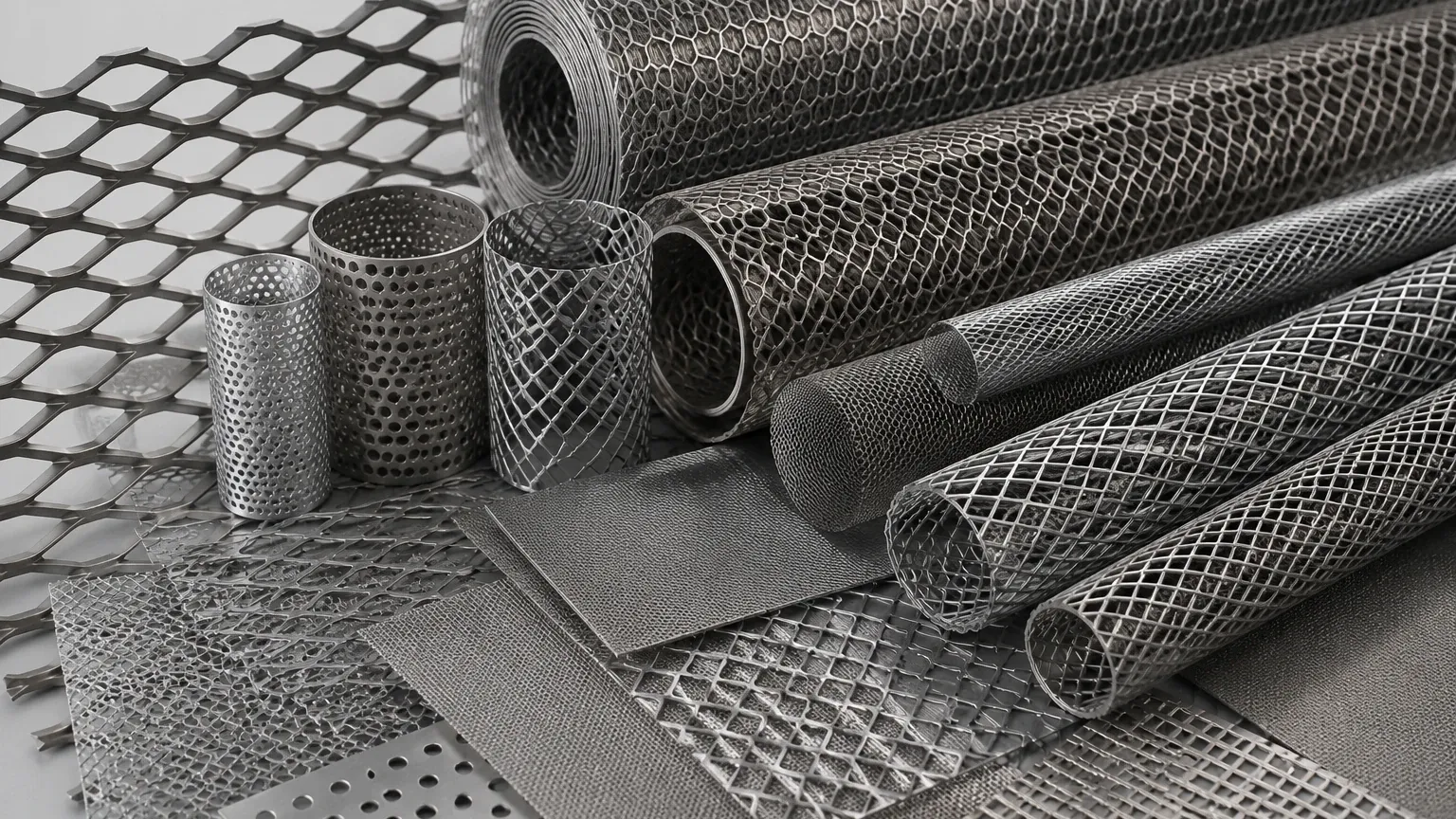
Comparing Perforated and Expanded Metal
Engineers often weigh the pros and cons of perforated versus expanded metal. While both fall under the broader category of precision metal components, their performance profiles differ significantly.
| Feature | Perforated Metal | Expanded Metal |
| :— | :— | :— |
| Hole Shape | Highly customizable (Round, Square, Slotted) | Primarily Diamond-shaped |
| Material Waste | High (Slugs are punched out) | Zero (Material is stretched) |
| Weight | Heavier for the same strength | Lighter due to expansion |
| Cost | Generally higher due to waste and tooling | Generally lower for large volumes |
| Surface Profile | Flat | Raised or Flattened |
For applications requiring extremely precise hole diameters or specific aesthetic patterns, perforated metal is often the better choice. However, for industrial support and high-strength screening where cost-efficiency and weight are priorities, the expanded metal company provides a more optimized solution.
Evaluating a Manufacturing Partner
Selecting the right expanded metal company requires more than a price comparison. For B2B procurement in technical sectors, the following criteria should be confirmed before finalizing a supplier:
* Customization Capabilities: Can the manufacturer adjust the LWD and SWD to meet specific flow requirements? Do they offer custom shearing, forming, and welding to deliver a finished component rather than just a raw sheet?
* Quality Control Standards: Does the supplier adhere to international standards such as ISO 9001? For pharmaceutical or food-grade applications, are the materials traceable and free from contaminants?
* OEM Experience: Does the company have a track record of working with Original Equipment Manufacturers to develop proprietary filter designs? The ability to provide technical drawings and prototypes is essential for engineering-led projects.
* Secondary Processing: Look for a partner that can provide degreasing, annealing, and surface finishing (such as electropolishing or powder coating) in-house to streamline the supply chain.
Total Cost of Ownership and Maintenance
While the initial purchase price of expanded metal is often lower than other mesh types, the total cost of ownership should consider the replacement cycle and maintenance requirements. Stainless steel expanded metal is exceptionally durable, but in high-fouling environments, the "pockets" created by the diamond intersections can trap debris.
Engineers should specify flattened expanded metal if the application requires frequent cleaning or backwashing, as the smooth surface facilitates easier cake release. Additionally, ensuring that the edges are properly deburred or finished during the manufacturing stage prevents mechanical wear on adjacent filter layers, reducing the frequency of unplanned downtime.
Conclusion
Expanded metal is a fundamental component in the design of efficient, durable industrial filtration systems. By offering a unique combination of strength, material efficiency, and versatility, it addresses the structural needs that other materials cannot. Whether used as a support core for a hydraulic filter or a protective screen in a chemical reactor, its performance is dictated by the precision of its manufacture.
When partnering with an expanded metal company, technical teams gain access to specialized engineering knowledge that can optimize system design and reduce long-term operational costs. By focusing on material grade, diamond geometry, and secondary processing, engineers can ensure that their filtration solutions meet the rigorous demands of modern industrial applications.
