


U Channel for Expanded Metal
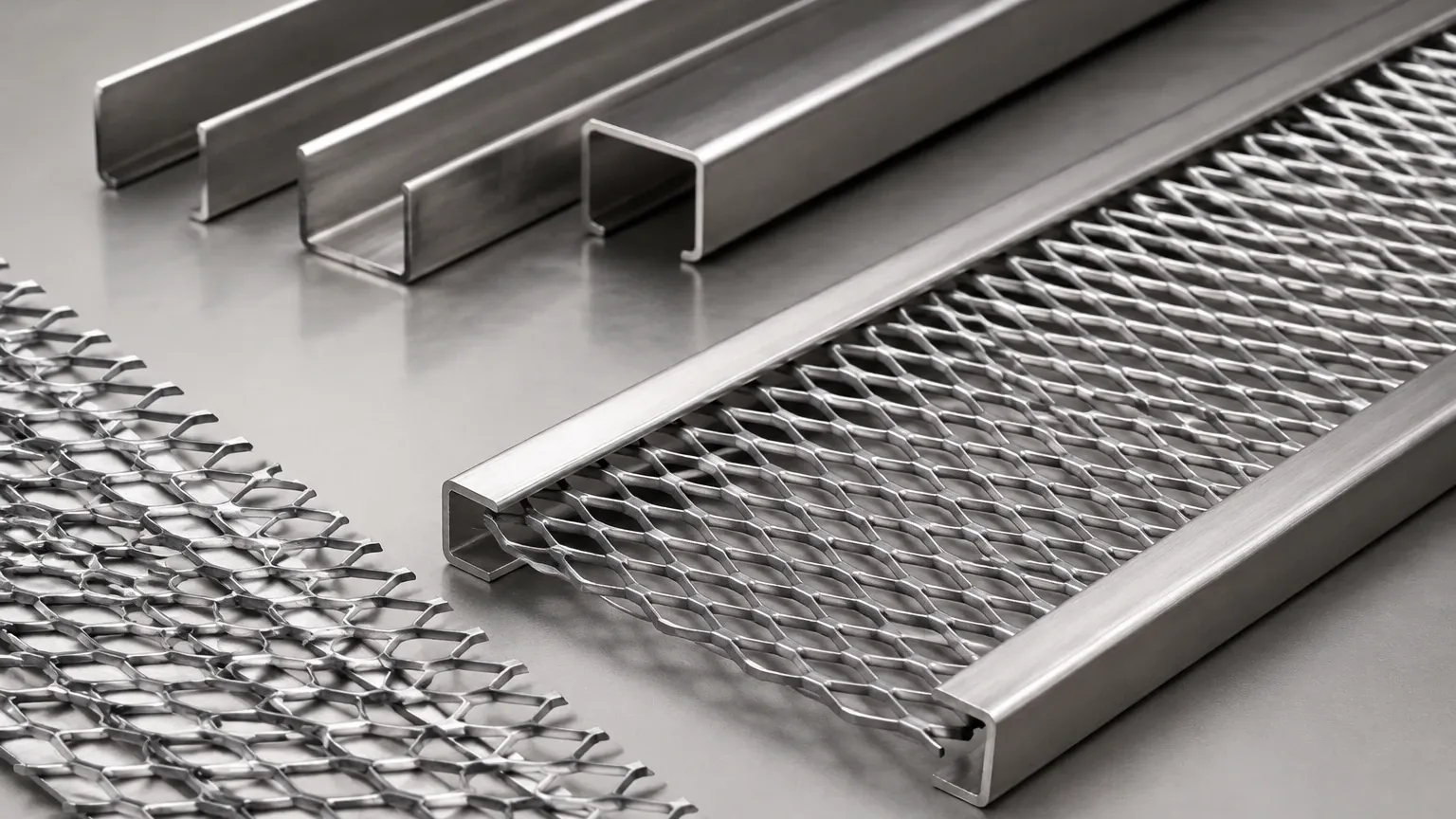
In industrial fabrication, the utility of expanded metal is often limited by its raw, unfinished edges. While the diamond-mesh structure offers excellent strength-to-weight ratios and filtration properties, the shearing process leaves sharp "strands" and "bonds" exposed. For engineers and procurement specialists in the chemical, food processing, and hydraulic sectors, the solution is the integration of a U-channel frame. A U-channel for expanded metal serves as a functional perimeter that provides structural rigidity, safety for personnel, and a clean interface for mounting into larger systems.
Selecting the correct U-channel requires an understanding of material compatibility, dimensional tolerances, and the specific demands of the operating environment. This guide examines the technical considerations essential for specifying U-channel components in industrial filtration and guarding applications.
The Functional Role of U-Channel in Industrial Assemblies
Expanded metal is manufactured by simultaneously slitting and stretching a solid metal sheet. This process creates a continuous mesh without joins or welds, but it also results in a three-dimensional profile where the strands are angled. Without an edging profile, these edges are hazardous and prone to deformation under mechanical stress.
Edge Protection and Safety
The primary function of a U-channel is to encapsulate the sharp edges of the mesh. In environments where technicians frequently interact with equipment—such as removable filter screens or safety guards—exposed expanded metal edges pose a significant laceration risk. The U-channel provides a smooth, rounded, or flat perimeter that eliminates this hazard.
Structural Rigidity
Expanded metal is inherently flexible, especially in lighter gauges. By welding a U-channel around the perimeter, the assembly gains significant torsional stiffness. This is critical for filtration panels that must withstand pressure differentials or vibration without buckling. The frame acts as a load-bearing member, allowing the mesh to maintain its planar integrity under operational stress.
Mounting and Integration
A framed panel is significantly easier to install than a raw mesh sheet. The flat surfaces of the U-channel provide ideal contact points for mechanical fasteners, brackets, or slide-in tracks. In filtration housings, a precise U-channel frame ensures a tight seal against gaskets, preventing bypass—a common failure point in industrial liquid and gas separation.
Technical Specifications: Sizing and Tolerances
Specifying a u channel for expanded metal involves more than matching the material type. Engineers must account for the "overall thickness" of the expanded metal, which is often greater than the original gauge of the flat sheet due to the angling of the strands during the expansion process.
Throat Width (The Opening)
The most critical dimension is the throat width or the internal opening of the U-channel. This must be slightly wider than the overall thickness of the expanded metal to allow for a proper fit. If the throat is too narrow, the mesh will not seat fully, leading to gaps and weak weld points. If it is too wide, the mesh may rattle or require excessive filler material during welding.
Leg Length
The "legs" of the U-channel are the two parallel sides that grip the mesh. Longer legs provide more surface area for welding and greater structural reinforcement. In heavy-duty industrial walkways or high-pressure filter cartridges, longer legs are preferred to ensure the mesh cannot be pulled out of the frame under load.
Material Gauge
The thickness of the U-channel itself should be proportional to the mesh it supports. For filtration applications using stainless steel Perforated & Expanded Metal, the U-channel is typically specified in 18-gauge to 11-gauge thickness, depending on the required durability and the total weight of the assembly.
Material Selection for Corrosive and High-Temperature Environments
In B2B industrial applications, material choice is dictated by the chemical compatibility and thermal requirements of the process. Using mismatched materials between the mesh and the frame can lead to galvanic corrosion, where the less noble metal corrodes at an accelerated rate.
Stainless Steel (304 and 316 Grades)
For the pharmaceutical, food and beverage, and chemical processing industries, stainless steel is the standard.
* Grade 304: Offers excellent corrosion resistance and formability. It is suitable for most general industrial applications.
* Grade 316: Contains molybdenum, providing superior resistance to chlorides and acetic acids. This is the preferred choice for marine environments and aggressive chemical filtration.
Carbon Steel and Galvanized Options
In applications where corrosion is less of a concern, such as machine guards or structural partitions, carbon steel U-channels are a cost-effective alternative. These are often hot-dip galvanized after fabrication to provide a protective zinc coating that covers both the mesh and the frame, including the weld points.
Aluminum
When weight is a primary constraint, such as in aerospace or portable filtration units, aluminum U-channels are utilized. While lighter, they require specialized welding techniques (TIG welding) and have a lower fatigue limit compared to steel or stainless steel.
Fabrication Techniques: Welding and Finishing
The method used to join the U-channel to the expanded metal significantly impacts the longevity and performance of the final product. Industrial filters and guards require robust attachment points to handle the rigors of high-flow environments.
Tack Welding and Continuous Welding
* Tack Welding: Small, intermittent welds are placed along the length of the U-channel. This is sufficient for safety guards and low-pressure panels where the primary goal is containment.
* Continuous Welding: The mesh is welded to the frame along the entire perimeter. This is necessary for high-pressure filtration components to ensure no fluid bypasses the media and to maximize the structural strength of the cartridge.
Mitered vs. Butt-Joint Corners
For a professional, high-strength finish, corners should be mitered at a 45-degree angle. This closes the U-channel completely, preventing debris or bacteria from accumulating inside the frame—a critical requirement in sanitary food and beverage applications. Butt-joints are simpler to produce but leave the ends of the U-channel open unless capped with additional material.
Surface Treatment
After welding, stainless steel frames often undergo passivation or electropolishing. This process removes surface contaminants and restores the chromium oxide layer, ensuring the frame is as corrosion-resistant as the mesh itself. For industrial filtration, a smooth surface finish also reduces the adhesion of particulates, making the filters easier to clean during backwashing cycles.
Applications in Industrial Filtration and Beyond
The combination of expanded metal and U-channel frames is found across a wide range of demanding sectors. Because Kaifil specializes in custom stainless steel solutions, these components are often engineered for specific performance metrics.
1. Chemical Processing: Framed expanded metal serves as support structures for finer wire mesh filters or as primary strainers for removing large particulates from corrosive streams.
2. Food and Beverage: Stainless steel U-channel frames are used in dewatering screens and sorting trays. The smooth, welded edges meet strict hygiene standards by eliminating "bug traps" where organic material could collect.
3. Hydraulic Systems: In high-pressure hydraulic reservoirs, framed expanded metal acts as a diffuser or a coarse suction strainer, protecting pumps from large debris while maintaining high flow rates.
4. Acoustic Insulation: In power plants and manufacturing facilities, expanded metal panels framed with U-channels hold acoustic batting in place, providing sound attenuation while allowing air to pass through for cooling.
Selection Criteria for Engineering and Procurement
When sourcing a u channel for expanded metal, procurement teams should confirm several factors with the manufacturer to ensure the final product meets the application's technical requirements:
* Dimensional Accuracy: What are the tolerances on the throat width and leg length? In precision filtration, even a 0.5mm variance can affect the fit within a housing.
* Weld Quality: For sanitary or high-vibration environments, are the welds ground smooth and free of porosity?
* Material Certification: Can the supplier provide Mill Test Reports (MTRs) to verify the grade of the stainless steel or alloy used?
* Customization: Does the application require non-standard U-channel shapes, such as offset legs or specific radiused corners?
Total Cost of Ownership and Maintenance
While raw expanded metal is inexpensive, the value of a properly framed component lies in its service life and ease of maintenance. A high-quality stainless steel U-channel frame prevents the mesh from fraying or deforming, which significantly extends the replacement cycle. In filtration systems, a rigid frame allows for more aggressive cleaning methods, such as high-pressure hosing or ultrasonic baths, without damaging the filter media.
Investing in a precision-engineered frame also reduces downtime. Panels that fit perfectly into their tracks or housings every time eliminate the need for field adjustments or "shimming," which can compromise the seal and safety of the equipment.
Conclusion
The U-channel is an indispensable component for any industrial application utilizing expanded metal. By providing safety, structural integrity, and a professional finish, it transforms a raw material into a high-performance industrial tool. Whether for chemical filtration, food processing, or heavy-duty guarding, selecting the right U-channel—matched in material, size, and fabrication quality—is essential for operational success. Engineers should look for manufacturers who understand the nuances of metal expansion and provide customized solutions tailored to the specific rigors of the end-use environment.
