


Ukuran Perforated Metal
In industrial filtration and structural engineering, the specification of perforated materials is a critical factor that dictates both performance and longevity. The term "ukuran perforated metal" refers to the comprehensive dimensional specifications of a perforated sheet, including hole diameter, pitch, arrangement, sheet thickness, and open area percentage. For engineers and procurement specialists, understanding these parameters is essential to ensuring that the selected Perforated & Expanded Metal meets the rigorous demands of chemical processing, food production, or hydraulic systems.
At Kaifil, we specialize in the manufacturing of precision stainless steel filtration components. Achieving the correct dimensions is not merely a matter of aesthetics; it is a technical requirement that influences flow rates, pressure drops, and the structural integrity of the filter assembly. This guide provides a technical overview of the essential measurements and engineering considerations involved in selecting the right perforated metal sizes.
Core Dimensional Parameters: Understanding the Basics
When specifying perforated metal, several key measurements define the "ukuran" or size of the product. These parameters must be precisely defined to ensure the material performs as expected in industrial environments.
1. Hole Diameter (D)
The hole diameter is the most fundamental measurement. In filtration applications, the hole size determines the maximum particle size that can pass through the media. For stainless steel filter cartridges, hole diameters can range from sub-millimeter precision to several centimeters, depending on whether the perforated metal acts as the primary filter or a support structure for a finer wire mesh.
2. Pitch (P)
Pitch refers to the distance from the center of one hole to the center of the adjacent hole. The relationship between the hole diameter and the pitch determines the amount of solid material remaining between the perforations, known as the "bridge." A larger pitch with a smaller hole diameter results in a stronger sheet but a lower open area.
3. Open Area Percentage
The open area is perhaps the most critical technical specification for engineers. It is the ratio of the total area of the holes to the total area of the sheet, expressed as a percentage. This value directly impacts the flow velocity and the pressure drop across the filter.
For a standard 60-degree staggered round hole pattern, the formula for calculating the open area is:
Open Area % = (D² × 90.69) / P²
Where:
* D = Hole Diameter
* P = Pitch
4. Sheet Thickness (Gauge)
The thickness of the metal sheet affects the mechanical strength and the weight of the final component. In high-pressure hydraulic applications, a thicker gauge is often required to prevent deformation under stress. However, as thickness increases, the difficulty of punching smaller holes also increases. A general engineering rule is that the hole diameter should not be smaller than the material thickness to avoid tool breakage and ensure clean perforation.
Hole Patterns and Their Engineering Impact
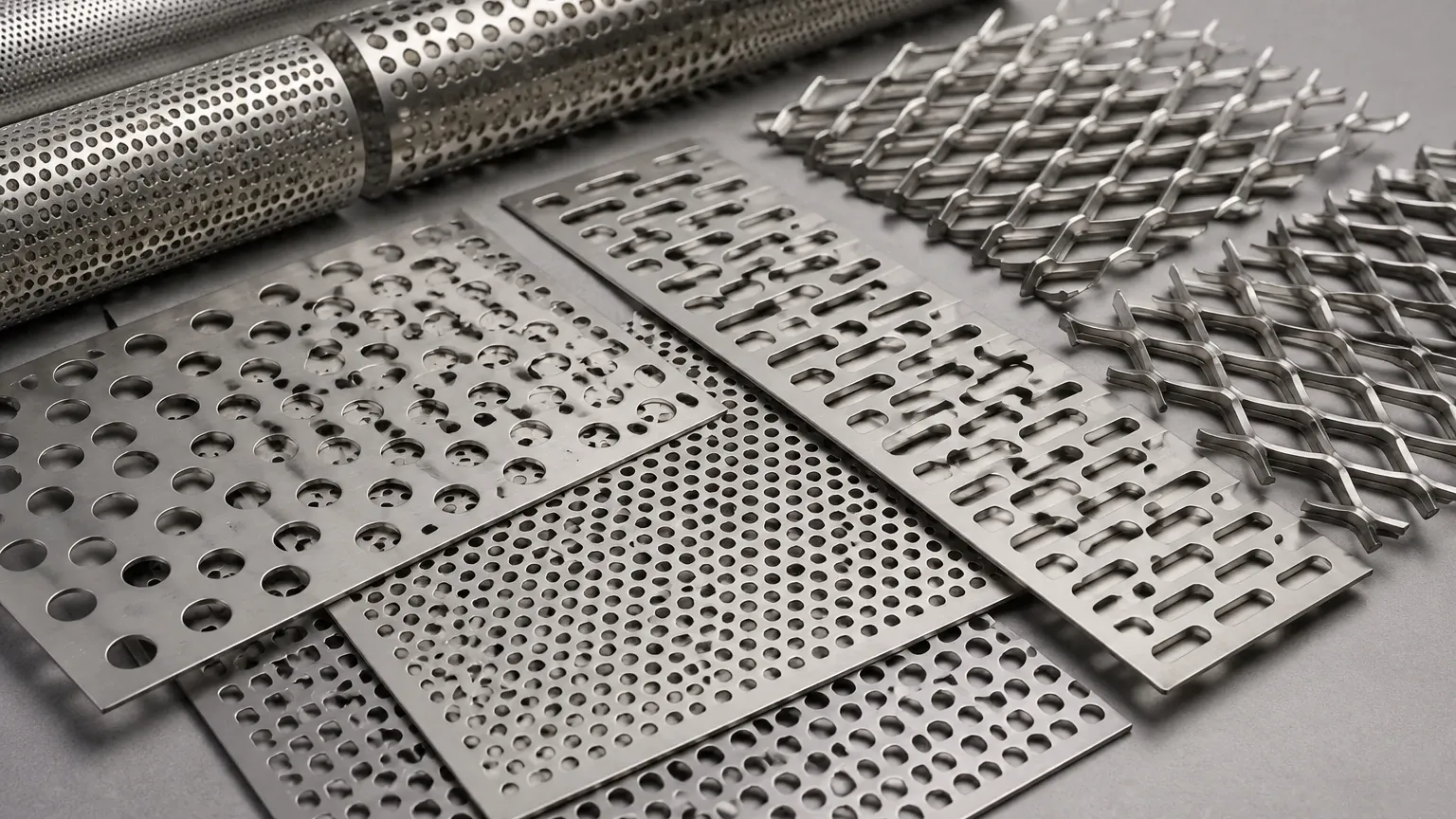
The arrangement of the holes—the pattern—is a vital component of the overall ukuran perforated metal specification. The pattern influences how fluid or gas flows through the material and how the material reacts to mechanical loads.
Staggered Pattern (60-Degree)
The 60-degree staggered pattern is the most common industrial configuration. It provides the highest degree of structural integrity and a uniform open area, making it the standard choice for filter cores and protective screens. This arrangement ensures that the stress is distributed evenly across the metal bridge.
Straight Pattern
In a straight pattern, holes are aligned in both horizontal and vertical rows. While this is simpler to manufacture for certain applications, it generally offers lower structural strength than staggered patterns. It is often used in architectural applications or where specific alignment with other components is required.
Slotted and Decorative Patterns
For specialized filtration needs, such as the separation of elongated particles or seeds in food processing, slotted holes may be specified. The ukuran perforated metal for slots includes both the width and the length of the slot, as well as the end type (round or square ends).
Material Selection and Performance
The dimensions of perforated metal cannot be discussed without considering the material. Kaifil primarily utilizes stainless steel due to its superior corrosion resistance and durability in demanding industrial sectors.
* Stainless Steel 304: Suitable for general-purpose industrial applications, providing good corrosion resistance and excellent forming properties.
* Stainless Steel 316/316L: The preferred choice for chemical processing and marine environments. The addition of molybdenum enhances resistance to pitting and crevice corrosion, particularly in chloride-rich environments.
* Specialty Alloys: For high-temperature or highly acidic environments, materials like Duplex stainless steel or Hastelloy may be required.
The material choice affects the achievable tolerances for the ukuran perforated metal. Harder alloys may require specialized punching equipment or laser cutting to maintain dimensional accuracy without causing micro-cracks in the bridges.
Technical Considerations for Filtration Systems
When engineers integrate perforated metal into a filtration system, they must look beyond the flat sheet dimensions. The following factors are critical for performance optimization:
Pressure Drop and Flow Rate
The open area percentage is the primary driver of pressure drop. If the open area is too low, the system will experience a significant drop in pressure, requiring more pump energy and potentially leading to system inefficiency. Conversely, if the open area is too high, the structural integrity of the filter might be compromised, leading to collapse under high differential pressure.
Support for Fine Mesh
In many high-precision filters, the perforated metal serves as a "support tube" or "outer guard" for a fine stainless steel wire mesh. In this configuration, the ukuran perforated metal must be designed to provide maximum support to the mesh to prevent pleat deformation while maintaining enough open area to ensure the mesh remains the primary point of resistance.
Edge Margins and Blank Areas
Standard perforated sheets often come with "minimum margins" along the edges. However, for custom filter cartridges, specific "blank areas" (unperforated sections) may be required for welding or mounting flanges. Specifying these margins is a crucial part of the technical drawing process to ensure the component fits perfectly into the filter housing.
Customization and Manufacturing Precision
At Kaifil, we understand that standard sizes do not always meet the needs of specialized industrial processes. Our manufacturing capabilities allow for significant customization of Perforated & Expanded Metal products.
Precision Punching vs. Laser Cutting
For most high-volume industrial orders, CNC punching is the most cost-effective method for achieving precise ukuran perforated metal. It allows for high-speed production with consistent tolerances. For thicker materials or complex patterns where punching is not feasible, laser cutting provides the necessary precision without the mechanical stress of a physical die.
Tolerances and Quality Control
Industrial applications demand tight tolerances. Variations in hole diameter or pitch can lead to uneven flow distribution. We adhere to strict quality control protocols to ensure that every sheet or fabricated component meets the specified dimensions. This includes checking the flatness of the sheet, as the punching process can sometimes introduce internal stresses that cause bowing or camber.
How to Select the Right Ukuran Perforated Metal
Choosing the correct dimensions requires a balance between filtration efficiency, mechanical strength, and cost. Engineers should consider the following steps during the selection process:
1. Define the Particle Retention Size: Determine the minimum hole diameter required to block target contaminants.
2. Calculate Required Flow Rate: Use the desired flow rate to determine the necessary open area percentage.
3. Assess Structural Load: Determine the maximum differential pressure the filter will face to select the appropriate material thickness and bridge width.
4. Consider the Environment: Select a material (e.g., SS316L) that can withstand the chemical and thermal conditions of the application.
5. Evaluate Fabrication Requirements: Determine if the perforated metal needs to be rolled, welded, or fitted with end caps, which will influence the required margins and blank areas.
Applications Across Industries
The versatility of perforated metal makes it indispensable across various sectors, each requiring specific ukuran perforated metal configurations:
* Chemical Processing: Used in catalyst support grids and strainers where chemical compatibility and precise hole sizes are paramount.
* Food and Beverage: Requires smooth, burr-free perforations for easy cleaning and compliance with hygiene standards. Often used in centrifugal screens and grain drying.
* Pharmaceuticals: Demands high-grade stainless steel with precise dimensions for cleanroom filtration and fluid bed dryers.
* Water Treatment: Used in intake screens and pre-filtration stages to protect sensitive downstream equipment from debris.
Conclusion
Specifying the correct ukuran perforated metal is a foundational step in designing an effective industrial filtration or separation system. By carefully considering hole diameter, pitch, open area, and material thickness, engineers can optimize their systems for performance and durability.
As a professional manufacturer, Kaifil provides the technical expertise and manufacturing flexibility required to deliver custom perforated solutions. Whether you need a standard support tube or a highly specialized perforated component, our team works closely with you to ensure every dimension meets your exact application requirements. For more information on our capabilities and to explore our range of products, please visit our Perforated & Expanded Metal section.
